Some bedrooms have everything they technically need and still feel unfinished. A neutral bed, blank walls, plain curtains, and safe furniture can create a perfectly usable room, but there is nothing that makes you want to look twice.
A Green Living Bedroom can change that completely. Instead of treating green as one small accent, these makeovers let it shape the entire atmosphere through walls, upholstery, curtains, rugs, millwork, pattern, furniture, and styling.
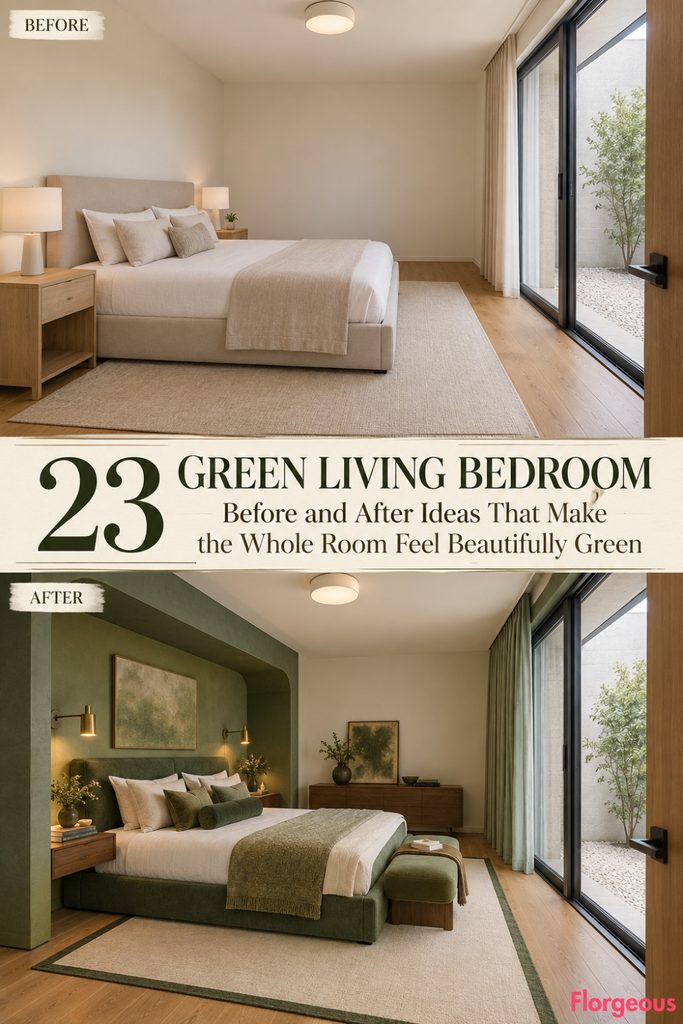
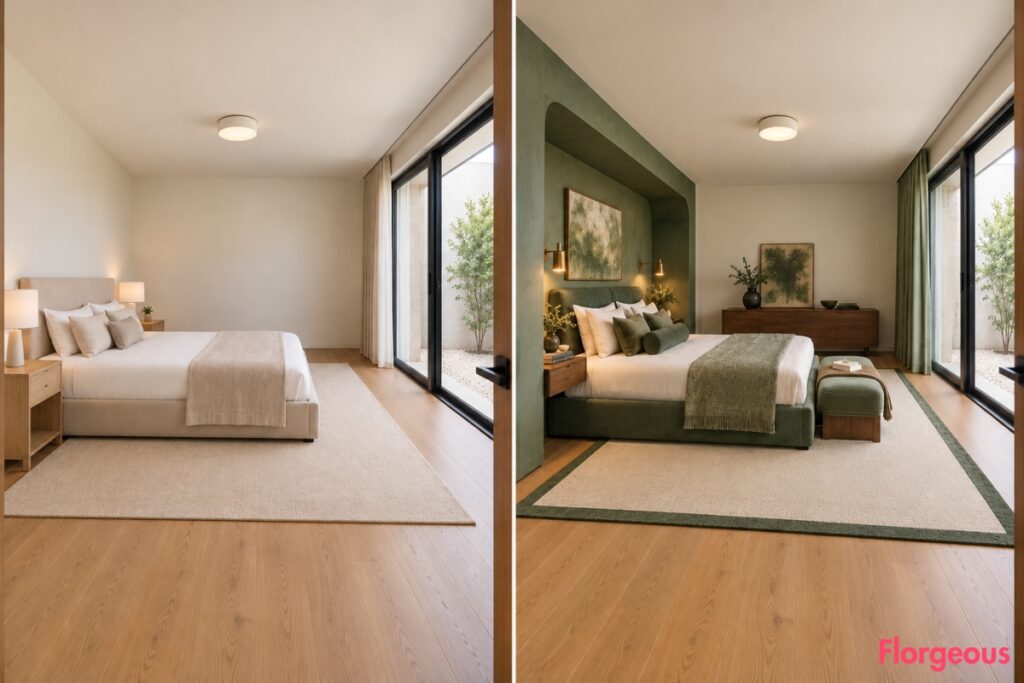
Every BEFORE uses the same locked Garden-Court Bedroom: warm off-white walls, a basic neutral upholstered bed against the solid left wall, two simple pale-wood nightstands, plain bedding, warm oak flooring, a basic ceiling light, and minimal styling. The front-right entry, solid far wall, right-side sliding courtyard doors, ceiling, corners, and floor footprint never move.
Only the AFTER changes, and each version creates a completely different green room.
1. Turn the Bed Into a Sculptural Malachite Green Room Within a Room
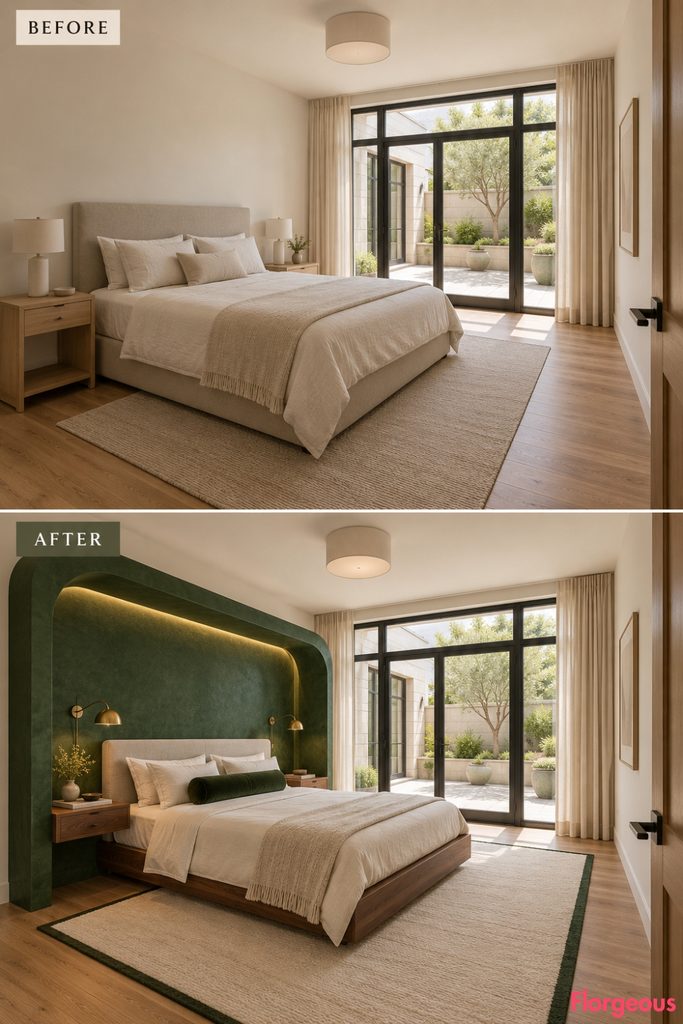
This opening makeover needs to stop the scroll immediately. A broad green sleeping portal gives the room a completely new silhouette while every architectural wall stays exactly where it was.
Before: The plain neutral bedroom has no focal point and the bed feels small against the long left wall.
After: Frame the entire sleeping zone with a broad freestanding malachite-green portal with softly rounded inner corners. Continue the same rich green through a low upholstered bed, deep moss bolster, green-bordered cream rug, and one muted jade bedside surface. Warm walnut ledges and aged-brass lights break up the green without weakening it.
Why it works: Green becomes the visual architecture of the room rather than a single painted surface.
Try this: Keep the portal simple and oversized. Extra shelves or niches would dilute the effect.
2. Sweep a Sage Green Ribbon Around the Entire Sleep Zone
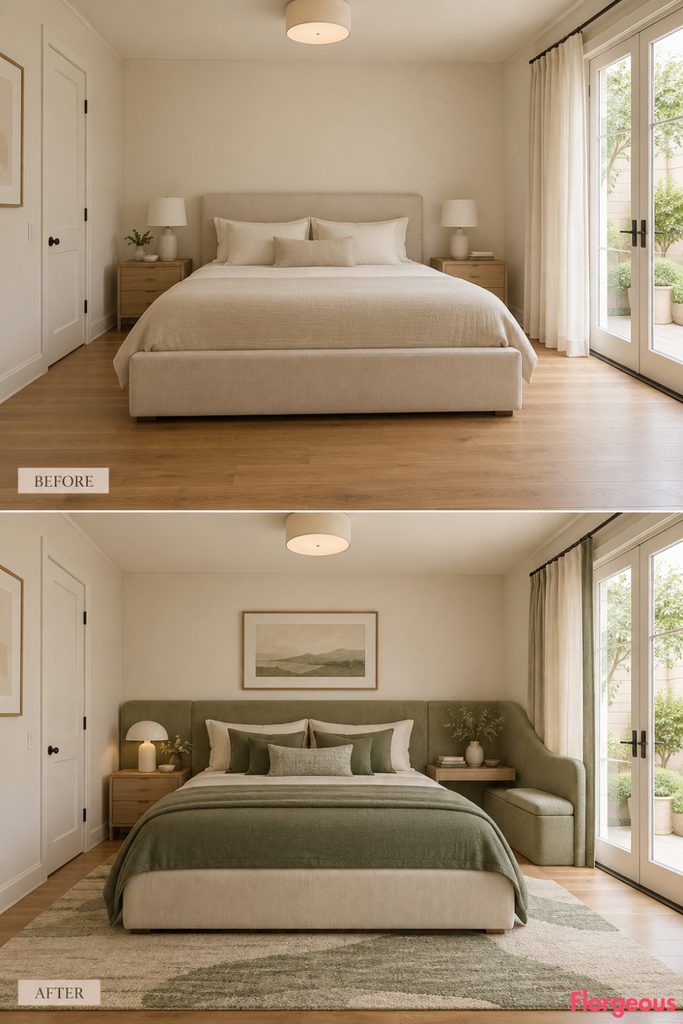
Instead of treating the headboard as one object, turn it into a continuous sculptural gesture that visually connects the bed, bedside areas, and low bench.
Before: The same plain Garden-Court Bedroom has a basic neutral bed, bare nightstands, warm off-white walls, and no visual movement.
After: Create a wide upholstered sage-green ribbon that begins as an extra-wide headboard, curves gently around one bedside corner, drops into a low wall-mounted ledge, and continues into a compact upholstered bench near the foot-side edge. Layer the room with deeper olive bedding, eucalyptus cushions, sage-edged ivory curtains, a pale-green and cream rug, and blond oak.
Why it works: The green is not applied as decoration. One continuous form organizes the whole bedroom and makes the palette feel architectural.
Try this: Keep the ribbon at only two or three heights so the composition remains elegant.
3. Build an Olive Green Paneled Envelope With a Walnut Bed Island
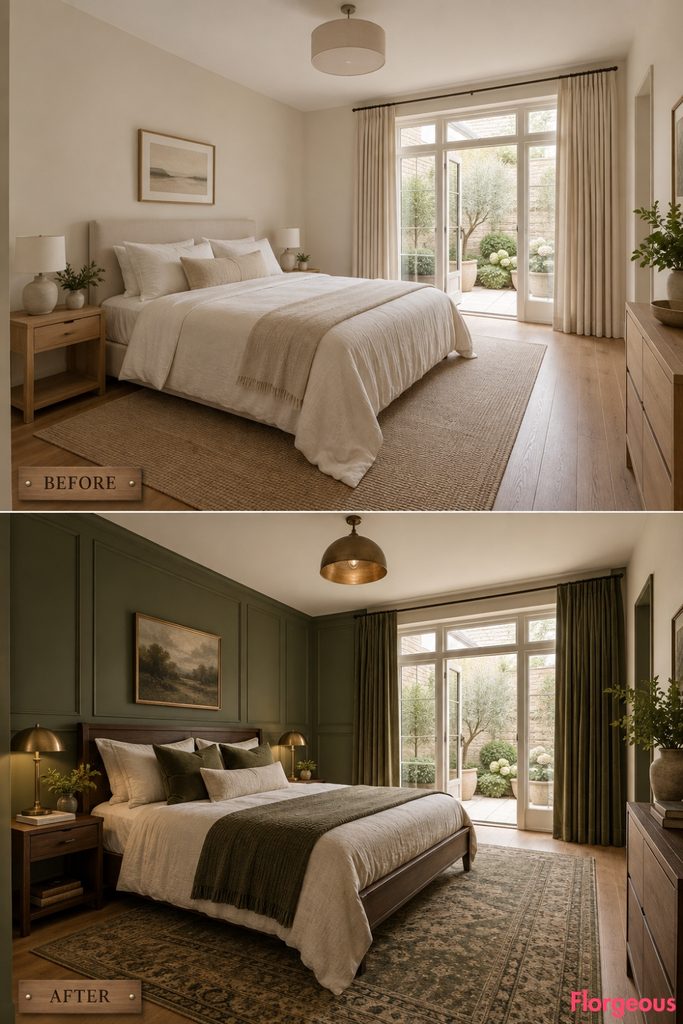
This room should feel richer and more architectural than a conventional paneled bedroom.
Before: Flat warm off-white walls leave the bed visually exposed.
After: Wrap the bed wall and a controlled portion of the adjoining far-wall return in deep olive paneling using wide asymmetric rectangles instead of traditional symmetrical molding. Center a broad dark-walnut bed inside the green envelope, then add muted moss curtains, olive velvet cushions, cream linen, an antique-brass wall light, and a faded olive-tobacco rug.
Why it works: Olive becomes a three-dimensional room envelope rather than a paint color.
Try this: Stop the paneling before the courtyard side so daylight still has a lighter surface to bounce from.
4. Carve a Eucalyptus Green Relief Wall Behind a Floating Bed
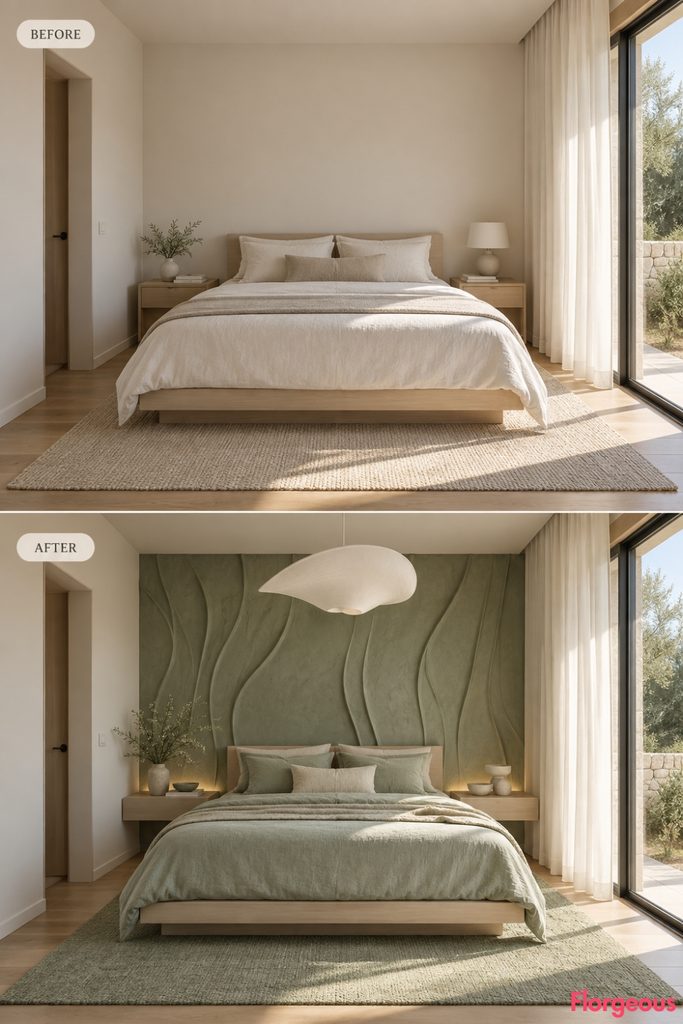
Eucalyptus gets a much more artistic treatment here than simply painting the room pale green.
Before: The solid left wall is completely flat.
After: Apply a shallow sculptural wall relief made of flowing vertical plaster ridges, all finished in muted eucalyptus green. Float a pale-ash bed slightly forward from the relief with integrated slim bedside shelves. Use celadon linen, ivory curtains, cool sage wool, and one sculptural white ceiling light.
Why it works: Light and shadow move across the green relief during the day, making the wall itself the artwork.
Try this: Keep the relief shallow enough to preserve the usable width of the room.
5. Wrap the Bed in a Deep Moss Upholstered Cocoon
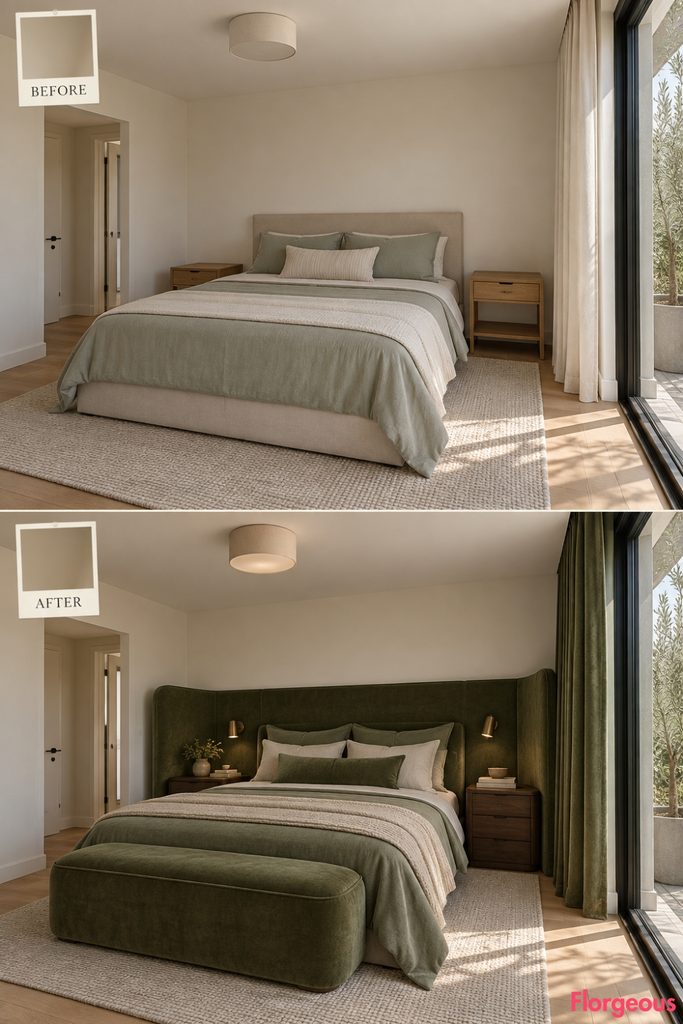
This should feel almost like a room inside the room, but entirely soft rather than built from hard panels.
Before: The small neutral headboard has little presence.
After: Create a tall moss-green upholstered composition wrapping behind the bed and around both bedside zones with softly curved ends. Continue the moss into full-height curtains and a large foot bench, then layer sage-gray bedding, cream linen, dark walnut, and tiny bronze lights.
Why it works: Repeating one deep green through several large soft surfaces creates an immersive cocoon without relying on dark paint everywhere.
Try this: Keep the upholstery smooth and architectural instead of heavily tufted.
6. Create a Gray-Green Monolithic Bedroom With a Stone Horizon Line
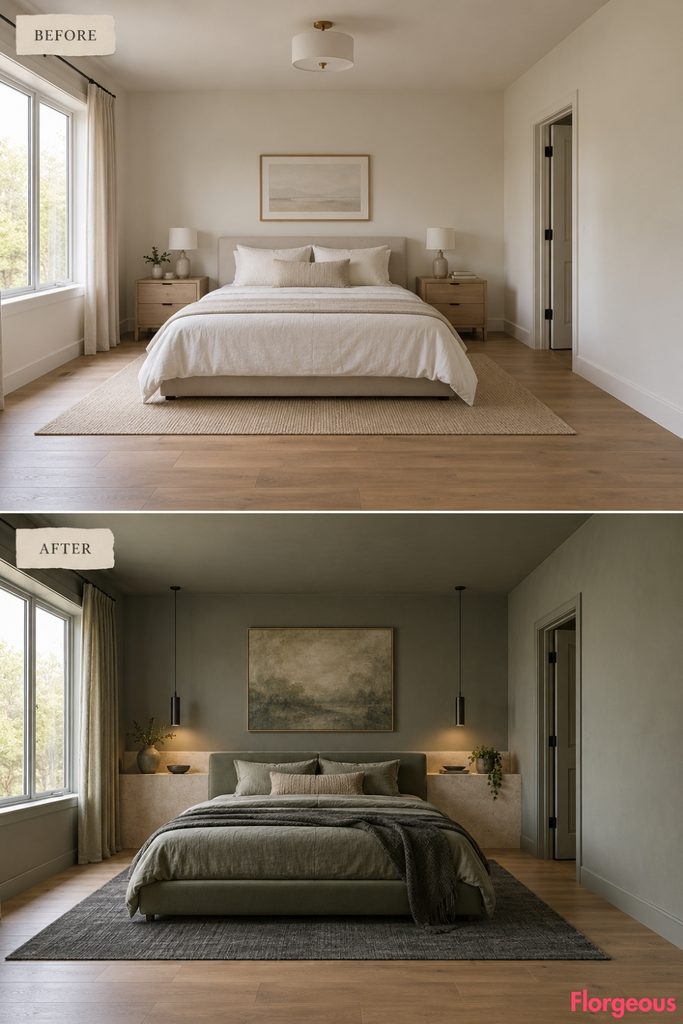
This room should feel calm, severe, and highly architectural.
Before: The room lacks any strong horizontal organization.
After: Finish the visible walls in smoky gray-green and run one continuous pale limestone ledge along the entire bed wall at headboard height. Set a low sage upholstered bed below it, then use smoke-green linen, charcoal wool, pale stone accessories, and narrow black pendant lights.
Why it works: One strong horizontal line gives the whole room visual discipline while the green-gray envelope keeps it unmistakably green.
Try this: Keep the ledge mostly bare. Its length is the statement.
7. Turn Emerald Green Into a Lacquered Boutique Suite
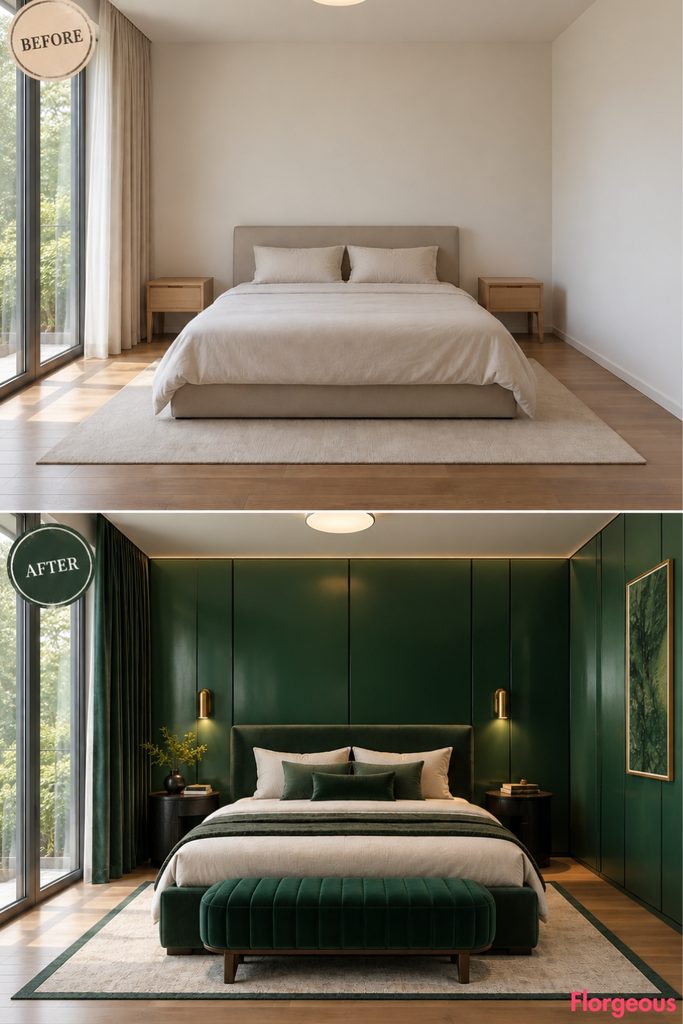
The emerald room needs a stronger design idea than dark paint and velvet.
Before: The bedroom has no evening focal point.
After: Create a series of large satin-lacquer emerald wall planes behind and beside the bed, separated by narrow shadow gaps. Add a darker bottle-green upholstered bed, matching emerald curtains, cream bedding, blackened-oak pedestal tables, brass reading lights, and a forest-green bench.
Why it works: The subtle sheen changes with the light, giving emerald depth without decorative clutter.
Try this: Use satin rather than high gloss so the room stays residential.
8. Build an Avocado Green Mid-Century Wall With Floating Teak Forms
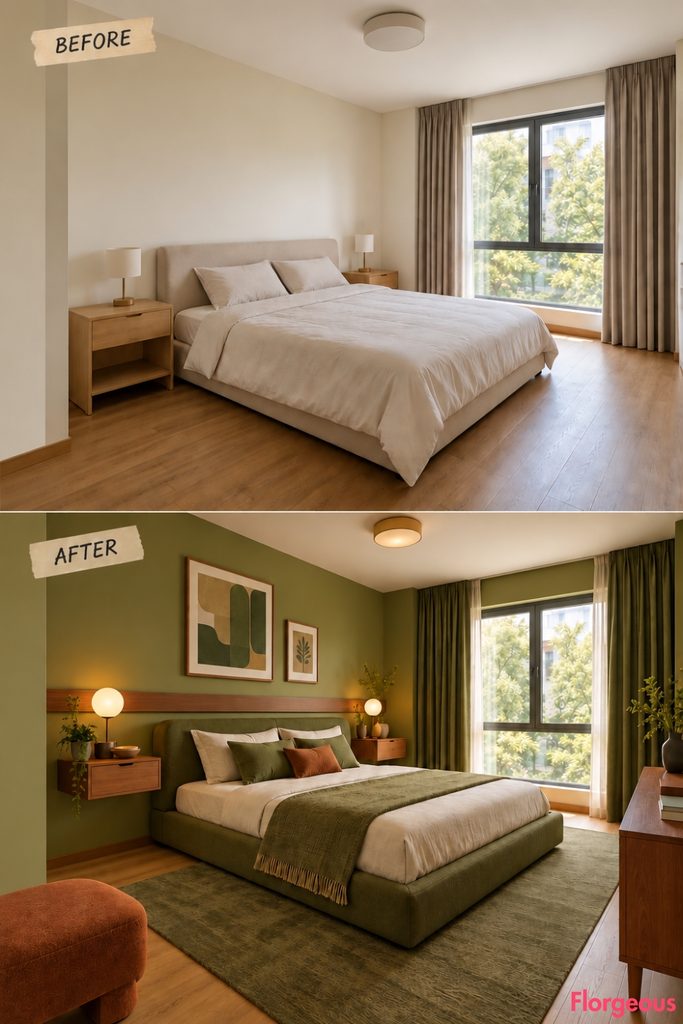
Rather than just pairing avocado paint with teak furniture, integrate both into one composition.
Before: The bed wall and furniture feel unrelated.
After: Paint the wall warm avocado and mount a long sculptural teak rail behind the bed, with staggered floating boxes, one compact drawer, and small globe lights integrated into the composition. Add an olive upholstered platform bed, moss-and-cream bedding, avocado wool rug, and restrained rust accents.
Why it works: The teak installation gives the room recognizable mid-century geometry while green dominates every textile layer.
Try this: Keep the teak composition asymmetric to avoid a showroom feel.
9. Frame a Pale Celadon Bed With Sliding Screen Panels
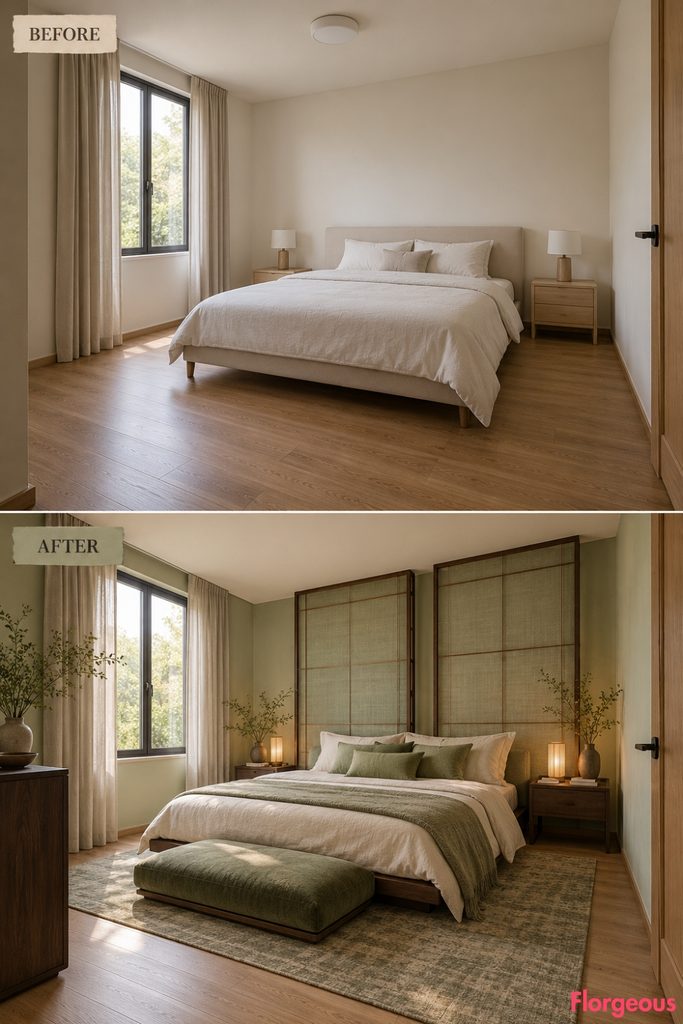
This gives the Japanese direction a strong visual device rather than relying only on low furniture.
Before: The pale room is minimal but visually unfinished.
After: Install two large freestanding sliding-style timber screens behind the bed with translucent celadon textile inserts. Center a low smoked-oak bed between them and use sage linen, rice-white bedding, muted moss floor cushions, and a soft green-gray rug.
Why it works: The screen composition gives celadon a distinct architectural identity and makes the room feel calm without becoming empty.
Try this: Keep the screens fixed as decorative panels rather than blocking access or glazing.
10. Compose an Olive and Terracotta Bedroom Around a Giant Painted Arch
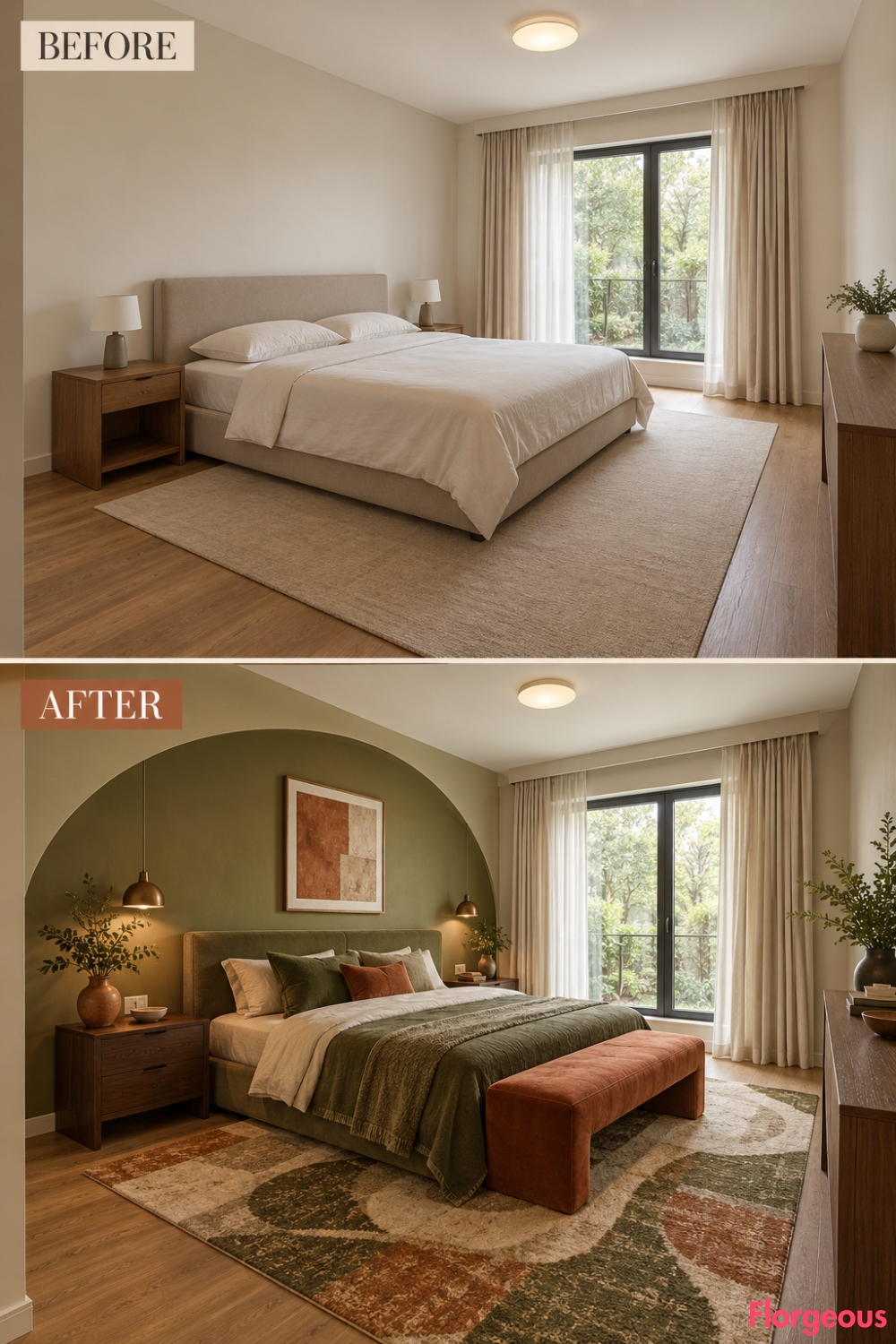
This should be graphic and artistic, not simply earthy.
Before: The room has no relationship between the bed and the tall wall behind it.
After: Paint a huge softened olive arch behind the bed, extending well beyond the headboard. Surround it with lighter sage-gray walls. Use an olive upholstered bed, terracotta bench, moss bedding, dark walnut, cream curtains, and a rug mixing olive, clay, and ivory.
Why it works: The oversized arch creates a memorable visual silhouette while terracotta gives green warmth and contrast.
Try this: Make the arch significantly larger than the bed so it feels architectural.
11. Turn the Far Wall Into a Forest Green Library Pavilion
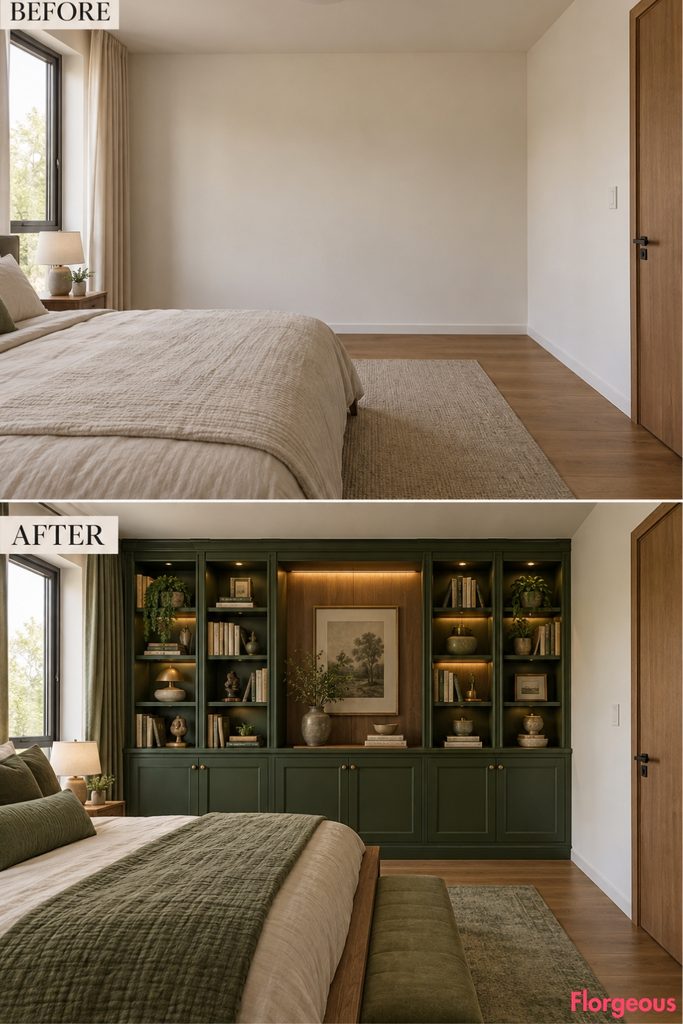
The strongest element moves completely away from the bed wall.
Before: The solid far wall is empty and contributes nothing visually.
After: Build a full-depth forest-green library and storage composition across the far wall with closed lower cabinets, tall vertical book bays, and one off-center warm-oak display niche. Repeat forest and olive through the bedding and curtains, while keeping the bed in warm walnut.
Why it works: Green architecture occupies an entire wall, giving the room depth and a collected residential character.
Try this: Keep the open shelves only partially filled.
12. Create a Pistachio Green Bedroom With a Sculptural Scalloped Wall
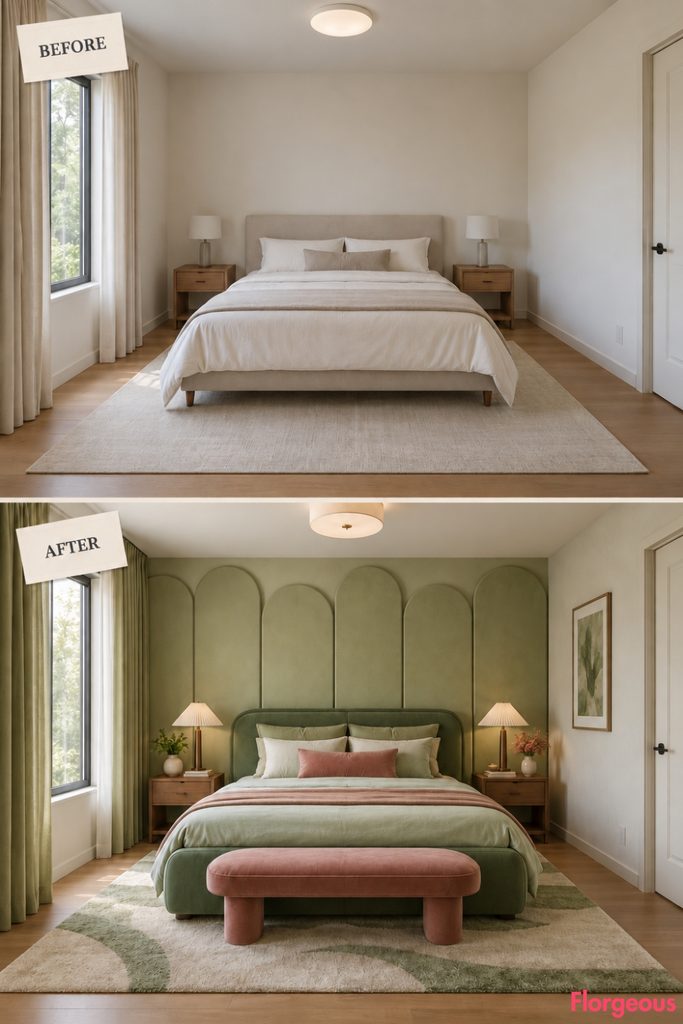
Pistachio should become more than a romantic paint color.
Before: The room lacks softness and a memorable silhouette.
After: Create a wide series of oversized shallow scalloped wall panels in softened pistachio behind the bed. Use a slightly darker sage upholstered bed, pale mint bedding, pistachio curtains, cream-and-green rug, dusty-rose accents, and petite pleated lights.
Why it works: The repeated curved geometry gives the light green palette a strong visual identity.
Try this: Oversize the scallops. Small decorative scallops would feel too cute.
13. Turn Peacock Green Into a Framed Art Wall
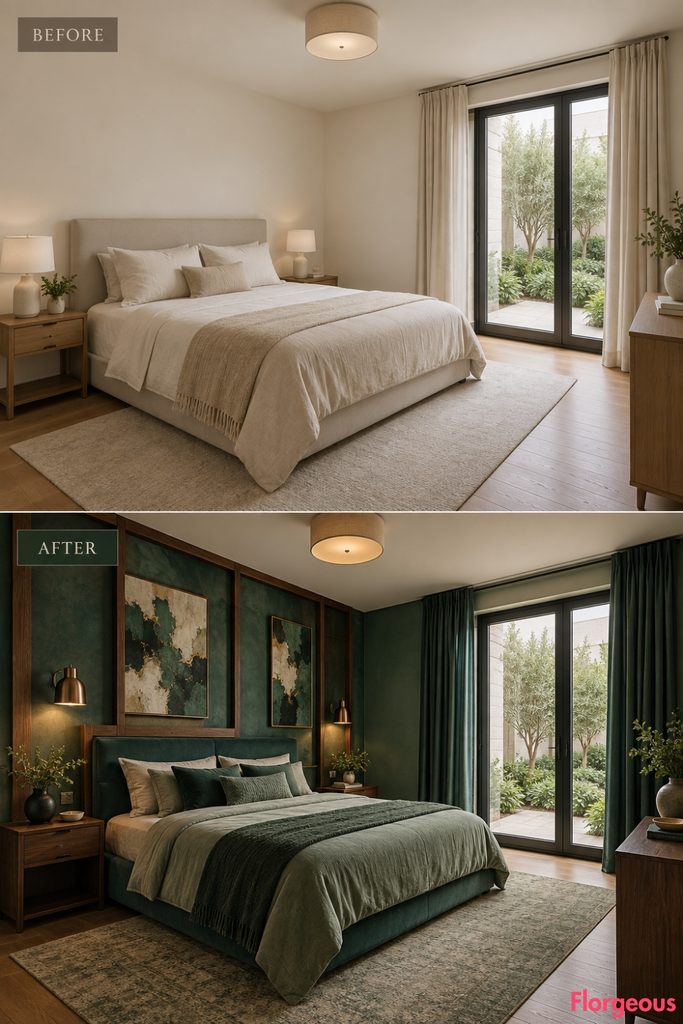
This concept needs to feel graphic, gallery-like, and completely separate from emerald.
Before: The bed wall has no visual hierarchy.
After: Use saturated peacock green across the wall, then overlay a large asymmetric dark-oak frame system creating several oversized empty fields around the bed. Integrate two small art panels without readable text. Add a smoky-teal bed, deep green curtains, sage bedding, and copper-toned lights.
Why it works: Peacock green becomes the backdrop for a strong graphic composition rather than a conventional accent wall.
Try this: Keep most framed fields empty so the structure itself remains the art.
14. Build an English Fern Green Room Around a Patterned Bed Alcove
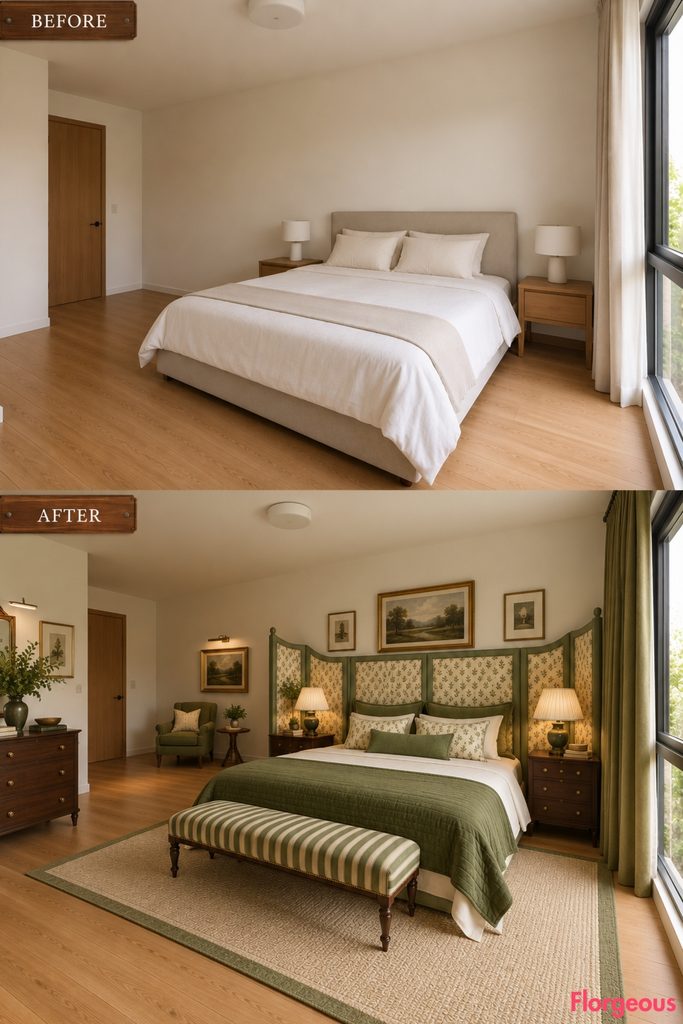
Instead of scattering cottage details, concentrate the pattern into one defined zone.
Before: The room feels sparse and generic.
After: Create a shallow freestanding bed surround with fern-green patterned fabric panels inside and solid muted fern-green framing around them. Use olive curtains, moss quilt, striped green footstool, dark timber chest, pleated lamps, and a small controlled gallery grouping.
Why it works: Pattern becomes architecture, making the English-inspired room feel intentional rather than decorative.
Try this: Use one small-scale pattern and one stripe only.
15. Cut a Tailored Loden Green Stripe Through the Whole Room
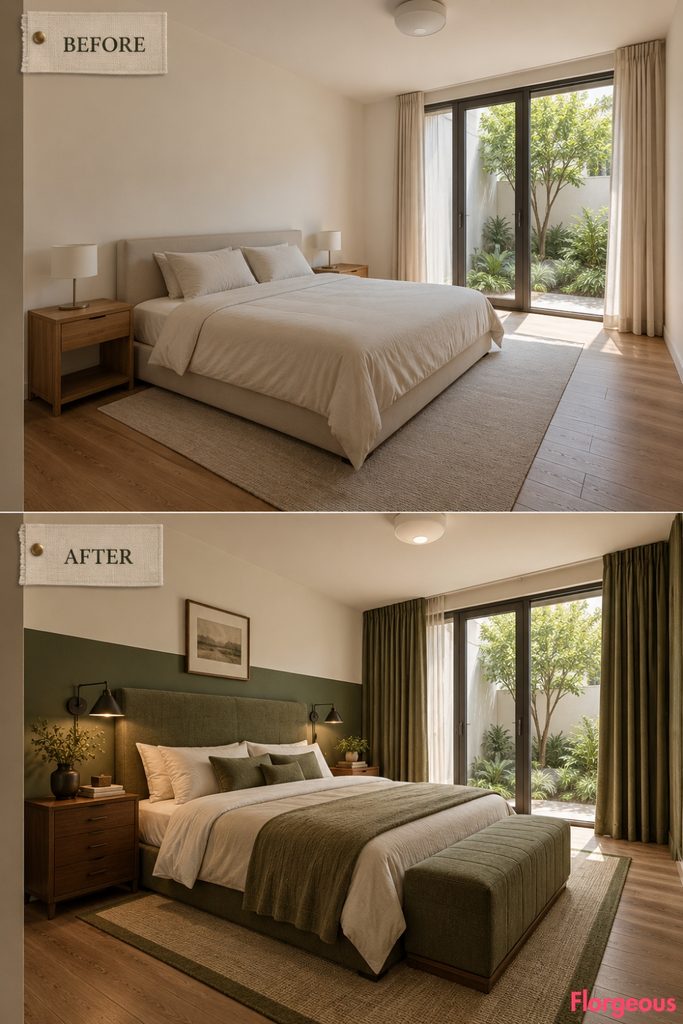
This one is sharp, linear, and fashion-inspired.
Before: The room has no strong visual line connecting its surfaces.
After: Run a broad loden-green horizontal band around the visible walls at headboard height, continuing visually into a tall olive wool headboard and a long green upholstered bench. Keep the upper walls warm ivory and add loden curtains, cream bedding, tobacco-brown bedside blocks, and blackened-bronze lights.
Why it works: One continuous green datum line organizes the room and gives it a tailored identity.
Try this: Keep the band perfectly level and free of extra molding.
16. Create a Sea-Glass Green Bedroom With a Translucent Curtain Pavilion
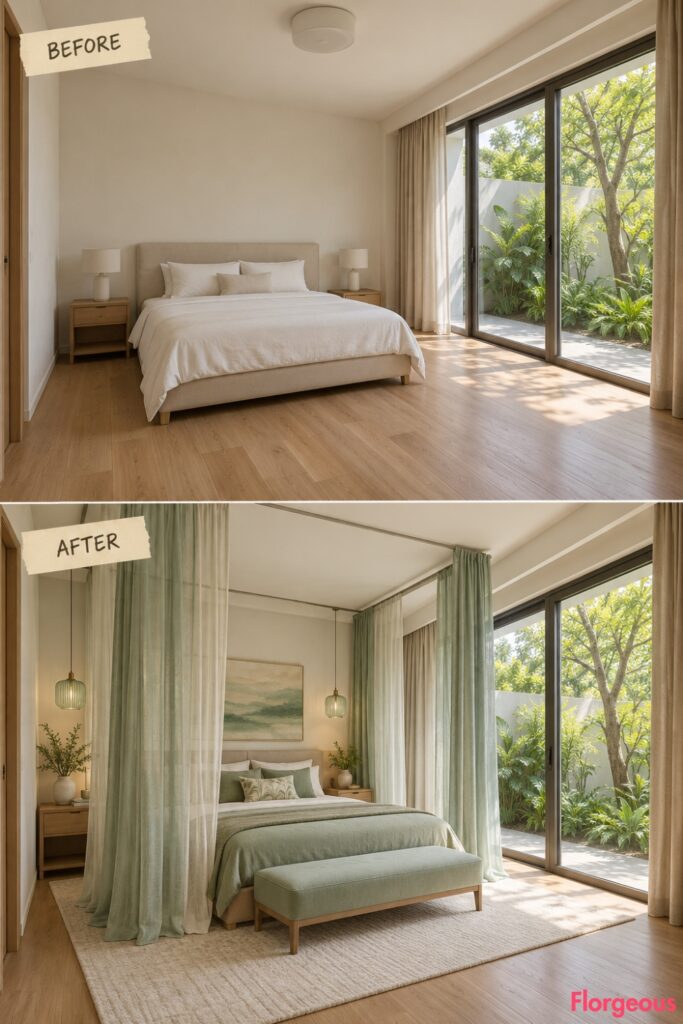
The lightest green concept should be visually special, not merely pale.
Before: The courtyard glazing feels separate from the sleeping area.
After: Suspend a slim ceiling-mounted rectangular curtain track around three sides of the bed zone without touching the architecture, then hang sheer sea-glass and eucalyptus-toned linen panels that can stack fully open. Use a bleached-oak bed, faded sage bedding, soft mint bench, ivory rug, and pale green glass lighting.
Why it works: Translucent green fabric catches daylight and makes the entire sleeping area glow softly.
Try this: Keep most panels open during the day so the effect stays airy.
17. Build a Graphic Clover Green Composition With Rounded Color Blocks
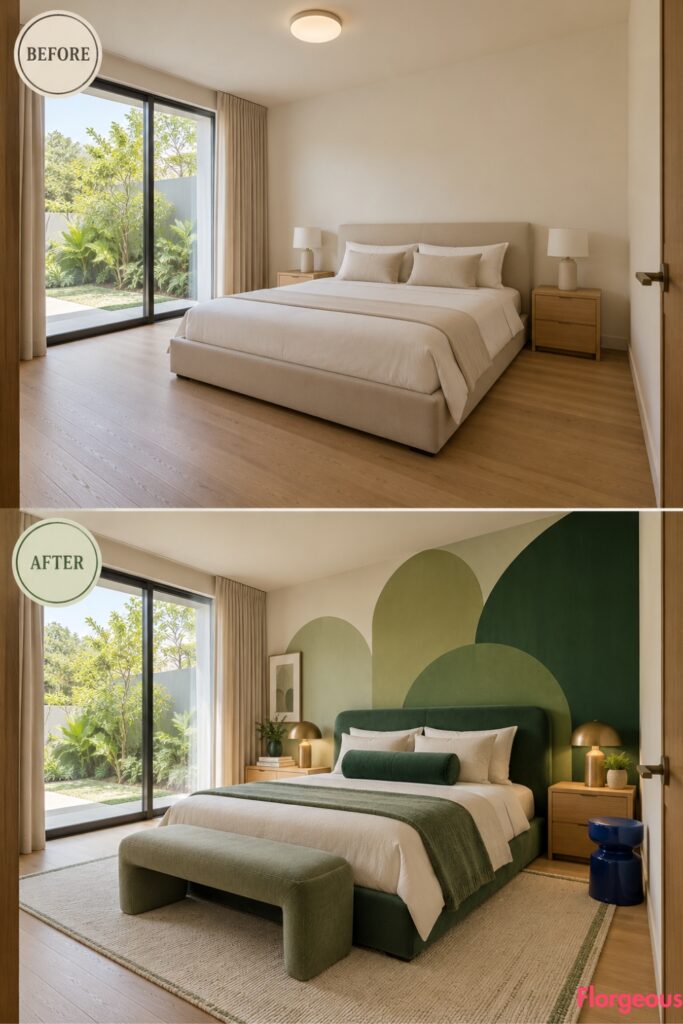
This should be the boldest modern color concept.
Before: The neutral walls have no visual rhythm.
After: Create oversized overlapping wall fields in pale sage, fresh clover, and deep bottle green using broad rounded geometric shapes. Place a jade upholstered bed against the composition, with ivory bedding, a bottle-green bolster, pale-oak side tables, and a cobalt accent stool.
Why it works: Green becomes graphic art at room scale rather than conventional decor.
Try this: Use only three green values so the mural remains controlled.
18. Wrap Sage Millwork Around the Far Corner Like Furniture Architecture
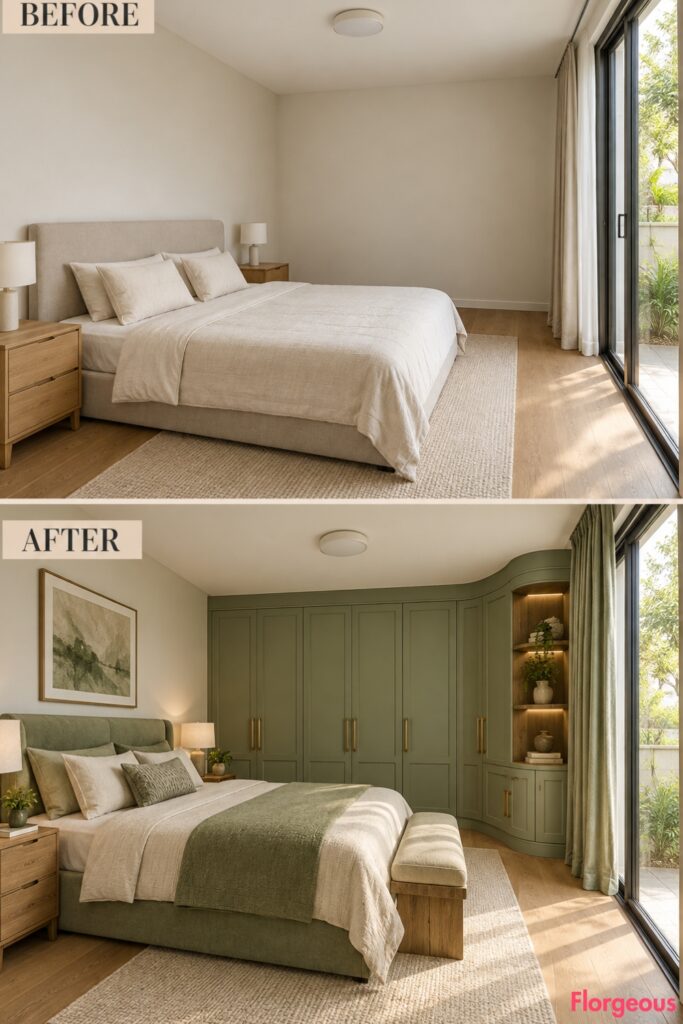
This replaces the flatter cabinetry concept with a more sculptural one.
Before: The far wall and corner feel visually dead.
After: Install full-depth sage cabinetry across the far wall, then curve the cabinetry around one far corner into a short return ending in a rounded open display niche lined in dark olive. Repeat sage on the bed upholstery and curtains, with cream bedding, warm oak, and bronze hardware.
Why it works: The curved return makes the cabinetry part of the room’s architecture instead of a storage wall.
Try this: Keep the return short so the central circulation remains generous.
19. Turn the Ceiling Into a Deep Olive Canopy Plane
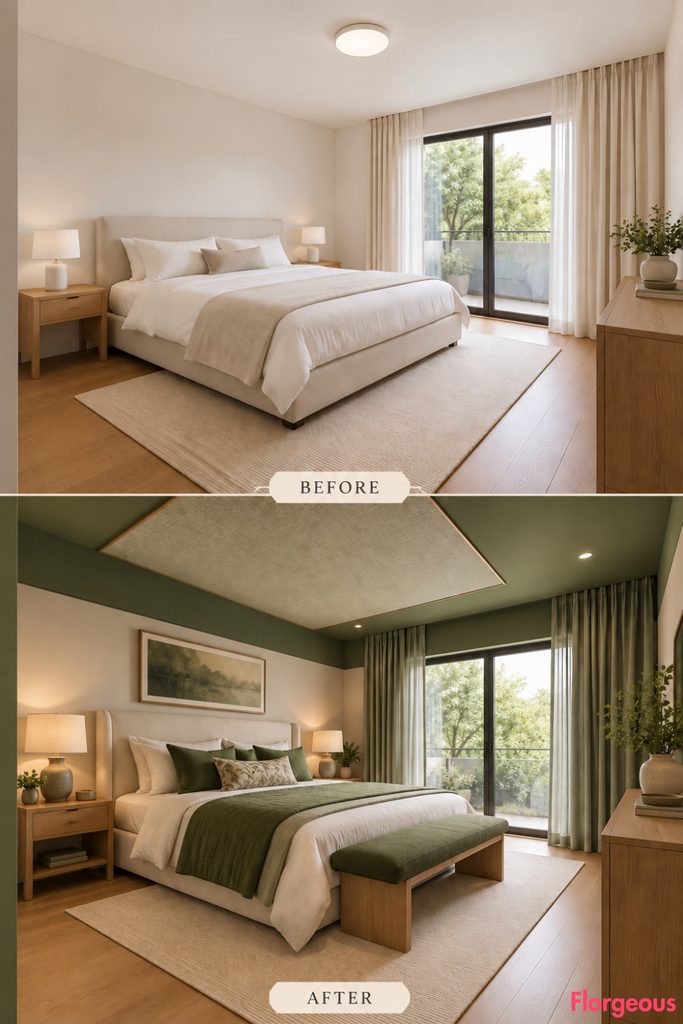
Instead of simply painting the ceiling, make it visually connect back to the sleeping zone.
Before: The flat white ceiling does nothing for the room.
After: Paint the ceiling deep olive and continue it 20 to 25 cm down all visible walls. Suspend a large shallow rectangular textile panel above the bed in muted sage linen, clearly below the ceiling but high enough to remain airy. Use olive bedding, moss cushions, sage curtains, ivory upholstery, and warm oak.
Why it works: The overhead green layers create a strong cocoon while the lower walls remain light.
Try this: Keep the textile ceiling panel flat and tailored, never draped.
20. Create a Sage and Fern Wallpaper Room With a Framed Headboard Niche
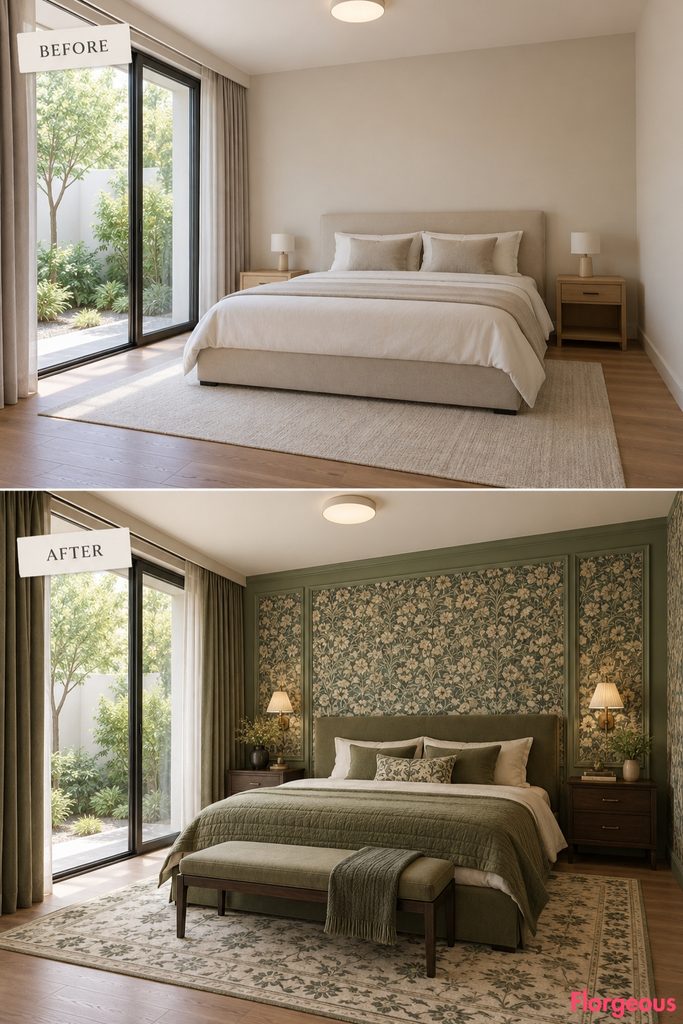
Wallpaper should drive the whole design, not just cover one wall.
Before: The neutral bed wall is completely featureless.
After: Cover the bed wall with a dense small-scale sage, fern, cream, and charcoal pattern. Place a broad solid sage frame around the bed area to create a visual niche inside the wallpaper. Add an olive upholstered bed, moss quilt, muted-green curtains, dark timber furniture, and a cream-and-green rug.
Why it works: Solid green framing gives the patterned wall structure, while the rest of the room pulls colors directly from the wallpaper.
Try this: Avoid large botanical motifs. The pattern should read as texture from across the room.
21. Build a Jade Green Tiled Bed Wall With a Soft Sage Crown
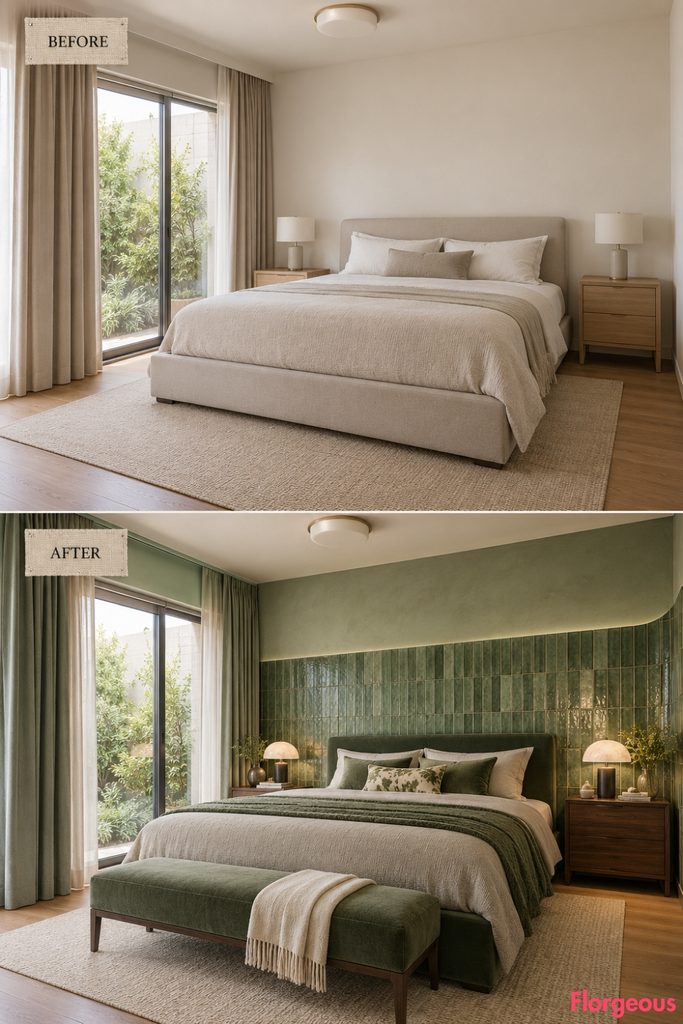
This gives the article one material-heavy concept that is still clearly an immersive green bedroom.
Before: The bed wall has no texture or reflected light.
After: Cover the lower two-thirds of the bed wall in narrow handmade jade-green glazed tiles arranged vertically. Finish the upper portion in soft sage plaster with a gently curved transition line. Add a deep-green upholstered bed, moss-gray bedding, muted jade curtains, dark walnut pieces, and ivory accents.
Why it works: Glossy jade and matte sage create depth through texture while remaining one continuous green story.
Try this: Choose varied handmade glaze rather than perfect uniform tile.
22. Stretch a Green Striped Canopy Across the Bed Like a Textile Installation
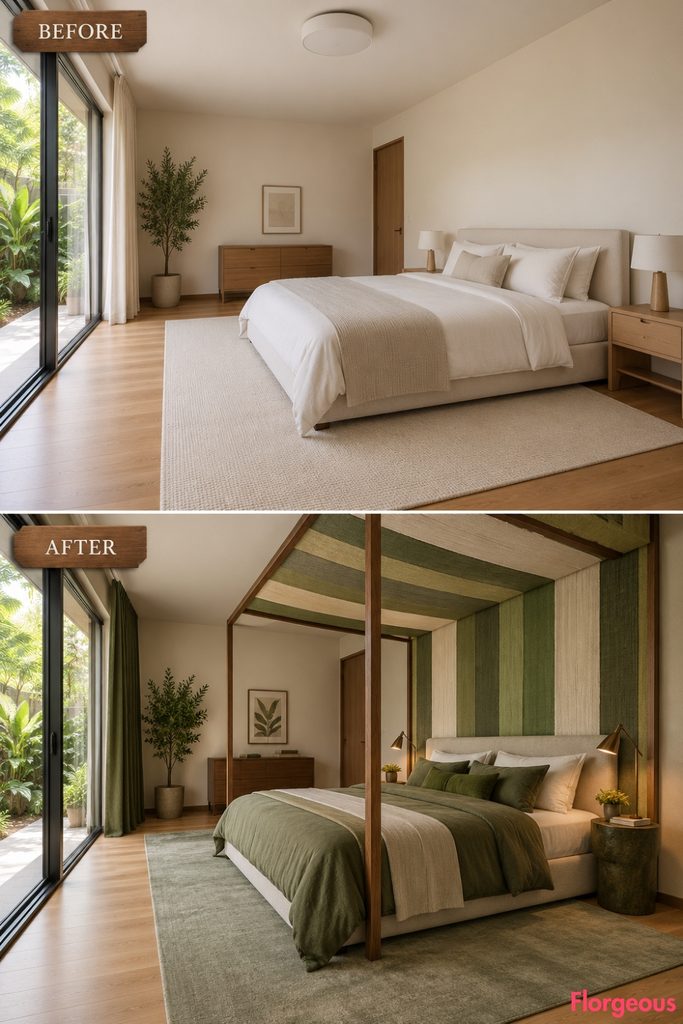
This needs to feel like art direction, not a traditional four-poster.
Before: The bed and high flat ceiling feel disconnected.
After: Install a slim walnut freestanding frame around the bed and tension broad sage, olive, and cream striped fabric across only the upper and rear planes. Continue the palette through deep olive bedding, moss bedside stools, forest-green curtains, and a muted sage rug.
Why it works: The striped plane creates a bold new visual volume while the whole room remains layered in green.
Try this: Keep the textile perfectly taut with wide stripes.
23. Create a Tonal Green Gallery Bedroom With Layered Architectural Frames
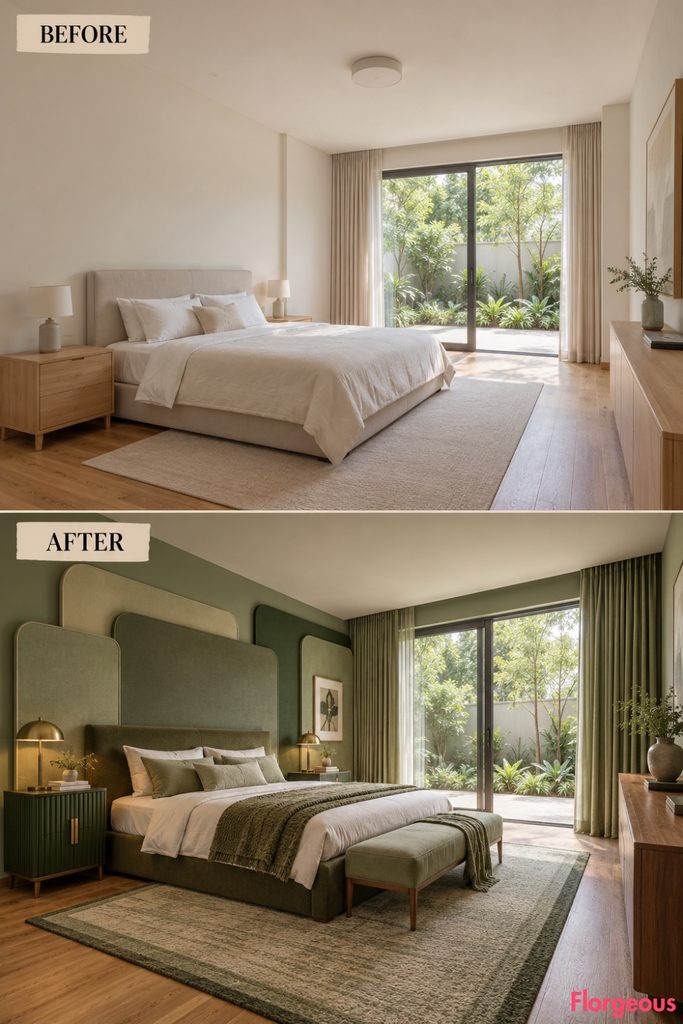
The finale should feel complex, collected, and memorable without turning chaotic.
Before: The room is neutral and visually flat.
After: Use a muted moss wall envelope with three large overlapping architectural frames in sage, deep olive, and forest green mounted shallowly around the bed and extending toward the far-wall return. Add a deep olive upholstered bed, sage curtains, eucalyptus bench, forest-green bedside cabinet, pale celadon cushions, warm walnut, cream bedding, and a green-toned wool rug.
Why it works: Multiple greens are separated by form, depth, and material, creating a layered gallery effect instead of one flat monochrome scheme.
Try this: Keep every green in a clearly different value so the composition remains readable.
How to Make a Green Bedroom Feel Designed From Every Angle
The most convincing green bedrooms do more than repeat the same color on a wall, pillow, and throw. They give green a clear role in the architecture of the room.
Start with one dominant gesture. It could be a sculptural bed portal, a curved upholstered ribbon, a paneled envelope, a relief wall, a ceiling canopy, a framed wallpaper niche, or full-height millwork. That large move gives the room its identity before smaller styling details are added.
Next, build depth with different green values. Pale celadon can sit beside moss, sage can sharpen against forest green, and olive becomes richer next to eucalyptus or jade. The shades should be visibly different enough that the room feels layered rather than muddy.
Material is just as important as color. Green velvet catches light differently from limewash. Sage linen feels softer than glazed jade tile. Dark olive cabinetry has more visual weight than a pale eucalyptus curtain. Mixing these surfaces is what makes a green room feel dimensional.
Finally, give the eye somewhere to rest. Ivory bedding, warm walnut, pale oak, limestone, brass, cream rugs, and restrained clay tones stop the green from becoming visually exhausting.
A strong Green Living Bedroom should feel green the moment you see the whole room, but it should also have an idea behind it. Choose one memorable architectural or decorative gesture first, then use the remaining layers to strengthen that story.