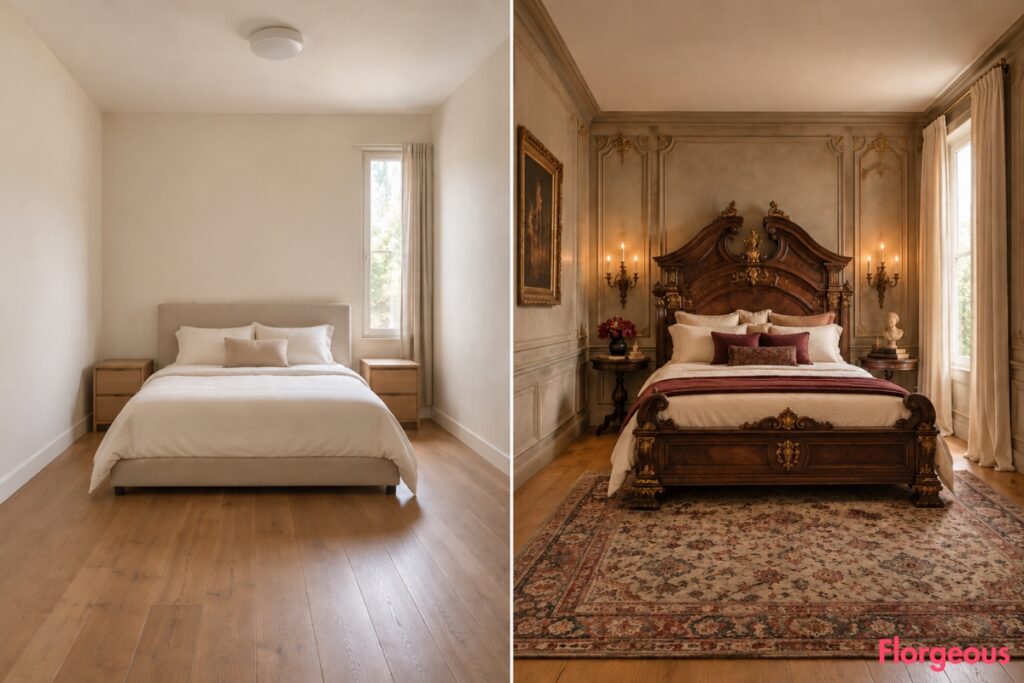
A plain bedroom can be perfectly comfortable and still feel forgettable. Warm off-white walls, a basic upholstered bed, cream bedding, two bare light-oak nightstands, a simple ceiling light and very little styling make a useful starting point, but they do not create much mood or identity.
For this Baroque Bedroom gallery, that exact same room becomes the base for every makeover. The architecture stays locked the whole way through: a modest rectangular bedroom, entry at the front-left, a bed centered on the flat far wall, and one tall narrow window on that same far wall, positioned to the right of the bed. Both side walls stay solid, the ceiling stays flat, and the floor stays warm oak.
Nothing structural changes. No niches, alcoves, extra windows, fake recesses or built-ins appear. What changes is the decorative language: carved walnut, damask, stucco relief, tooled leather, tapestry, twisted columns, marquetry, chandeliers, structured drapery, gilt mirrors, brocade, formal writing furniture, gilt molding, patterned carpets, marble consoles, bed crowns and chiaroscuro lighting.
The camera angle also changes from one idea to the next so the gallery feels varied. Inside each before-and-after pair, however, the camera, framing, architecture and daylight direction stay exactly the same.
1. Turn the Plain Room Into an Italian Baroque Chamber With a Split Pediment Bed
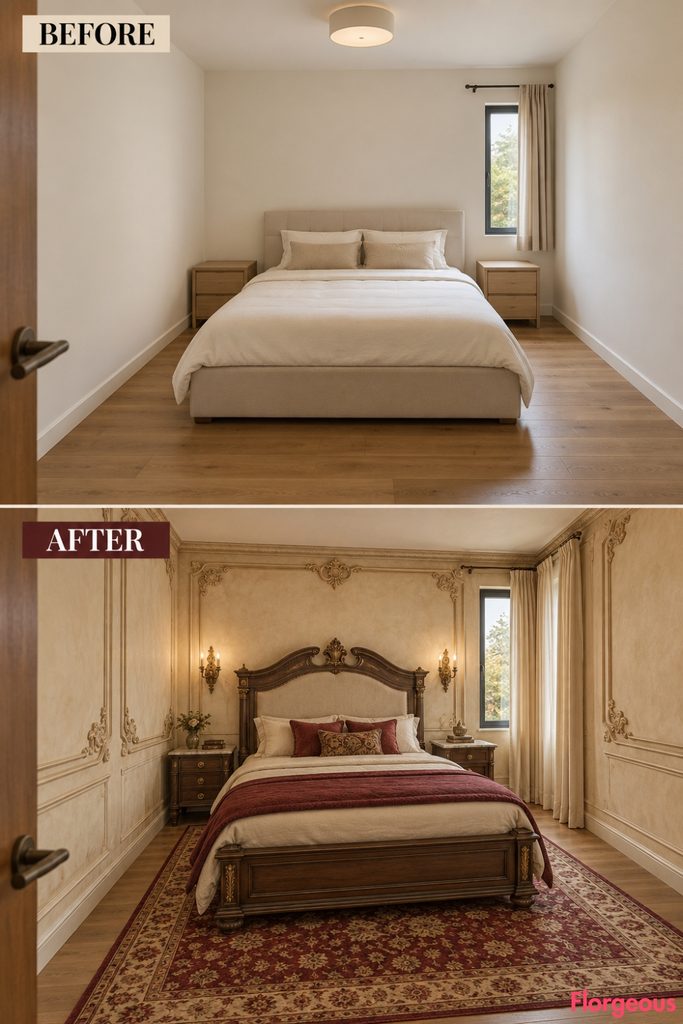
Before: The room has warm off-white flat walls, a basic neutral upholstered bed centered on the far wall, cream bedding, two bare light-oak nightstands, short plain curtains at the tall narrow far-wall window, a generic ceiling light and exposed warm oak flooring.
After: The whole room shifts into a restrained Italian Baroque direction. The new dark-walnut bed uses an architectural headboard with shallow carved pilasters, layered molding, a parchment-upholstered center panel, a restrained split pediment and one small central cartouche. The surrounding walls become warm parchment mineral plaster with shallow surface-applied decorative frames and restrained scroll corners. Full-height warm ivory curtains frame the far-wall window, paired aged-bronze wall lights flank the bed, and a muted claret-and-parchment patterned rug grounds the lower half of the room.
Why it works: The bed is still the hero, but the walls, curtains, rug and lighting now support the same Baroque language.
Designer Tip: Keep all wall decoration surface-applied and shallow so the room gains ornament without pretending it has new architecture.
2. Wrap the Bed Wall in Louis XIV Crimson Damask
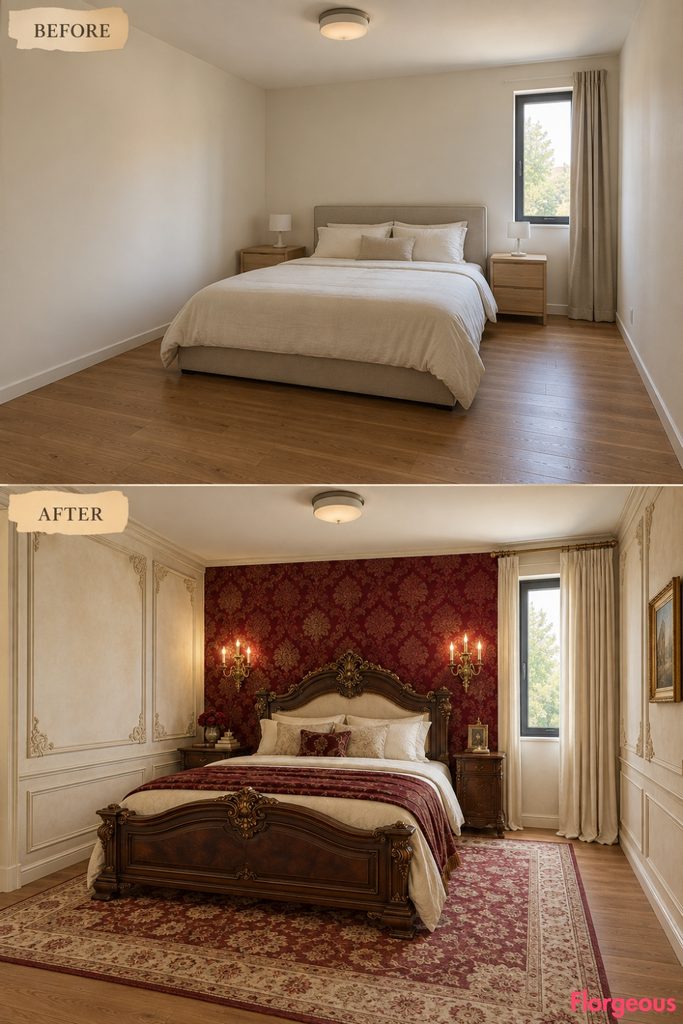
Before: The far wall remains completely plain, and the bed area has no formal backdrop.
After: Only the existing far wall receives deep crimson damask with a symmetrical scrolling motif. A substantial straight-framed dark-walnut bed sits beneath it, with paired aged gilt-bronze sconces, ivory linen and a faded formal carpet in cream and claret. The side walls stay quieter in warm parchment with restrained surface molding, so the far wall feels ceremonial rather than crowded.
Color Story: Crimson, ivory, walnut and dull gold give this room a formal Louis XIV tone that is very different from the softer Italian section above.
3. Create a Pale Italian Stucco and Cartouche Room
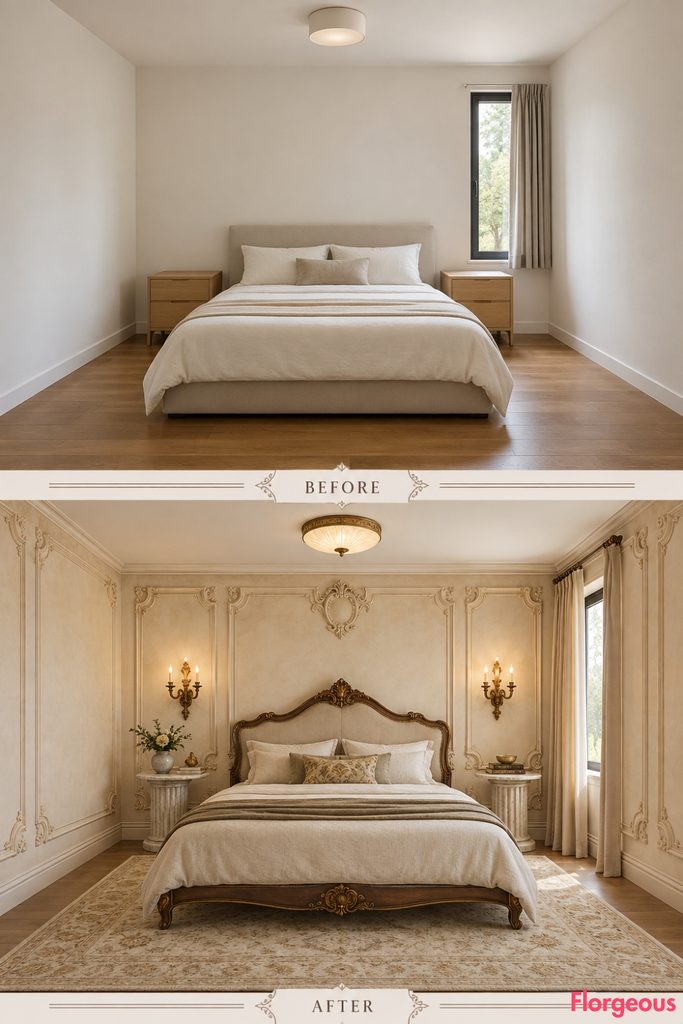
Before: The room feels clean but architecturally anonymous, with flat warm off-white walls and a generic upholstered bed.
After: The surfaces become the star. Shallow surface-applied plaster frames, restrained scroll corners and one modest cartouche above the bed create a pale Italian Baroque composition. Everything is painted warm parchment, including the wall treatment, so shadow reveals the ornament. A low walnut bed, stone linen, pale marble-topped pedestals, a soft cream rug and full-height parchment curtains keep the entire room calm and luminous.
Why it works: This room proves a Baroque Bedroom can feel architectural and airy rather than heavy and dramatic.
4. Go Darker With a Spanish Baroque Leather Headboard
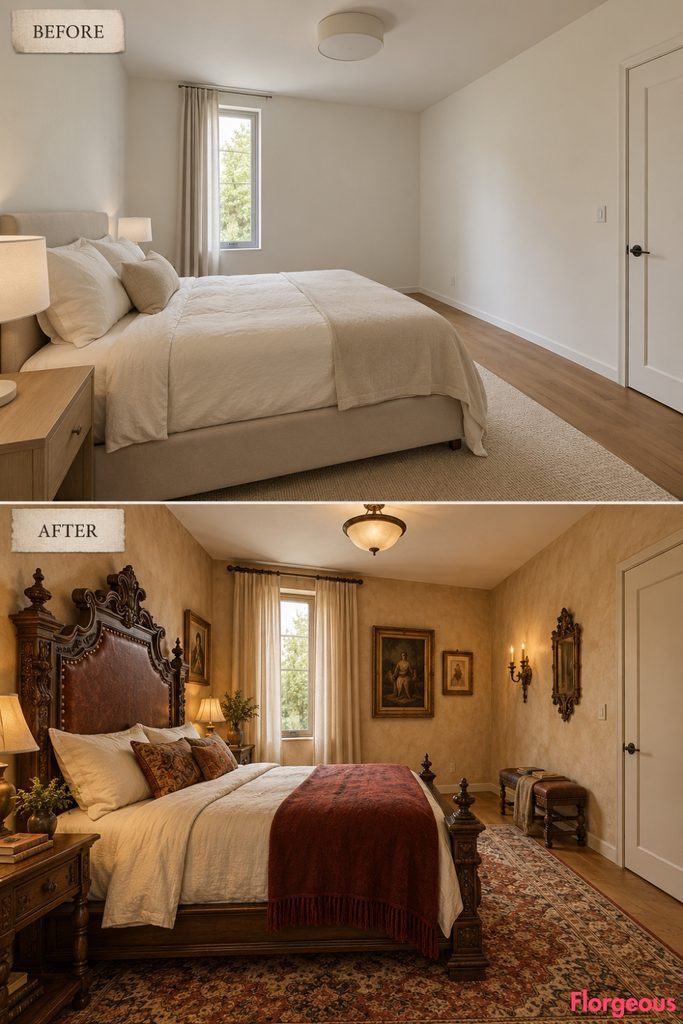
Before: The upholstered bed is soft and generic, and the room has very little material contrast.
After: The bedroom becomes heavier and more austere. A substantial dark-walnut bed uses a broad architectural headboard with a chestnut-brown tooled leather center panel and discreet bronze nailheads. The walls shift to a warm earthy plaster tone, the rug becomes faded rust and umber, the curtains become full-height warm ivory linen, and the bedside storage turns into simple dark chests with bronze lamps.
Try this: Tooled leather panels can also be used on a custom headboard insert if a full antique-style bed is outside the budget.
5. Make a Flemish Verdure Tapestry the Main Event
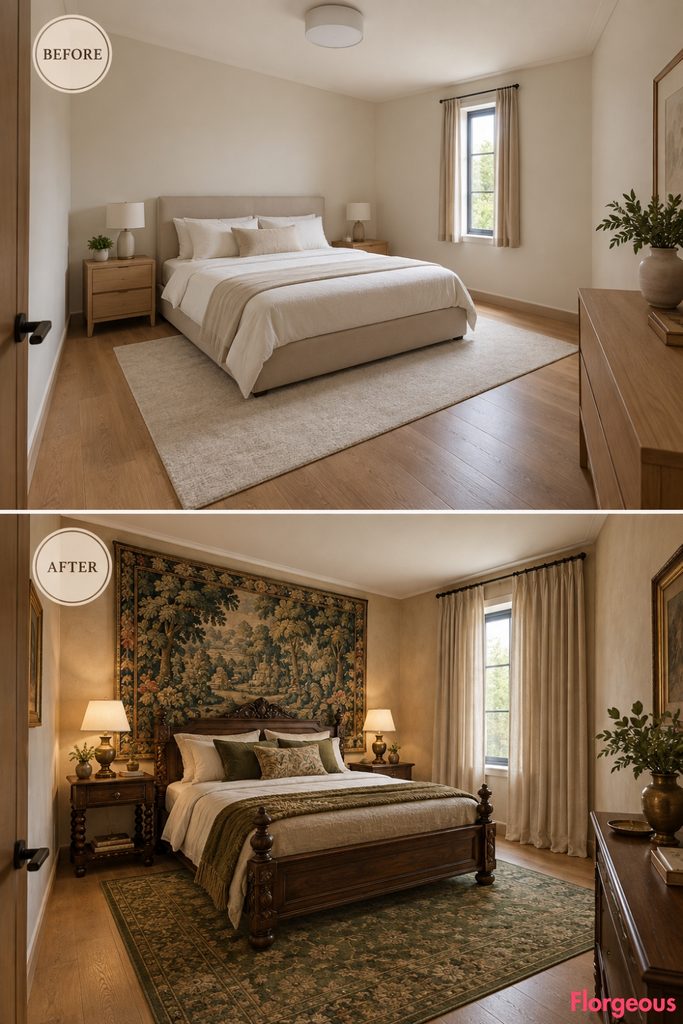
Before: The wall above the bed is bare, so the entire back of the room feels flat.
After: One large verdure-style tapestry becomes the focal plane behind the bed. Dense foliage, distant garden forms and scrolling vegetation appear in moss, faded blue, russet and parchment. The room around it follows that palette with a dark-oak bed, moss throw, aged brass lights, soft olive rug and full-height natural linen curtains that stay simple so the tapestry remains dominant.
Style Note: One major textile almost always works better than a busy cluster of smaller wall pieces.
6. Build the Room Around a Twisted-Column State Bed
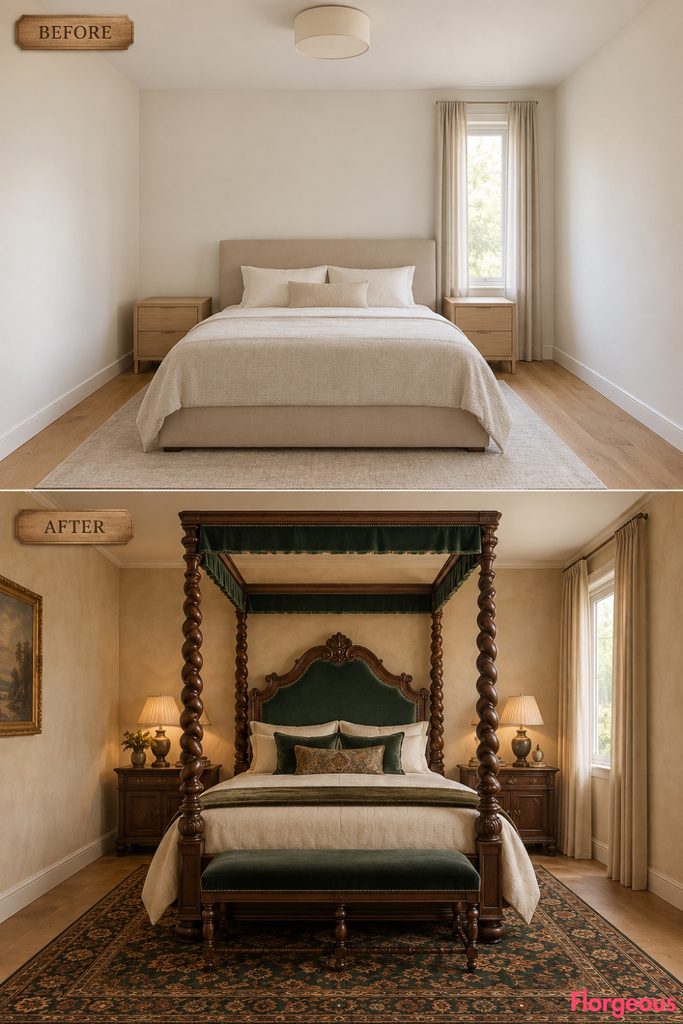
Before: The low neutral bed creates almost no vertical silhouette.
After: A freestanding walnut state bed introduces four substantial twisted columns and a shallow upper tester. Bottle-green velvet lines only the head section and upper canopy, leaving the sides open. The room supports that silhouette with warm parchment walls, a dark patterned rug, bronze lighting and simple full-height neutral curtains at the far-wall window.
Why it works: This makeover feels completely different because the drama comes from vertical structure, not from wall pattern or storage.
7. Bring in Boulle-Inspired Ebony and Brass Marquetry
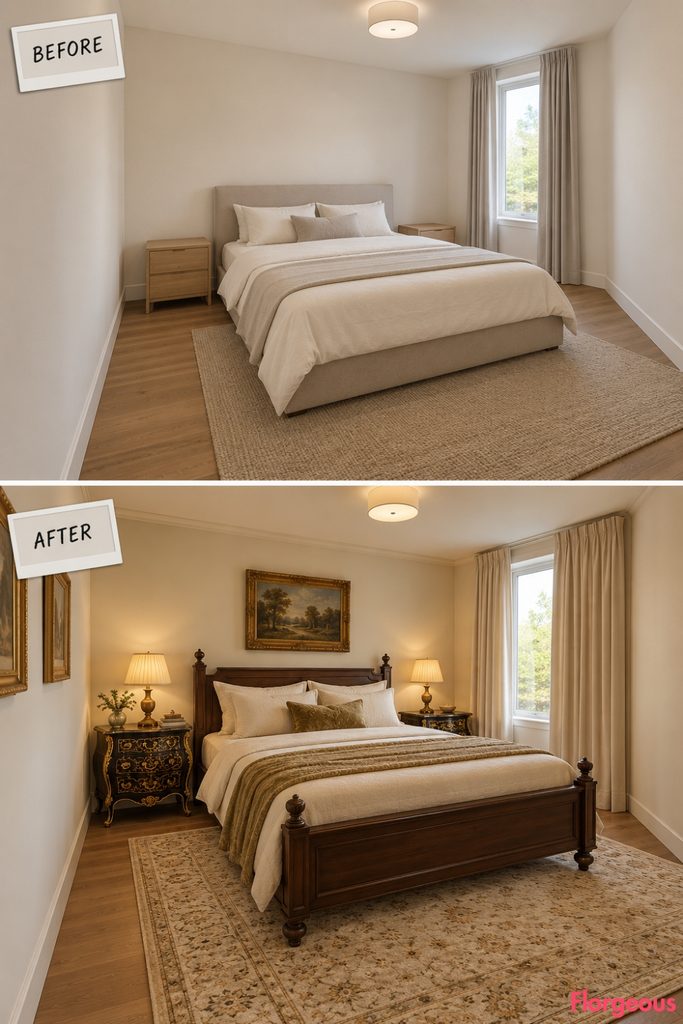
Before: Two pale wood nightstands feel lightweight and contemporary against the simple bed.
After: The room becomes more graphic and courtly. A relatively restrained dark bed is paired with compact ebony-toned bedside chests inspired by Louis XIV Boulle work, with fine brass-colored scrolling marquetry and small gilt-bronze mounts. Warm ivory walls, a faded cream rug, amber-shaded lights and full-height warm ivory curtains create a rich but controlled setting.
Why it works: The decorative richness happens at the furniture surface rather than through a louder wall or canopy idea.
8. Make the Ceiling the Focal Point With Baroque Lighting
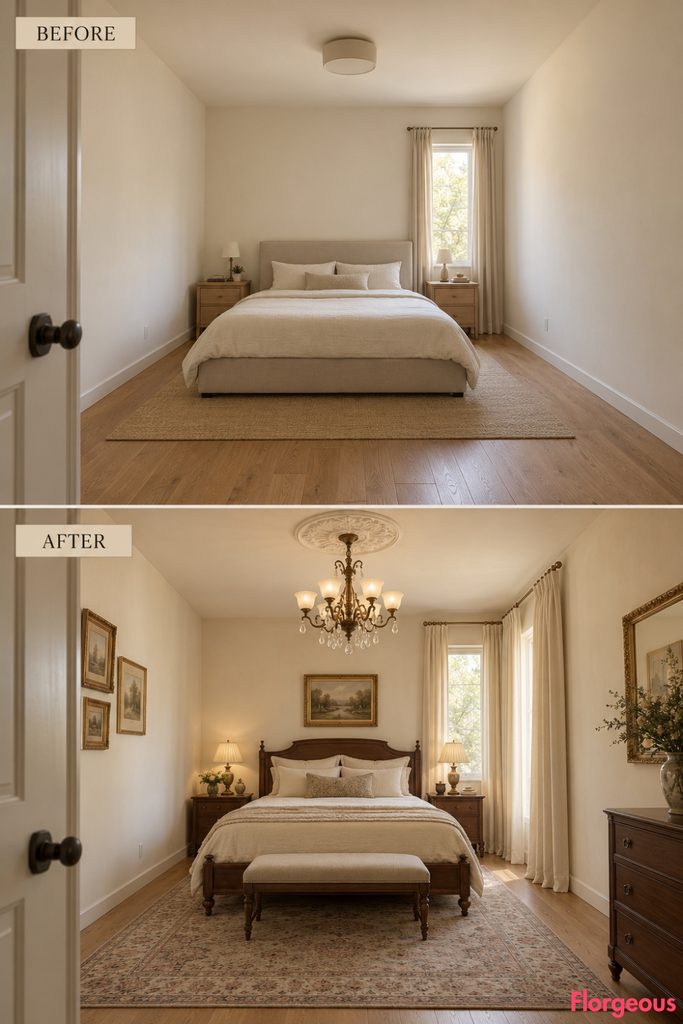
Before: A generic flush ceiling fixture leaves the upper part of the room visually empty.
After: One shallow plaster medallion surrounds the existing ceiling point and supports a correctly scaled aged-bronze chandelier with scrolling arms, restrained crystal drops and opaline shades. The rest of the room stays coherent with warm parchment walls, a simple walnut bed, cream linen, a formal muted rug and full-height ivory curtains at the far-wall window.
Common Mistake: In a normal bedroom, a chandelier should feel elegant and believable, not oversized and theatrical.
9. Dress the Far-Wall Window With a Structured Lambrequin
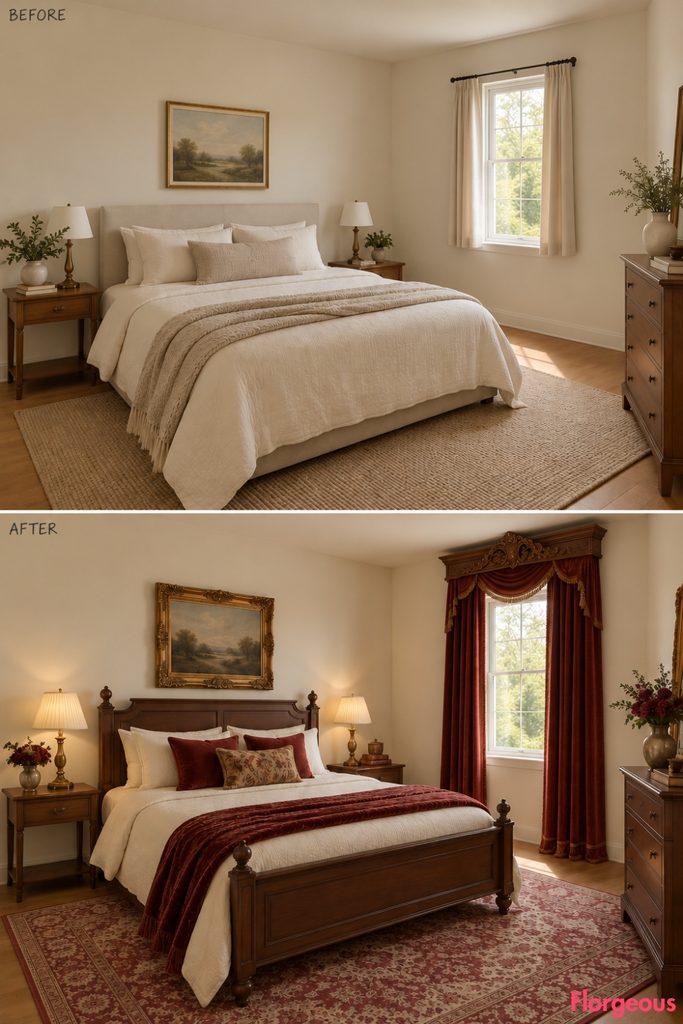
Before: Short plain curtains make the tall window beside the bed look incidental.
After: The exact same opening becomes a Baroque feature. Deep garnet velvet side panels fall to the floor while staying clear of the glass. Above them, a carved-walnut lambrequin frames a shallow central swag with narrow antique-gold braid. The bed stays simple in dark walnut and ivory, while the walls shift to warm parchment and the floor gets a faded rug in garnet and cream.
Color Story: Garnet, parchment and walnut make this room feel warmer and more textile-led than the cooler blue and green sections.
10. Build a Venetian-Inspired Mirror and Marble Dressing Zone
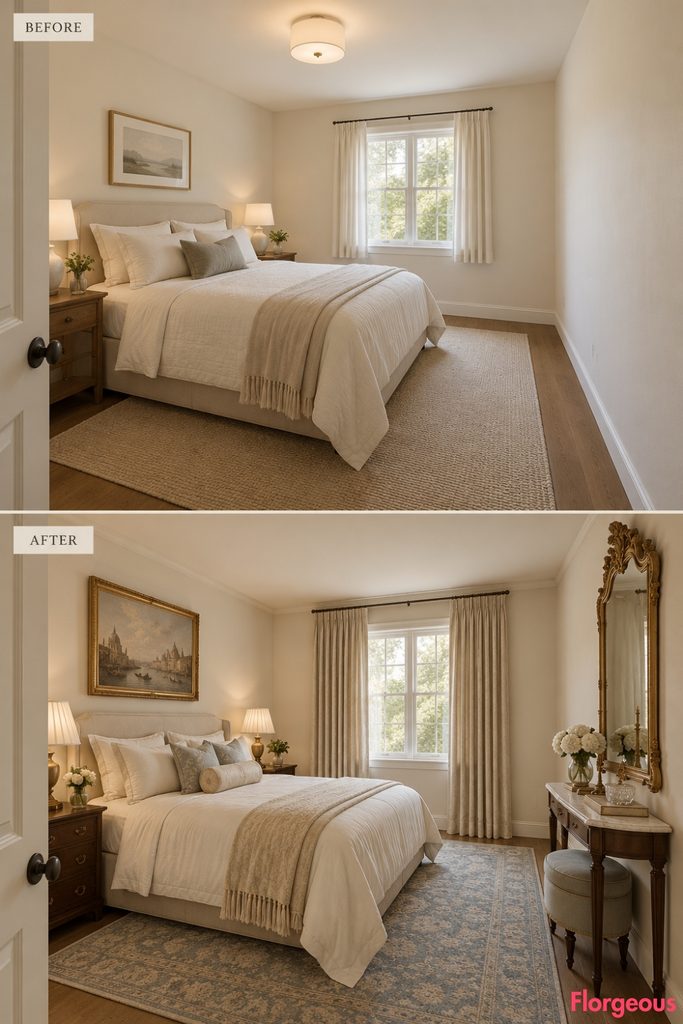
Before: One side wall contains no furniture and the room has no secondary function or reflective surface.
After: A dressing composition takes shape on the side wall with a tall architectural mirror in restrained aged gilding above a narrow dark-walnut console topped in softly veined pale marble. A compact upholstered stool tucks fully below. Pale warm walls, a muted blue-gray rug, ivory bedding and full-height neutral curtains keep the palette calm and reflective.
Why it works: The mirror and marble create a lighter Baroque mood that feels elegant rather than heavy.
11. Make Tobacco Brocade the Main Decorative Material
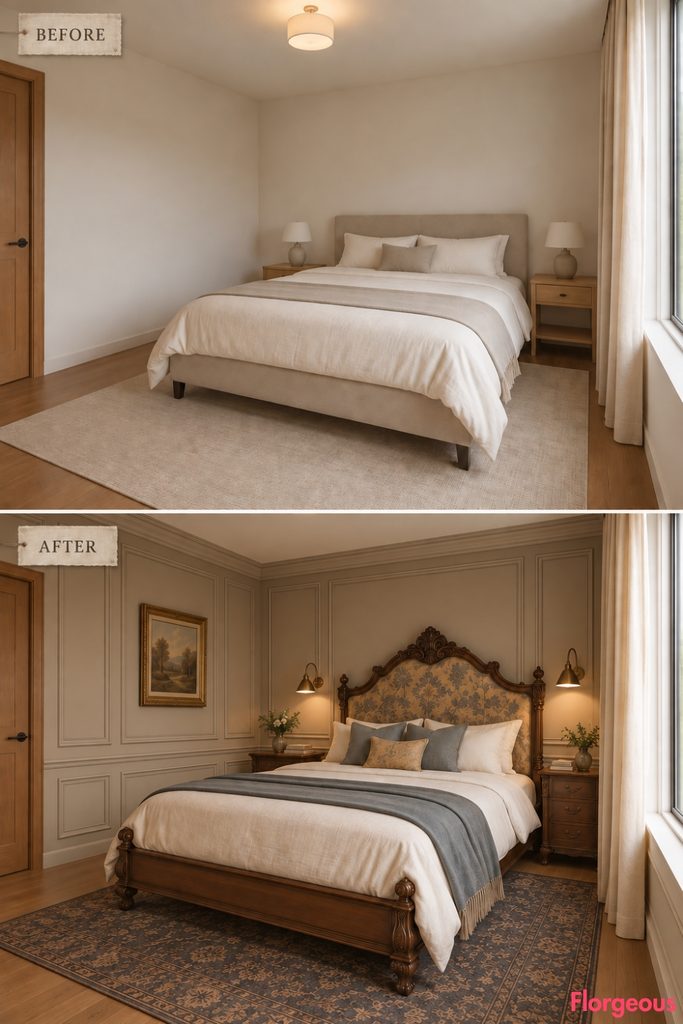
Before: The plain upholstered bed has almost no pattern or tactile richness.
After: The room centers on a broad dark-walnut headboard with a tobacco-and-old-gold brocade center panel, restrained scroll shoulders and a small carved crest. Bone linen, a faded blue-gray wool blanket, warm taupe walls, a low dark rug and bronze reading lights support that textile focus. Full-height warm neutral curtains keep the far-wall window elegant but quiet.
Try this: Use brocade only once at large scale. Repeating it on curtains and cushions can make the room feel busy very quickly.
12. Create a Formal Baroque Writing Chamber
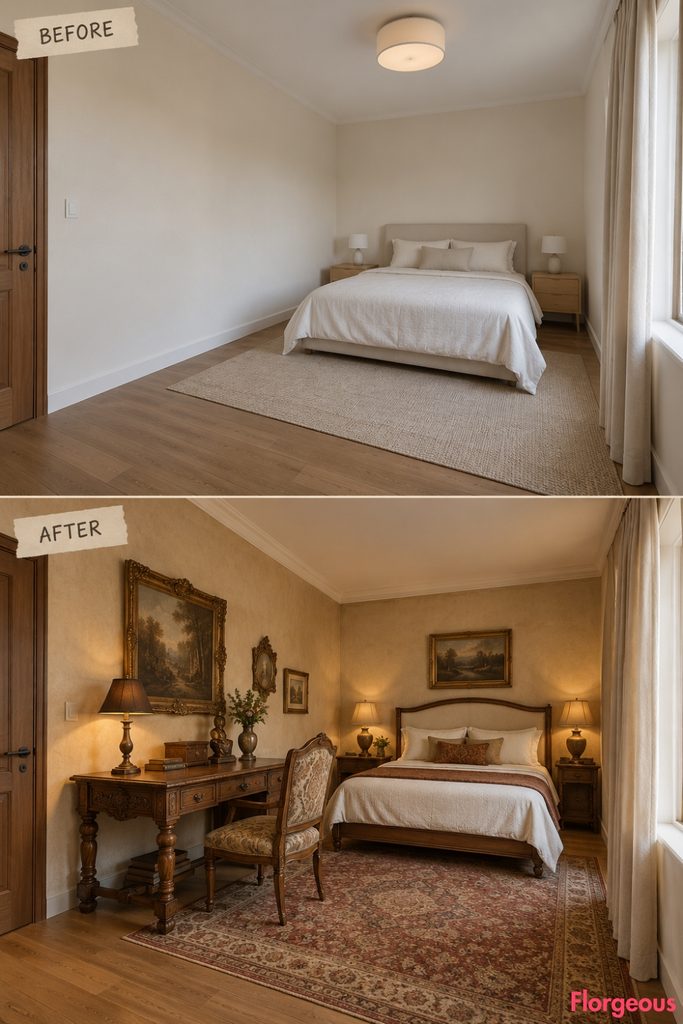
Before: The long side wall is unused, and the room has no meaningful secondary zone.
After: A substantial walnut writing table lines the solid wall, using turned supports, an architectural carved apron and restrained brass mounts. A high-backed upholstered chair and a small leather writing surface make it feel like a real chamber rather than an added desk. The rest of the room shifts to parchment walls, a muted rust rug, a darker simpler bed and shaded bronze lighting.
Why it works: This version changes the room’s function and hierarchy, not just its finishes.
13. Use Surface-Applied Gilt Molding for a Formal Courtly Look
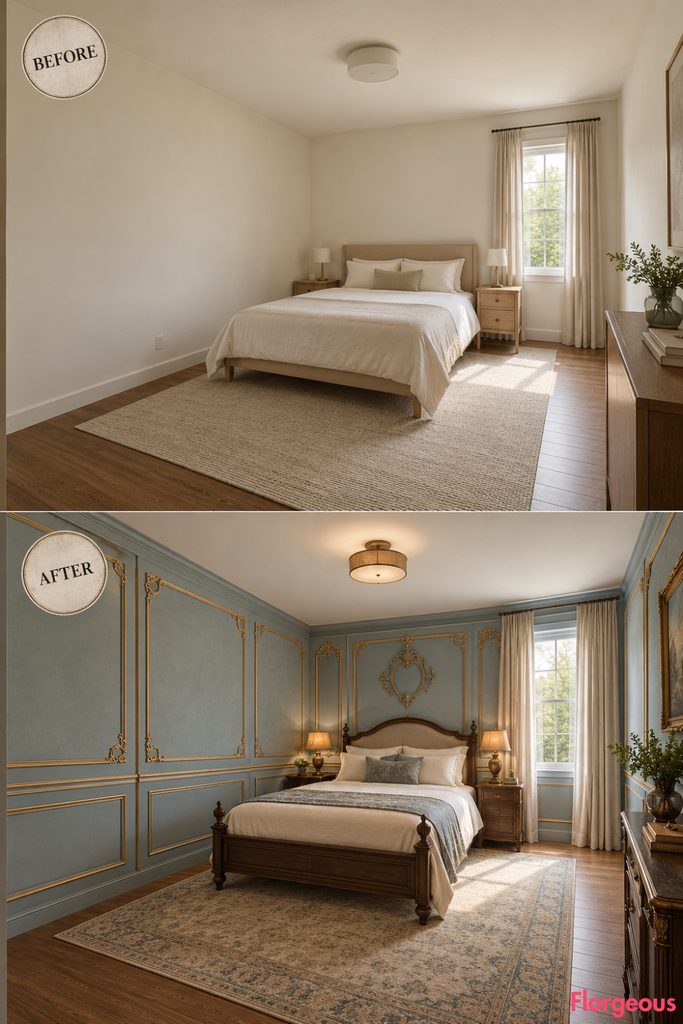
Before: The flat walls provide no rhythm or ceremonial structure.
After: The walls turn muted mineral blue and receive thin warm-gold surface-applied molding in large symmetrical frames. A small central cartouche above the bed ties the composition together. The bed stays dark and architecturally simple, with ivory linen, a low muted rug, bronze lamps and full-height neutral curtains at the far-wall window.
Why it works: This room feels graphic and formal, which makes it distinct from the soft plaster treatment in section 3.
14. Ground the Room With a Louis XIV Savonnerie-Style Carpet
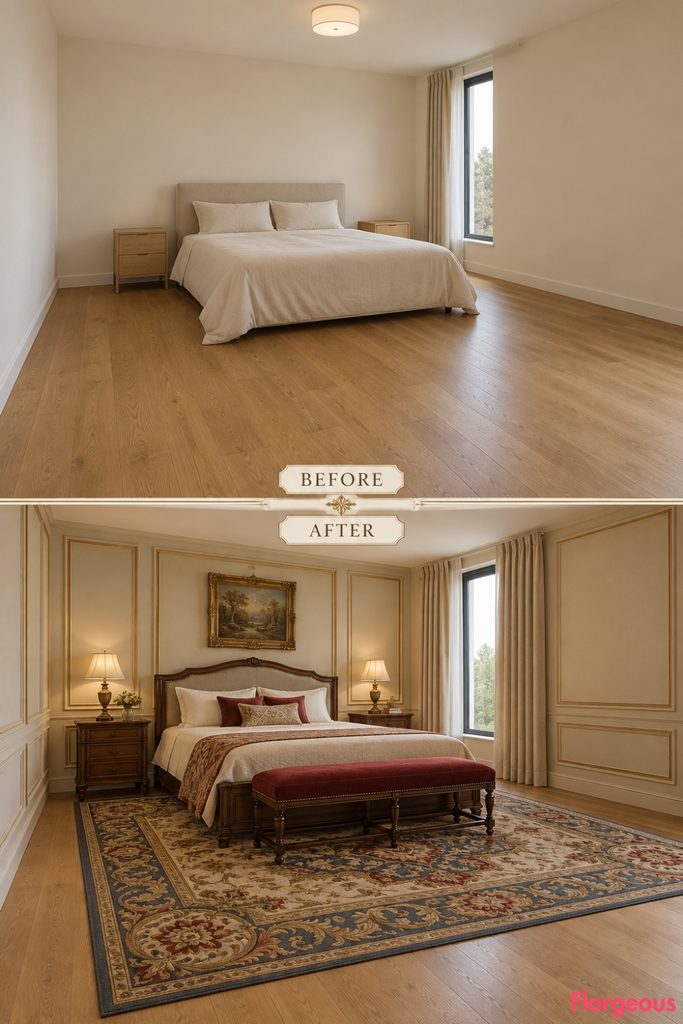
Before: The warm oak floor remains largely exposed, and the furniture seems to float in the room.
After: A large Savonnerie-inspired carpet beneath the lower portion of the bed becomes the hero. Formal floral medallions and scrolling acanthus borders use muted blue, olive, parchment and claret. At the foot of the bed sits a substantial walnut bench with turned legs and plain claret upholstery. The walls stay quiet, the bed stays relatively restrained and the curtains remain full-height but simple.
15. Create an Italian Marble Console Still Life
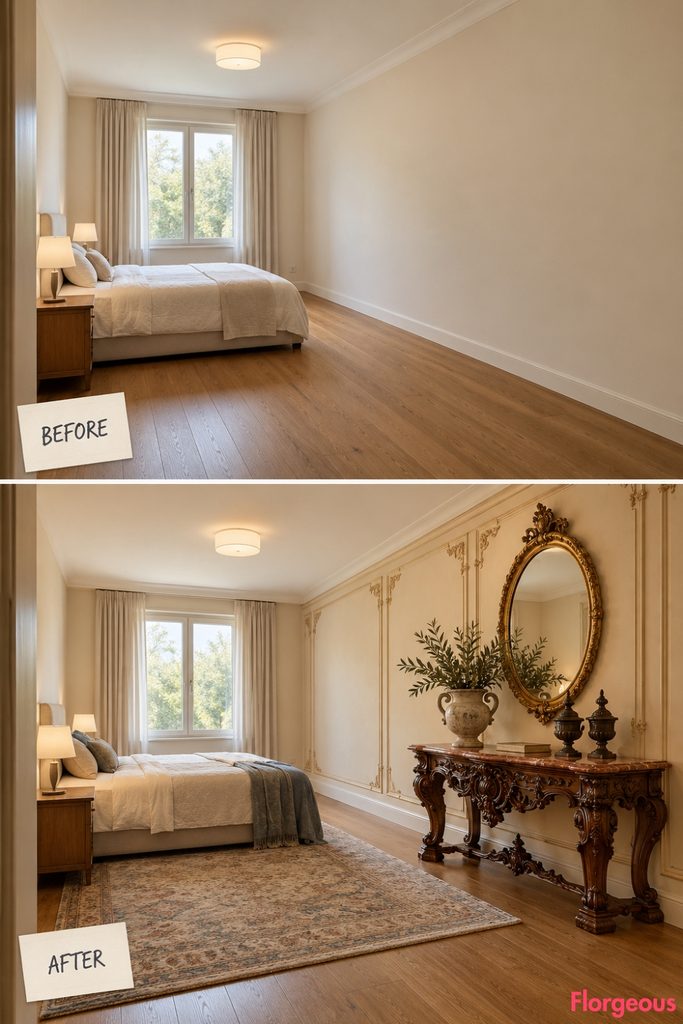
Before: A side wall remains visually empty and there is no decorative destination away from the bed.
After: A freestanding dark-walnut console with a deeply carved apron and architectural supports takes over that wall. A rosso-toned marble slab becomes the strongest accent. Above it hangs a modest oval gilt mirror. The console holds one large stoneware urn with scroll handles and two small dark-bronze objects, creating a controlled Baroque still life. The rest of the room stays warm in parchment, ivory and walnut.
Budget Version: A vintage console, a stone offcut and one oversized ceramic vessel can recreate the same hierarchy at a much lower cost.
16. Draw the Eye Up With a Carved Bed Crown
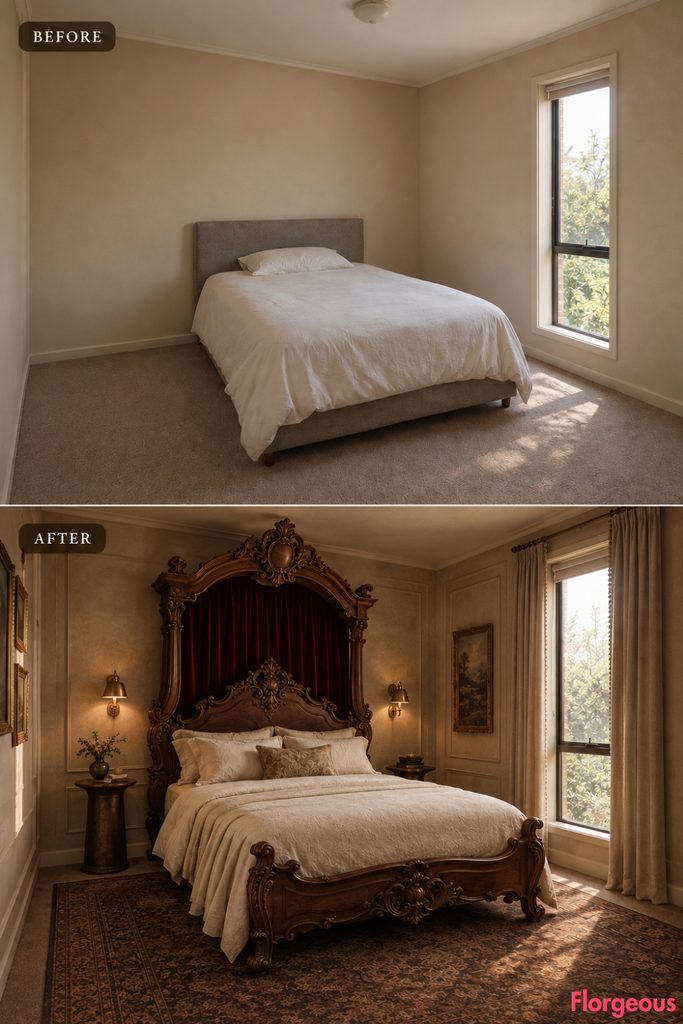
Before: A large area of blank wall remains above the low basic headboard.
After: The bed gains its own integrated decorative crown. Carved scrolls, acanthus leaves and one central cartouche rise above the headboard, while controlled claret textile falls behind the bed only. The room supports that gesture with warm stone walls, a dark rug, small bronze sconces, full-height neutral curtains and simple low bedside pieces.
Why it works: It adds height and ceremony without repeating the full tester-bed silhouette from section 6.
17. Finish With a Dark Chiaroscuro Baroque Chamber
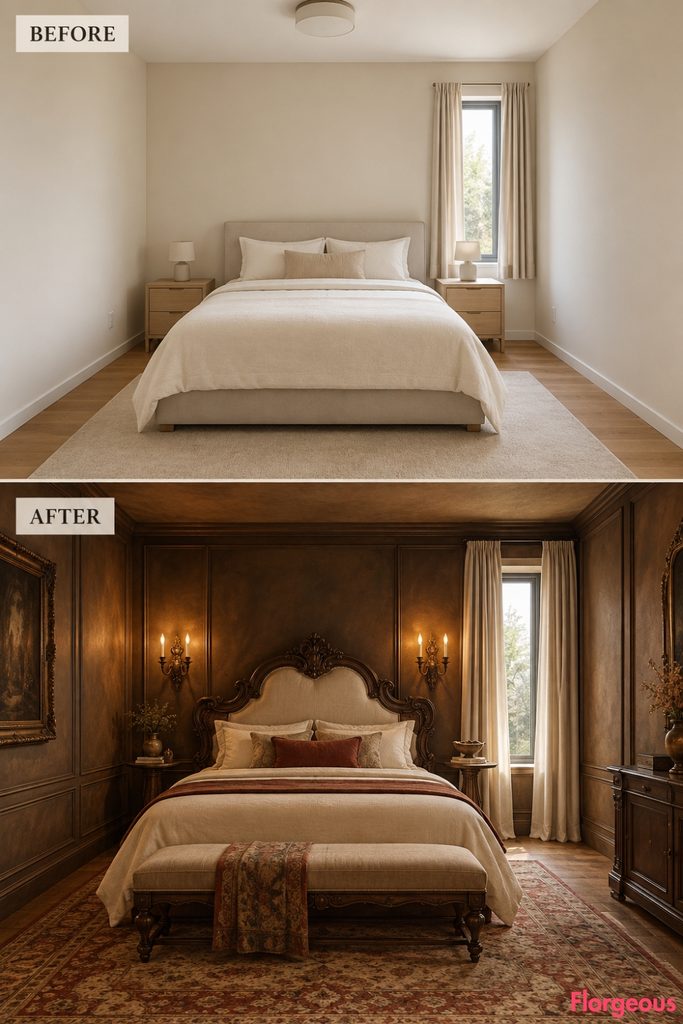
Before: Soft natural daylight spreads evenly across warm off-white walls and simple furniture.
After: The room becomes a dark theatrical chamber using deep warm umber walls rather than another bright jewel tone. A substantial walnut bed with broad carved scroll shoulders and a parchment upholstered center anchors the far wall. Compact bronze candle-style sconces create concentrated pools of warm light. Cream bedding, a faded parchment-and-rust carpet and heavy but plain ivory curtains keep the room from turning muddy.
There is almost no gilding here. The drama comes from carved mass, shadow and contrast.
How to Keep a Baroque Bedroom True to the Style Without Repeating the Same Look
The biggest mistake with this style is assuming Baroque always means the same palette and the same furniture. It does not.
One room can feel Italian and sculptural through carved walnut and split pediments. Another can feel French and courtly through symmetry, damask and formal carpet. A third can lean Spanish through tooled leather and earthy weight. Others can become architectural, tapestry-led, lighting-led, drapery-led or writing-chamber-led.
That is why the strongest Baroque Bedroom designs begin with a very specific historical mood rather than a generic “old world luxury” recipe. Choose whether you want the room to feel carved, textile-rich, pale and stuccoed, formal and gilded, dark and theatrical, or grounded by furniture and art objects. Then let the rest of the room support that choice.
Just as importantly, keep the shell believable. Preserve the real window, keep the entry clear, use full-depth furniture where storage is required and treat flat walls as flat walls. When the architecture still makes sense, the ornament feels far more convincing.