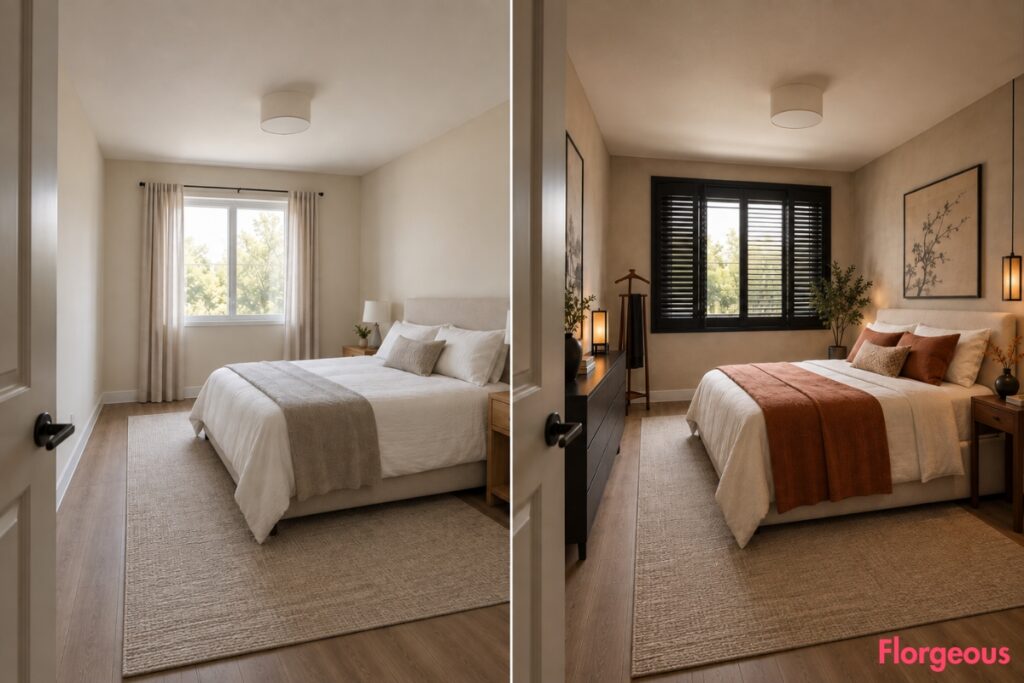
Start with one bedroom that could belong almost anywhere: warm off-white walls, a basic rectangular bed, neutral bedding, two bare nightstands, short plain curtains, ordinary flooring and very little styling.
Then keep returning to that same room.
These 21 Asian Bedroom makeovers do not depend on repeating low beds, beige timber and predictable decorative motifs. Instead, each AFTER develops a different furniture composition alongside its own material language, color story, storage strategy and focal point.
Some rooms feel light and crafted, others saturated, polished, graphic or tactile. What connects them is not a collection of obvious symbols, but thoughtful proportion, useful furniture and design traditions interpreted in a contemporary bedroom.
1. Filter Daylight Through Patchwork Ramie
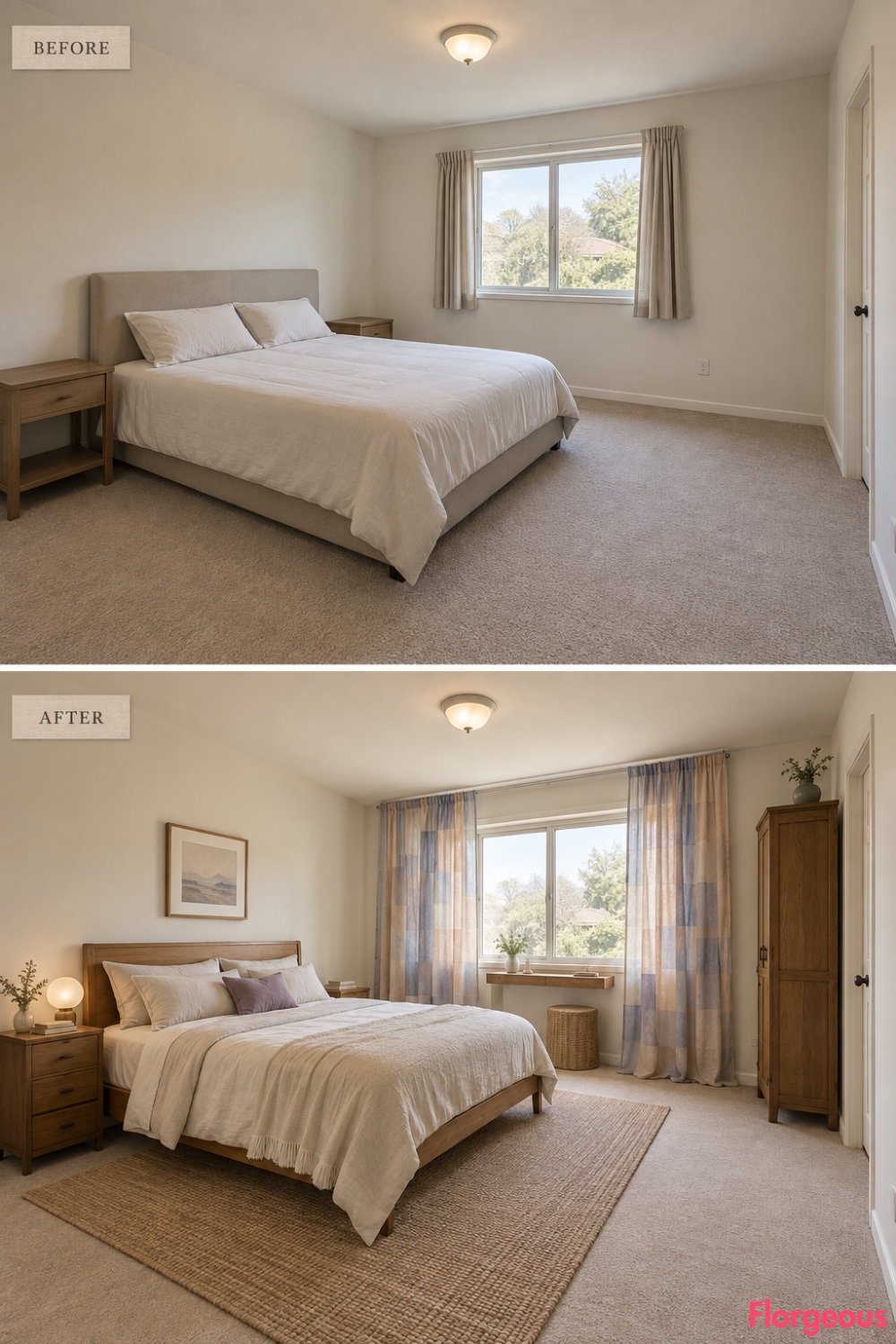
Translucent fabric becomes the starting point, but the furniture gives the room enough structure to feel finished.
Before: The plain bedroom has a basic bed, two bare nightstands, short neutral curtains and no useful storage beyond the bedside pieces.
After: A honey-elm bed moves rear-left. Full-height patchwork ramie curtains combine smoke blue, apricot, ivory and muted lavender. A slim three-drawer bedside unit sits beside the bed, while a tall narrow elm clothes press occupies the right wall. Near the window, a small woven-seat stool tucks beneath a shallow dressing ledge.
Designer Tip: Let the curtains carry the color variation and keep larger furniture in one timber family.
2. Replace the Rug With a Seamed Rush Floor
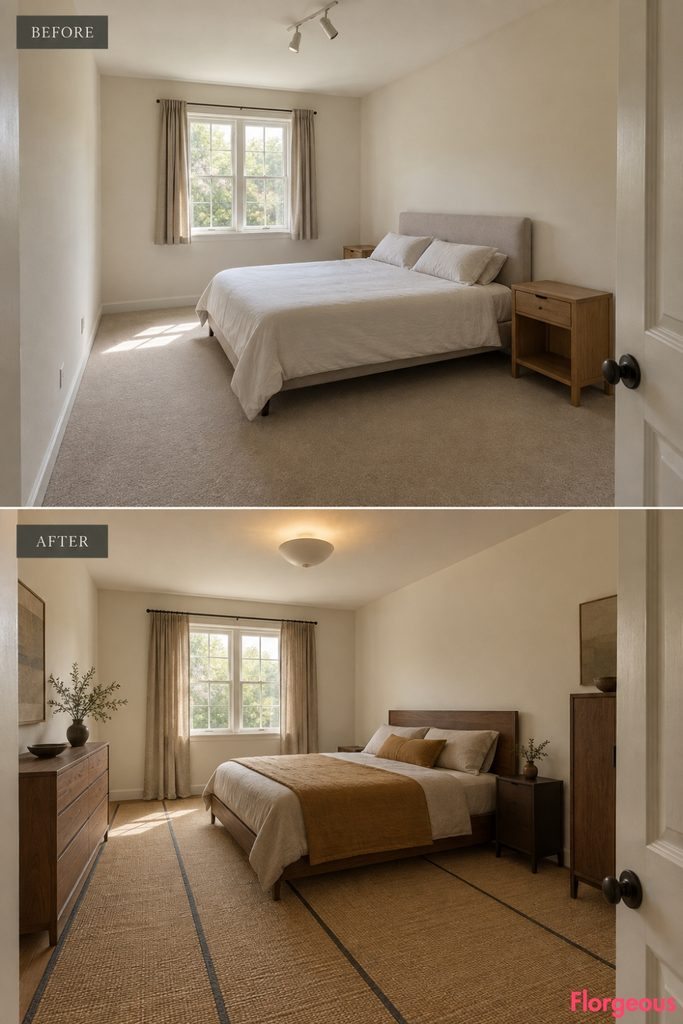
Here, the floor becomes architectural, but it is supported by a stronger furniture plan.
Before: Ordinary flooring leaves the basic bed and twin nightstands floating in an otherwise unfinished room.
After: Wall-to-wall woven rush flooring is divided by narrow charcoal textile seams. A walnut bed sits rear-center with one dark bedside cabinet. A broad low walnut clothes chest occupies the left wall, while a compact upright cabinet on the right provides folded storage without crowding the window.
Flax bedding and muted ochre give the darker furniture warmth.
3. Give the Window Satin-Black Lacquer Shutters
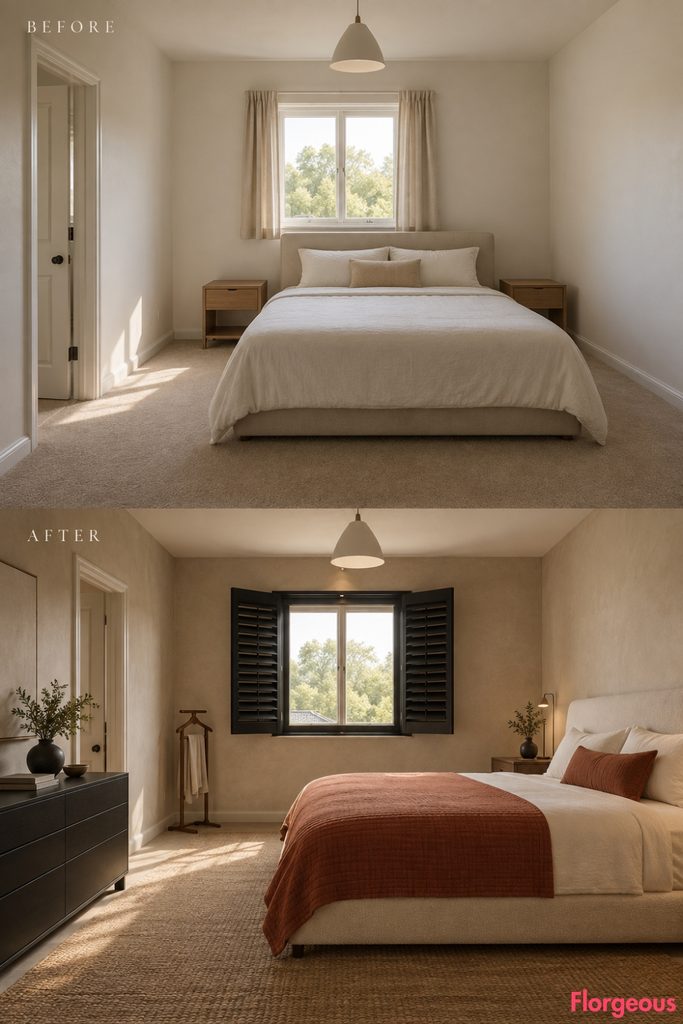
The existing window becomes graphic, while low furniture reinforces the horizontal lines.
Before: Short curtains, two lightweight nightstands and a generic bed make the room feel visually disconnected.
After: Satin-black lacquer pivot shutters fit the existing window. An ivory upholstered bed sits slightly right of center with one slim walnut bedside table. A long, low black-lacquer clothes chest occupies the left wall, balanced by a freestanding walnut valet stand near the dressing side of the bed.
Pale limestone walls and persimmon bedding keep the black lacquer from becoming severe.
4. Let a Hemp-Laced Bed Show Its Construction
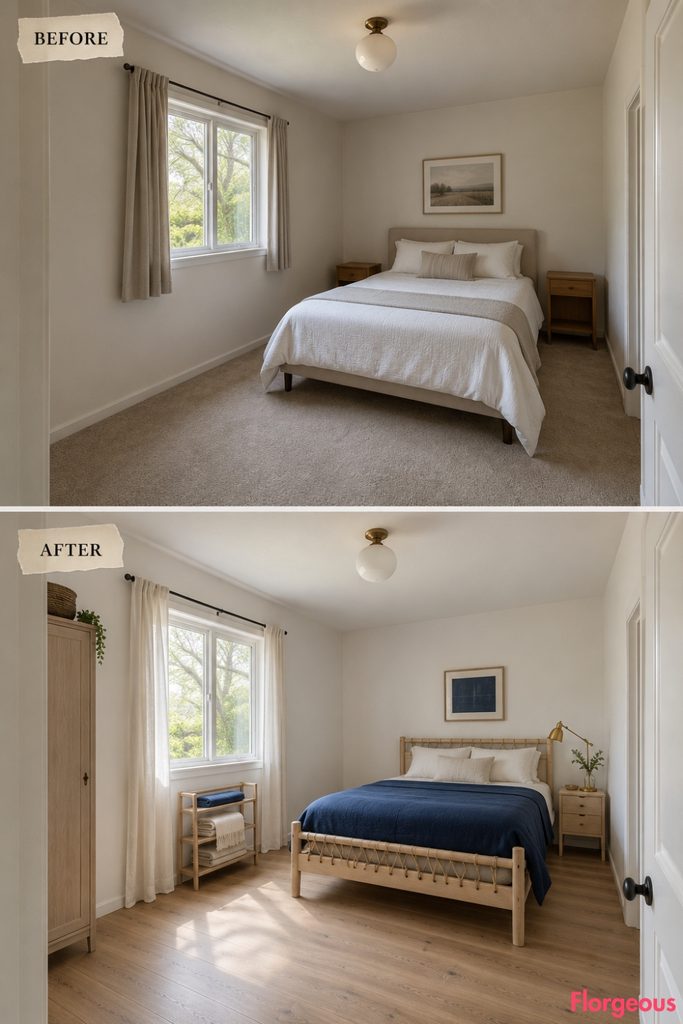
Furniture craftsmanship becomes the character of the room rather than applied decoration.
Before: The generic rectangular bed, two bare nightstands and plain surfaces have no material identity.
After: A pale-ash bed sits rear-right with tightly tensioned hemp lacing visible across the side and foot rails. A small ash drawer table serves the bedside, while a shallow tall ash clothes press sits against the left wall. Beneath the window, a compact open ash rack stores folded blankets.
Chalk-white walls and an indigo blanket keep the woven construction easy to see.
5. Wrap the Walls in Flat Tea-Rose Raw Silk
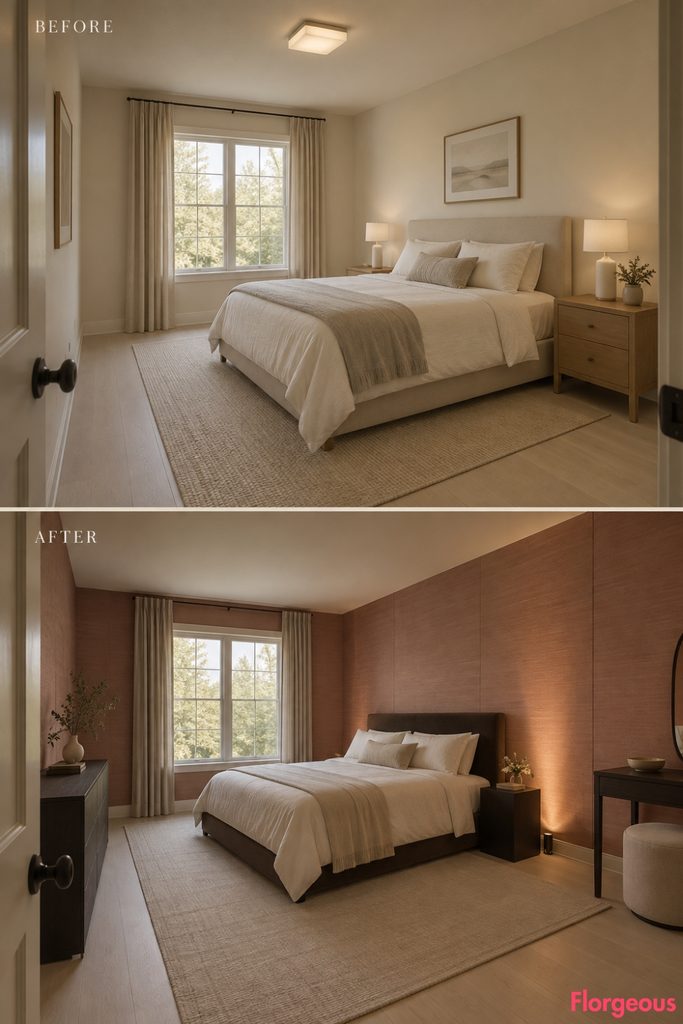
The walls provide softness, while dark, finely scaled furniture stops the room from feeling empty.
Before: Painted walls, bare nightstands and minimal furniture make the room feel thin and unfinished.
After: Flat muted tea-rose raw silk panels cover every visible wall. A straight dark-timber bed anchors the rear center, accompanied by a black bedside cube. On the right wall, a slender dark dressing table includes two shallow drawers and a small tuck-under stool. A low dark clothes cabinet occupies the opposite wall without reaching the window.
Ivory bedding and a pale floor lighten the room.
Style Note: The wall fabric should be stretched flat, not tufted or padded like a luxury hotel headboard.
6. Use Capiz Panels as Closet Fronts
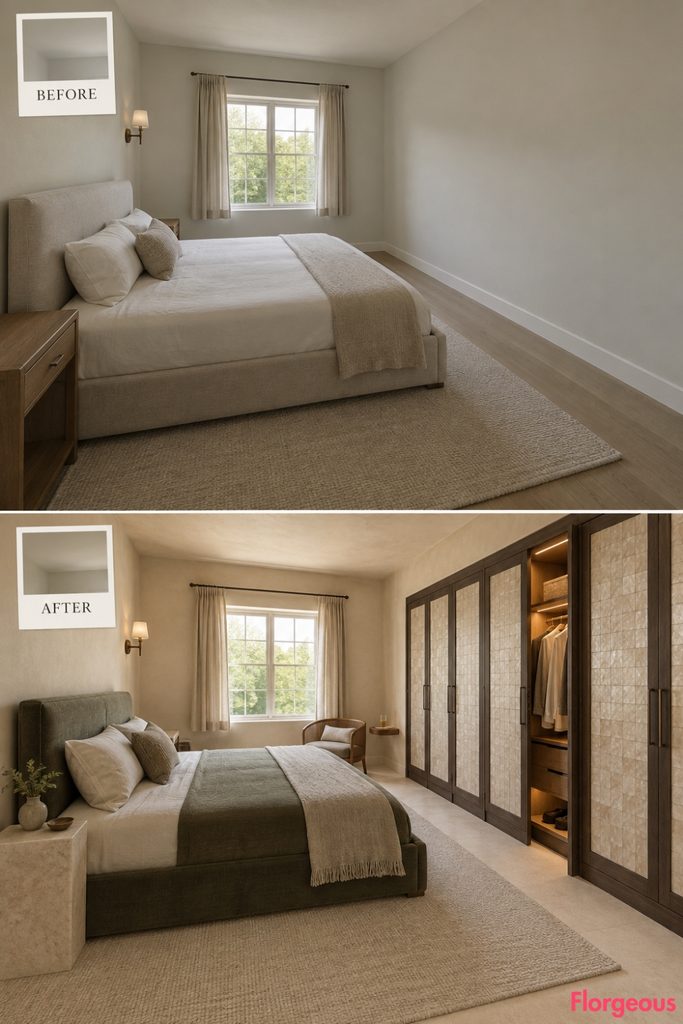
The wardrobe becomes a major architectural surface, while softer furniture keeps the bedroom livable.
Before: The plain room relies on small freestanding pieces and has no coherent clothes-storage zone.
After: Dark timber frames hold natural capiz closet doors along the right wall. A muted forest-green upholstered bed moves rear-left, with one low limestone bedside pedestal. A compact curved teak reading chair occupies the far-left corner near the window, paired with a tiny solid-wood drink ledge attached to the wall.
The chair creates a usable second zone without interrupting circulation.
7. Swap the Timber Bed for Burnished Copper
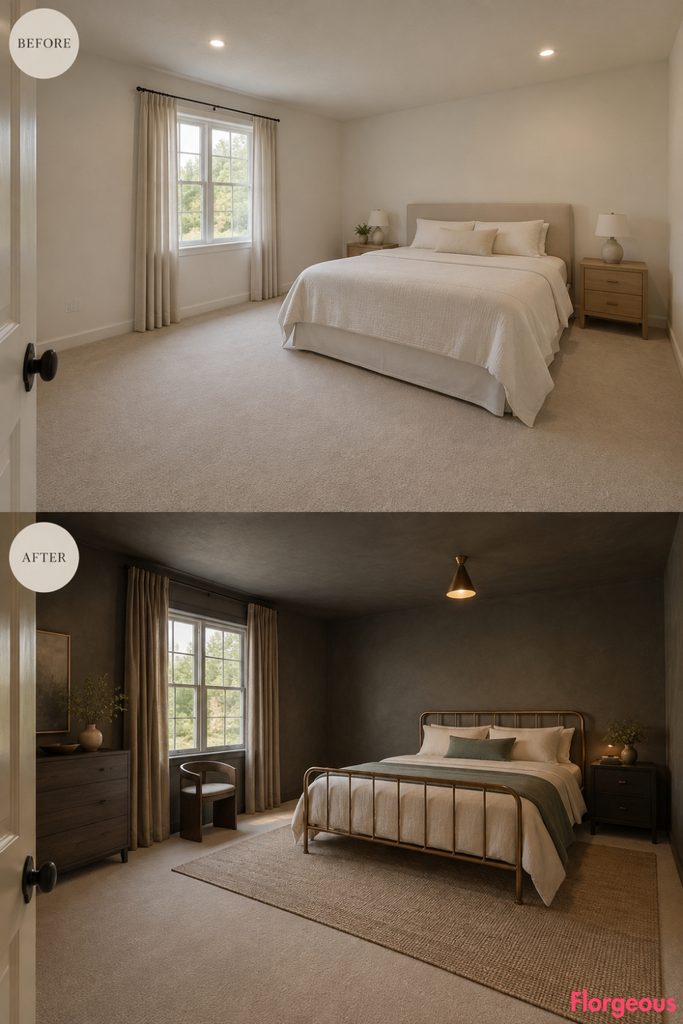
This room uses metal as actual furniture rather than a decorative finish.
Before: Warm neutral walls and a generic timber bed blend together without a strong silhouette.
After: A slim tubular burnished-copper bed stands rear-right against charcoal mineral plaster. A smoked-oak three-drawer dresser sits along the left wall, while one blackened-wood bedside drawer provides closed storage. Near the window, a compact curved dark timber chair creates a place to dress.
Cream linen and faded jade soften the darker shell.
Try this: Keep surrounding furniture matte so the copper bed remains the single reflective hero piece.
8. Put the Pattern Entirely Into the Curtains
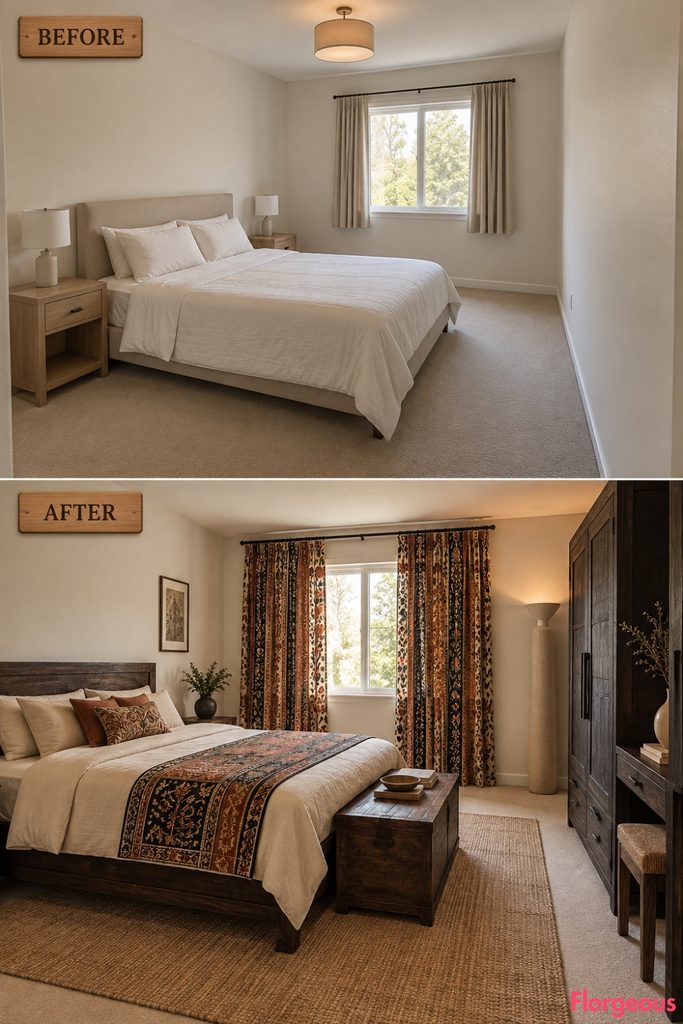
Pattern stays concentrated at the window, while the furniture composition is dark and practical.
Before: Short plain curtains barely affect the room, and the bed is flanked by two generic nightstands.
After: Full-height cotton curtains carry broad saffron, black, faded-rust and natural-cream bands. A dark mango-wood bed runs along the left wall. At its foot sits a low mango blanket chest, while a narrow black timber cabinet against the opposite wall stores clothing vertically.
A simple backless timber dressing stool slides beneath the cabinet’s projecting lower shelf.
9. Let One Oversized Shibori Quilt Carry the Room
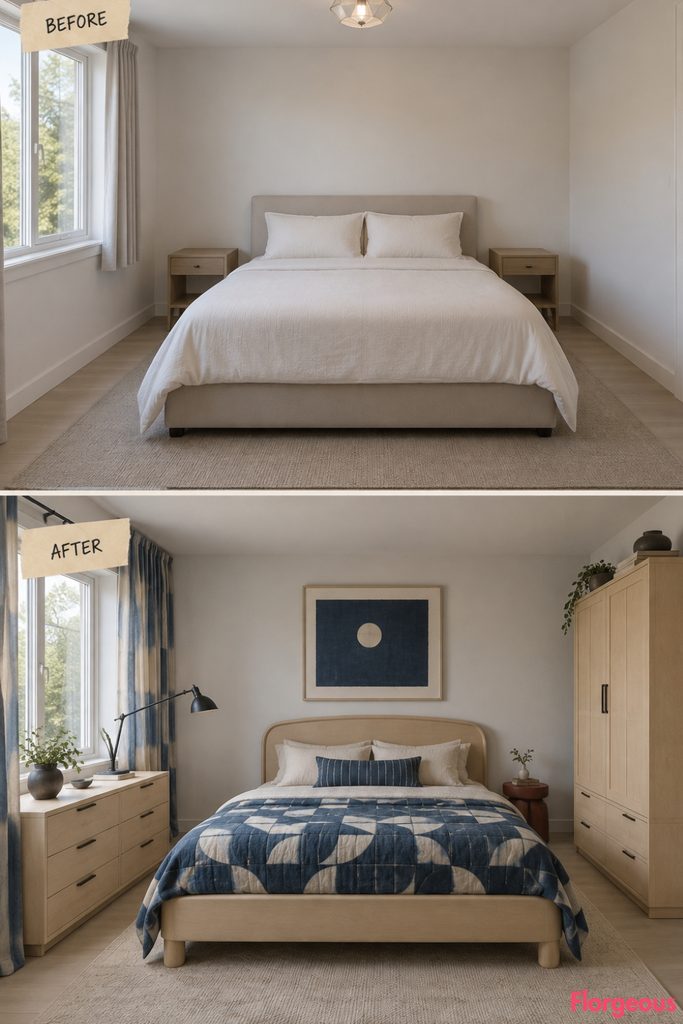
The quilt stays dominant, but the rest of the furniture is still functional.
Before: Neutral bedding and identical nightstands give the bed no visual hierarchy.
After: A softly curved pale-maple bed carries an oversized indigo resist-dyed quilt. A low pale-maple drawer cabinet fits beneath the window, while a tiny cinnabar stool works as an intentionally contrasting bedside piece. On the right wall, a tall shallow maple cupboard provides enclosed storage without adding another dark element.
Gray-white walls keep the saturated textile crisp.
10. Put Aubergine Gloss Underfoot
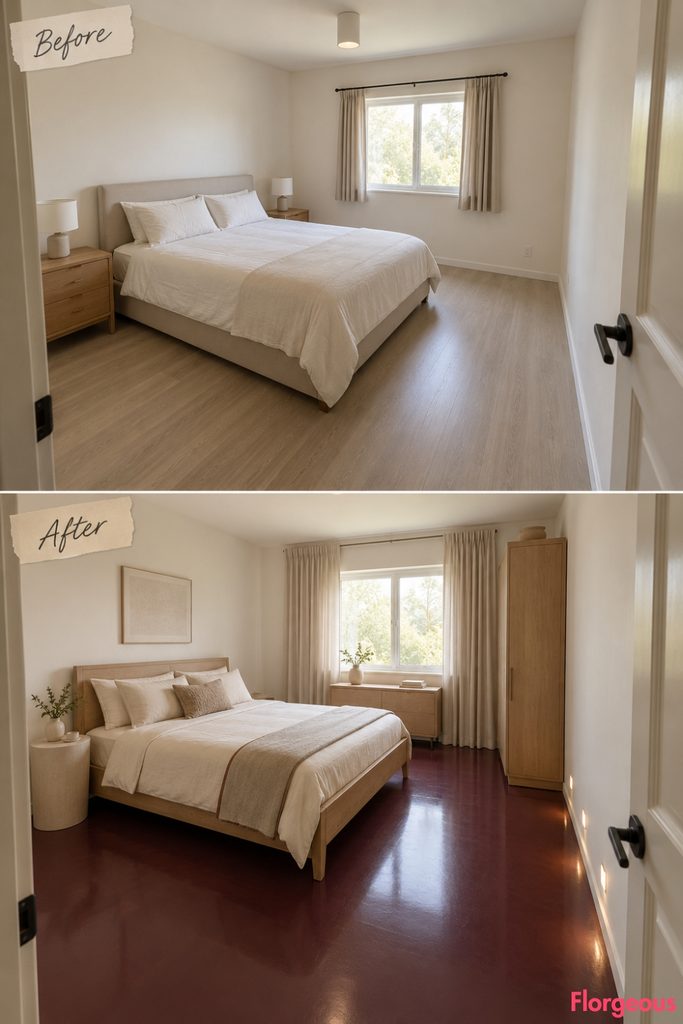
The saturated floor now supports a furniture composition with strong pale silhouettes.
Before: Ordinary flooring and generic furniture give the bedroom no visual anchor.
After: A glossy aubergine floor stretches wall to wall. A pale-oak bed sits rear-left with one cylindrical pale bedside pedestal. A tall narrow pale-oak wardrobe stands against the right wall, while a low rectangular oak storage chest sits below the window.
Because every major furniture piece is pale, the floor remains visually dominant without leaving the room under-furnished.
Color Story: Limit dark accents above floor level so the aubergine surface keeps its impact.
11. Split the Walls Between Pebble Wash and Smooth Plaster
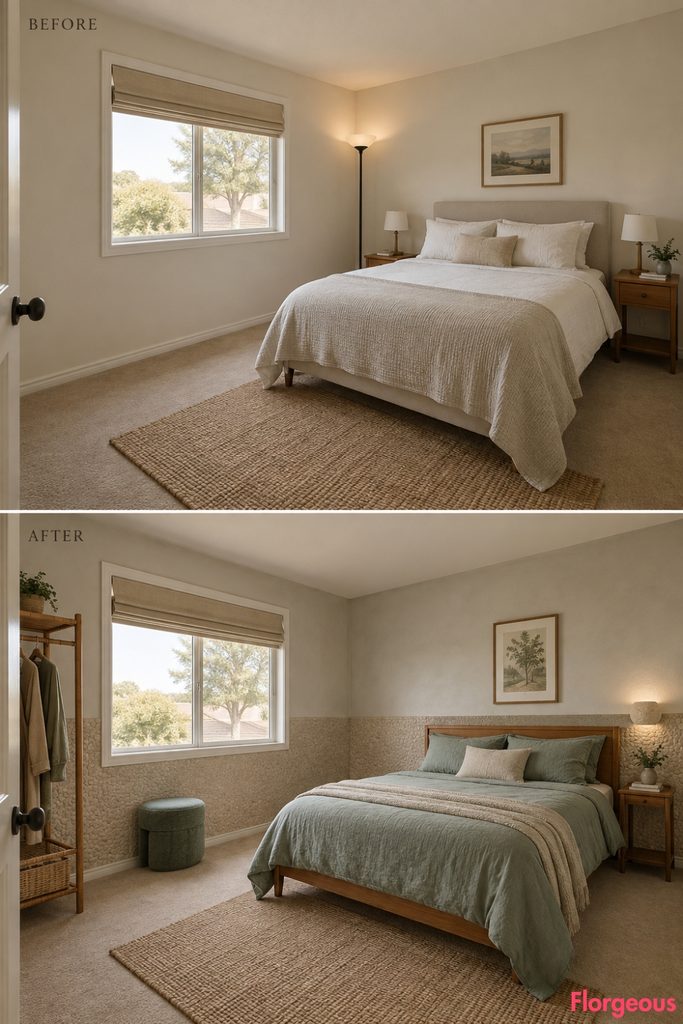
The wall treatment becomes more convincing once the furniture echoes its earthy weight.
Before: Uniform neutral paint, generic furniture and bare surfaces make the room feel flat from floor to ceiling.
After: Pebble wash wraps the lower 70 centimeters of the walls, with smooth pale-gray plaster above. A warm teak bed sits rear-right beside one narrow teak bedside table. Against the left wall, an open teak clothes rack combines a hanging rail with a woven lower shelf. A short sea-green upholstered dressing stool sits beneath the window.
Sea-green bedding connects the furniture zone to the cooler plaster.
12. Wash the Entire Room in a Smoky Ink Gradient
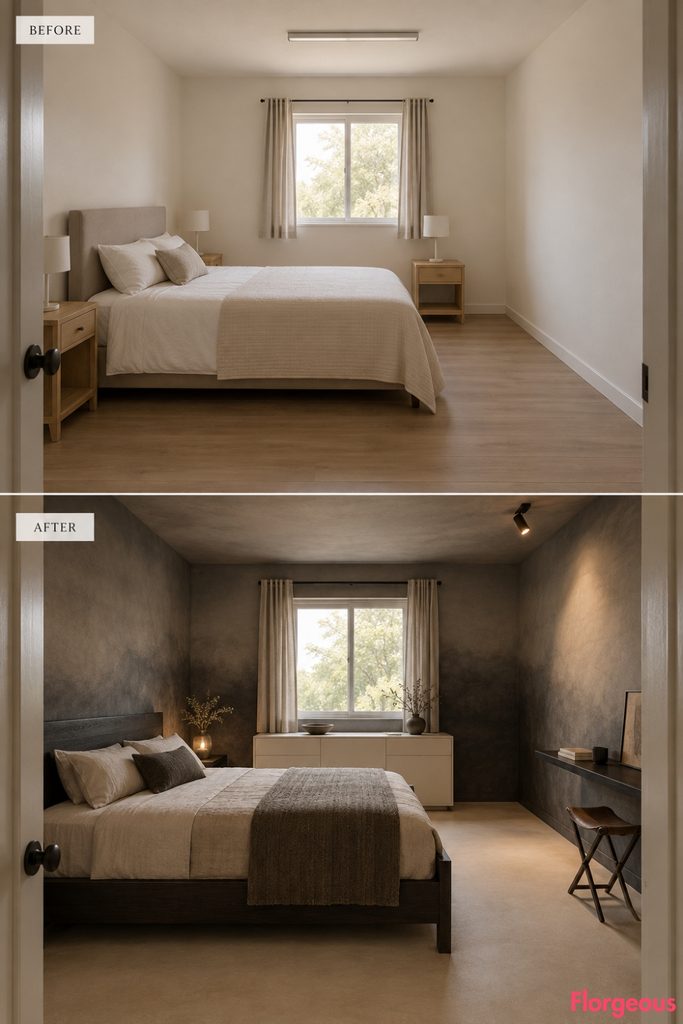
The atmospheric wall finish is paired with a crisp black furniture system.
Before: Warm-neutral paint remains visually identical from skirting to ceiling, with the bed and nightstands arranged conventionally.
After: Plaster fades from pale stone at floor level into smoky blue-gray and then pale mist toward the ceiling. A simple black-oak bed sits left of center. One ivory cabinet beneath the window breaks the dark furniture, while a narrow black writing shelf runs along the right wall with a small saddle stool tucked fully underneath.
Flax bedding keeps the room relaxed.
13. Give Mother-of-Pearl Inlay One Serious Job
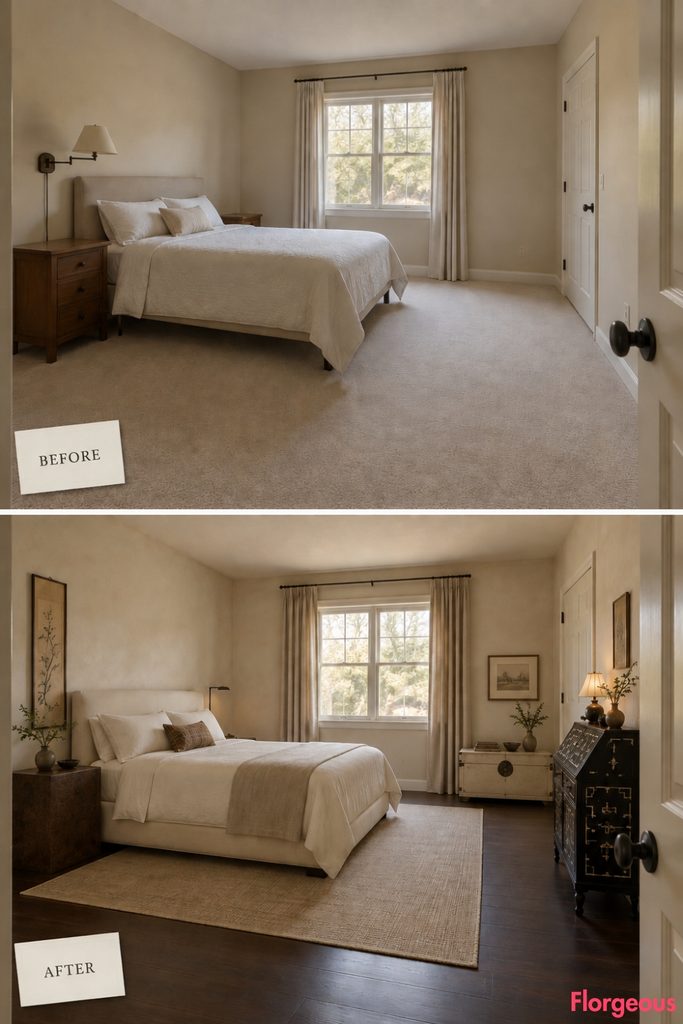
A detailed bureau becomes part of a complete but restrained furniture arrangement.
Before: Two empty nightstands provide basic storage but nothing worth looking at.
After: A compact black lacquer writing bureau with sparse mother-of-pearl geometric inlay occupies the right wall. A simple cream upholstered bed sits rear-left with one tobacco-colored bedside block. At the foot-side wall, a low cream-painted luggage chest provides blanket storage without competing with the bureau.
The rest of the room stays warm ivory and deliberately undecorated.
Common Mistake: Repeating intricate inlay across the bed, wardrobe and tables would make the craftsmanship feel less special.
14. Draw a Stone Mosaic Line Around the Floor
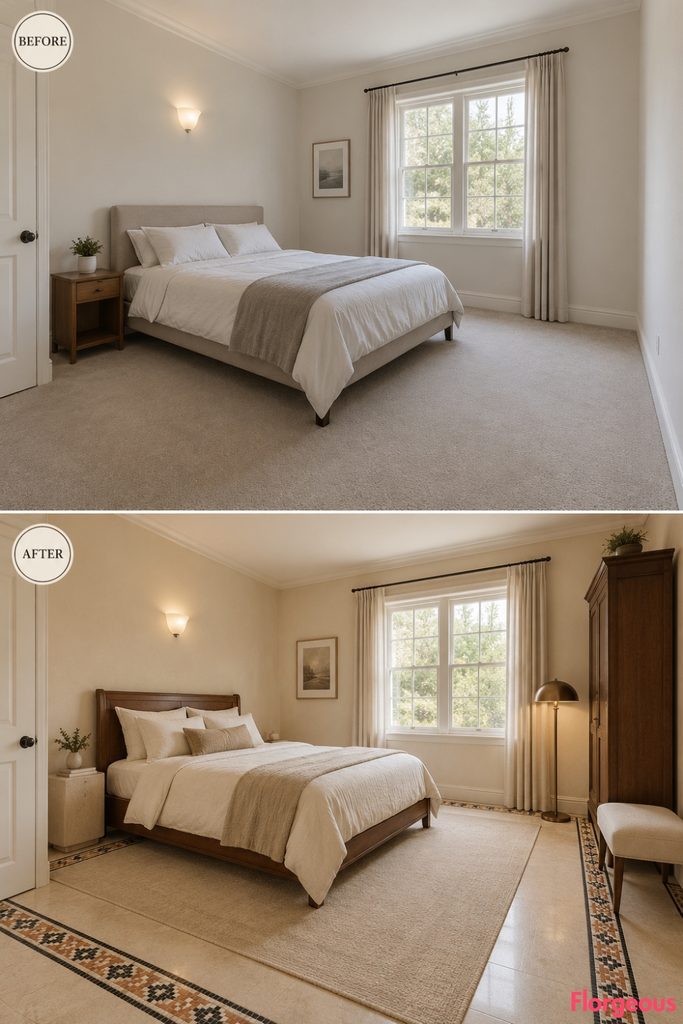
Furniture placement is deliberately pulled away from parts of the perimeter so the crafted edge remains visible.
Before: Uninterrupted ordinary flooring disappears beneath the generic bed and twin nightstands.
After: Black, terracotta and cream stone tesserae form a narrow border around the room edges. A chestnut bed sits rear-left with one low cream bedside table. A tall narrow chestnut armoire occupies the right wall, while a slender upholstered dressing seat rests near its end rather than in the main walkway.
The center of the original floor remains completely visible.
15. Turn the Existing Trim Into a Cinnabar Outline
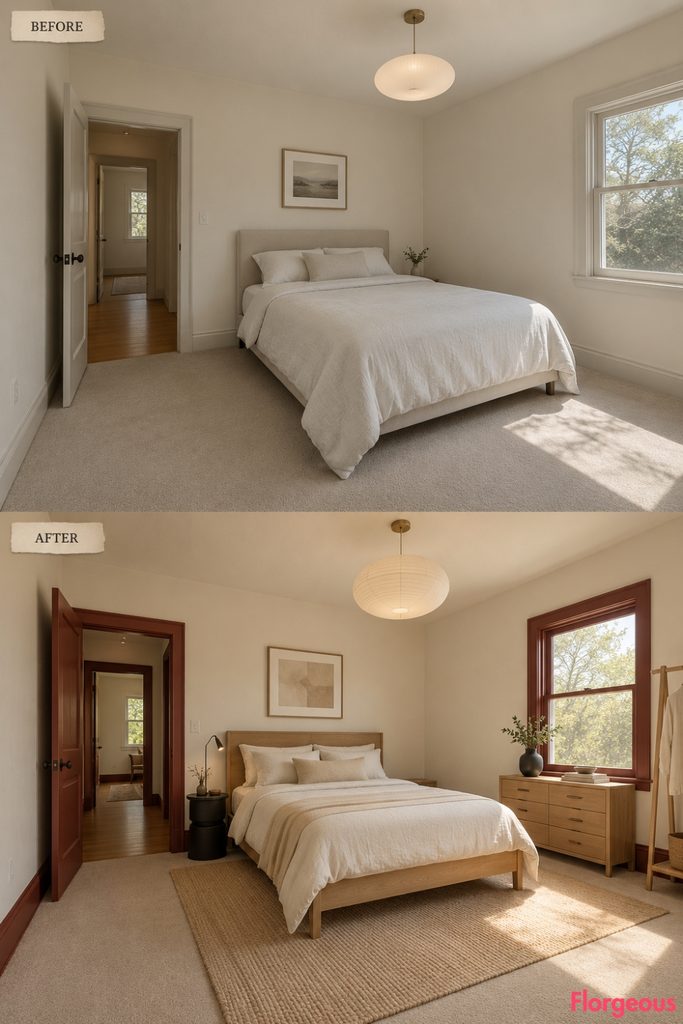
A restrained furniture palette lets the architectural color remain legible.
Before: Door casing, skirting and window trim disappear into the same warm-neutral shell as the generic furniture.
After: Deep cinnabar lacquer traces the existing doorway, skirting and window casing. A pale-oak bed sits rear-center with one black bedside table. Beneath the window, a low pale-oak drawer chest provides clothing storage, while a narrow freestanding oak garment stand occupies the opposite side.
Cream bedding and natural flooring leave the red outline uninterrupted.
16. Make White Porcelain Function as Bedside Furniture
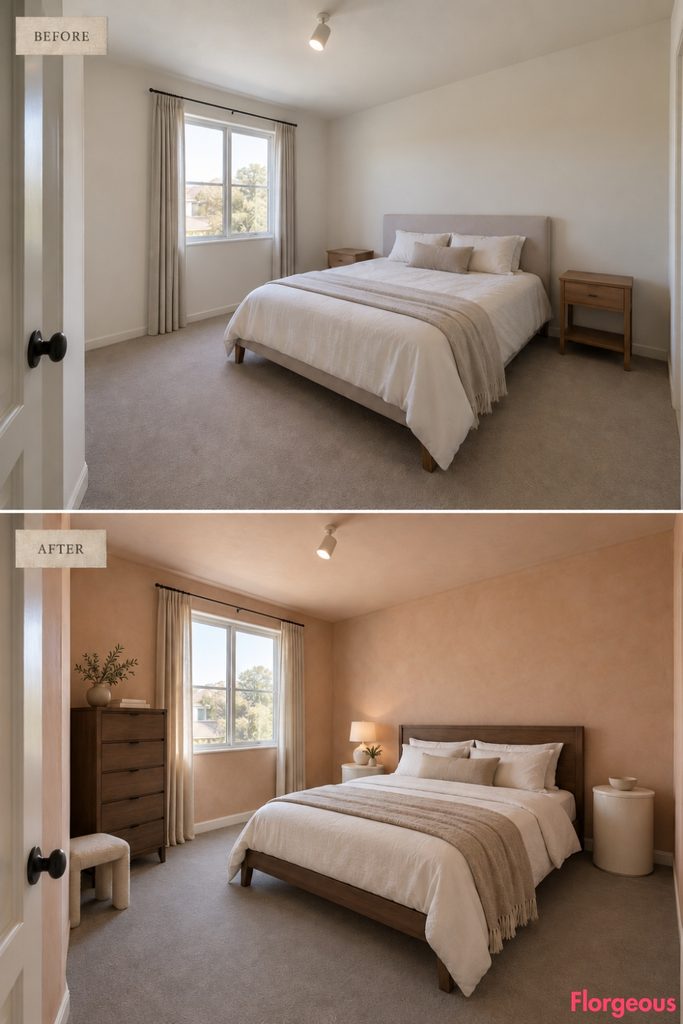
The ceramic pieces now sit within a more substantial dark-wood ensemble.
Before: Two lightweight generic nightstands create symmetry but little character.
After: A smoked-oak bed sits rear-right between two substantial white porcelain drum tables with genuinely usable flat tops. A tall smoked-oak five-drawer chest occupies the left wall, while a narrow upholstered dressing stool fits beside it without projecting into the main route.
Dusty-peach plaster adds warmth around the black-and-white furniture contrast.
17. Give a Dresser a Woven Tambour Front
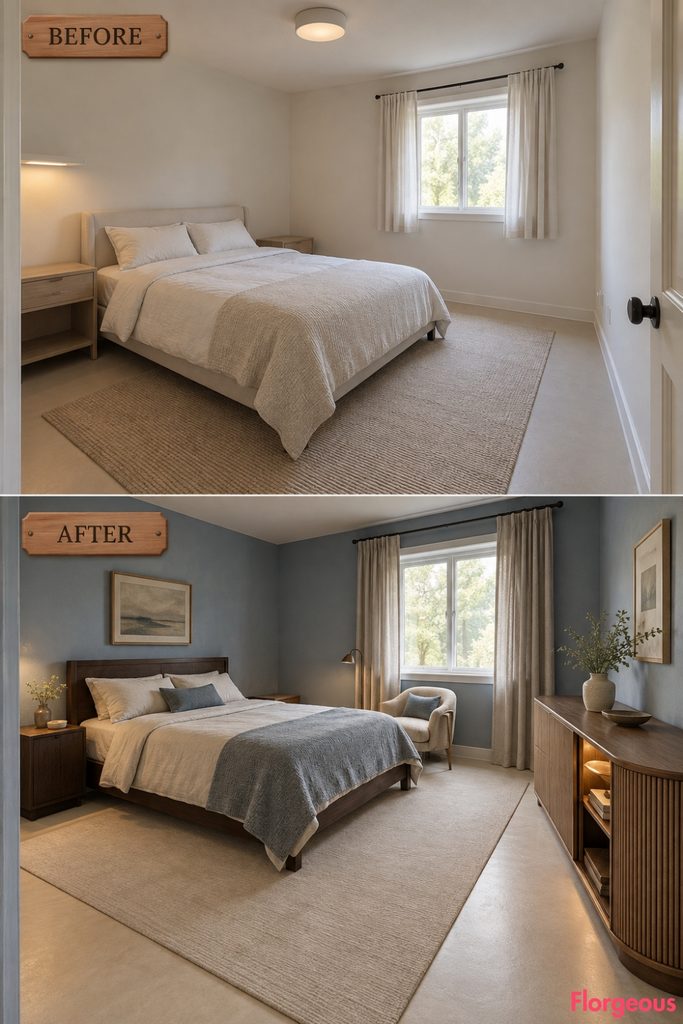
The dresser is the special piece, but the rest of the room now supports everyday use.
Before: Generic drawer furniture and paired nightstands consume wall space without creating a coherent arrangement.
After: A long rounded dresser on the right wall uses a woven-rattan tambour front that rolls upward. A dark timber bed sits rear-left with one compact square bedside cabinet. Near the window, a small upholstered reading chair faces diagonally toward the bed, with enough clearance to use the dresser comfortably.
Muted dusty-blue walls make the woven storage stand out.
Small Space Tip: Tambour fronts work especially well where ordinary hinged doors would conflict with a chair or narrow walkway.
18. Conceal Open Clothing Storage With Copper Mesh
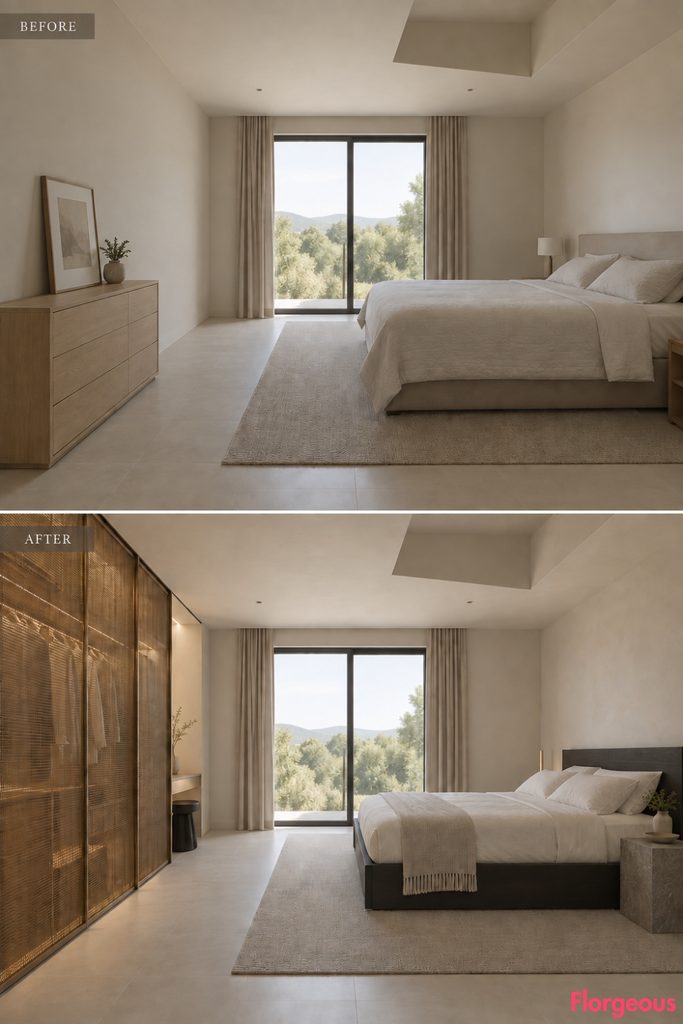
The flexible storage enclosure becomes part of a practical dressing side of the room.
Before: The neutral room has no dedicated wardrobe zone beyond its generic freestanding pieces.
After: A shallow open clothes rail runs along the left wall behind a floor-to-ceiling fine copper-mesh sliding curtain. An ebonized timber bed sits rear-right beside a low gray-stone bedside plinth. At one end of the clothes rail, a small black dressing stool tucks underneath a fixed shelf.
Stone-white plaster prevents the metallic mesh from making the room feel dark.
19. Upholster the Main Furniture in Coarse Khadi
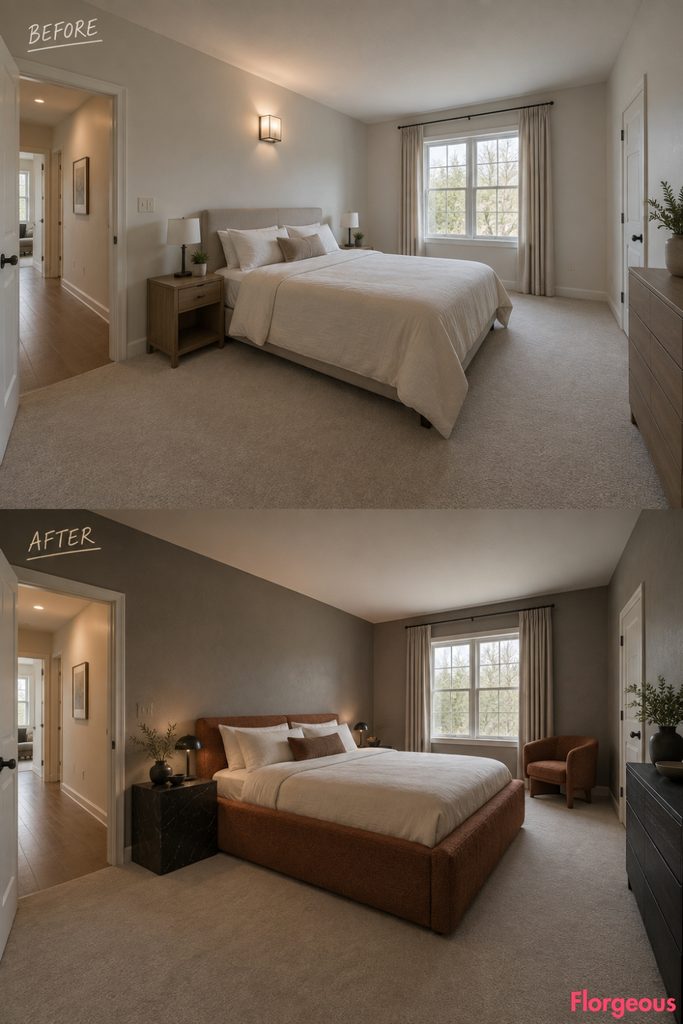
The textile language extends across several related pieces without turning into a matched furniture suite.
Before: Smooth neutral surfaces leave the generic bed and nightstands without texture or hierarchy.
After: A broad bed upholstered in coarse rust-colored khadi anchors the rear wall. One compact khadi-covered chair sits near the window, while a polished black stone block serves as the bedside surface. Across the room, a low black timber drawer chest provides closed clothing storage and visually links to the stone.
Chalk-gray walls and plain ivory sheets keep the handloom texture dominant.
20. Make Peach Lacquer Sharp With Indigo
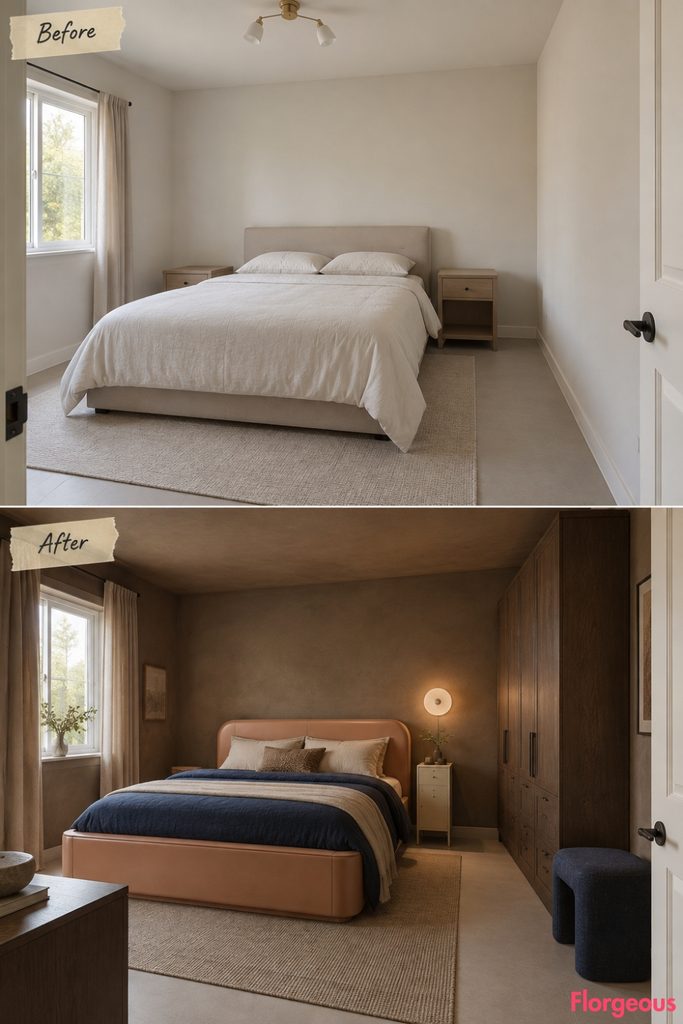
The curved bed is balanced by furniture with straighter industrial lines.
Before: Warm walls and an ordinary timber bed merge into one generic neutral composition.
After: A softly rounded peach-lacquer bed sits rear-left against smoky-brown plaster. A narrow cream-painted steel bedside unit gives the bed a sharper counterpoint. On the right wall, a tall smoked-oak cabinet provides clothing storage, while a low indigo-upholstered stool sits nearby as a practical dressing seat.
Deep-indigo bedding ties the smaller seat back to the bed.
Color Story: Peach looks far less sugary once it is placed beside indigo, smoky brown and dark oak.
21. Finish With a Rice-Straw Plaster Ceiling
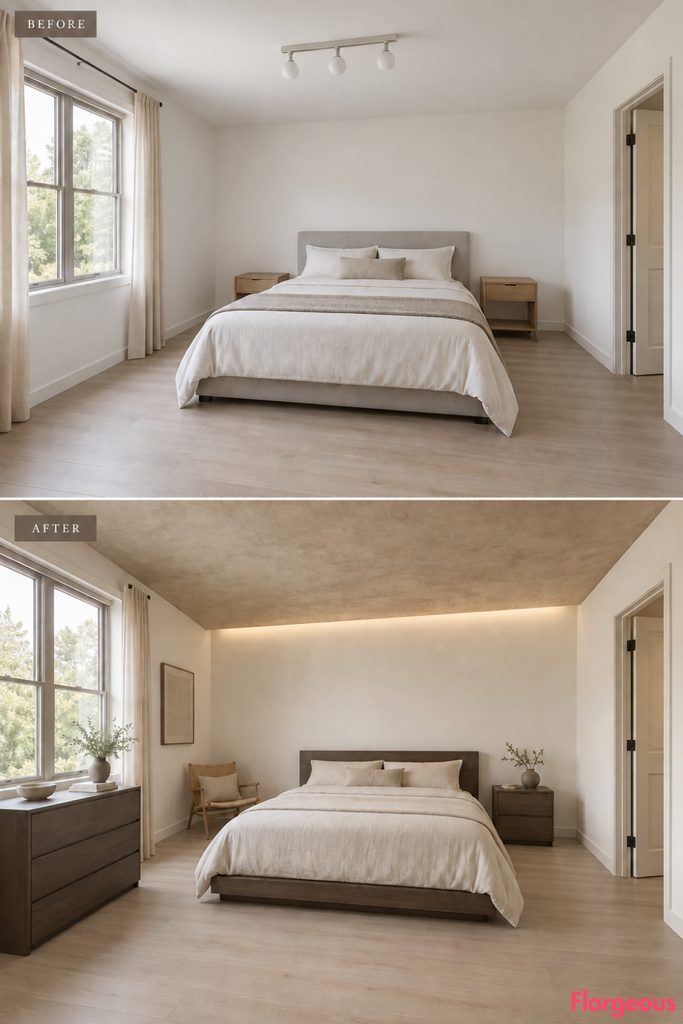
The ceiling becomes the unexpected finish, but the room below still functions as a complete bedroom.
Before: A plain white ceiling, generic bed and two bare nightstands leave the room with no hierarchy above or below eye level.
After: Warm ochre-gray rice-straw plaster covers the existing ceiling, with short natural fibers subtly visible in the surface. A low smoked-ash bed sits rear-center beside one asymmetrical drawer table. Beneath the window is a freestanding smoked-ash chest of drawers, while a pale woven lounge chair occupies the far-left corner with enough clearance to sit comfortably.
Cool ivory bedding and chalk-white walls keep attention on the ceiling texture.
Choose the Design Move Before You Buy the Decor
The most convincing transformations in this collection combine a distinctive material idea with a room that still works properly. The patchwork curtains belong to a bedroom with real clothing storage and a dressing ledge. The silk walls surround a usable dressing table. The capiz doors form an actual wardrobe. The woven tambour piece solves a clearance problem instead of existing only for decoration.
That is a useful way to approach an Asian Bedroom in your own home.
Start with the practical furniture you need. Decide where clothes, bedding and everyday objects will actually go, then choose one stronger design move that gives the room its personality.
Also pay attention to visual weight. A copper bed can handle a dark dresser, but it does not need five other metallic objects. Bold curtains benefit from quiet bedding. Two porcelain bedside tables already make a statement, so the larger chest can stay simple.
Choose the bed silhouette and the main storage strategy first. Once those two pieces work with the doorway, window and circulation, layer in the material, color and lighting that give the room its identity.