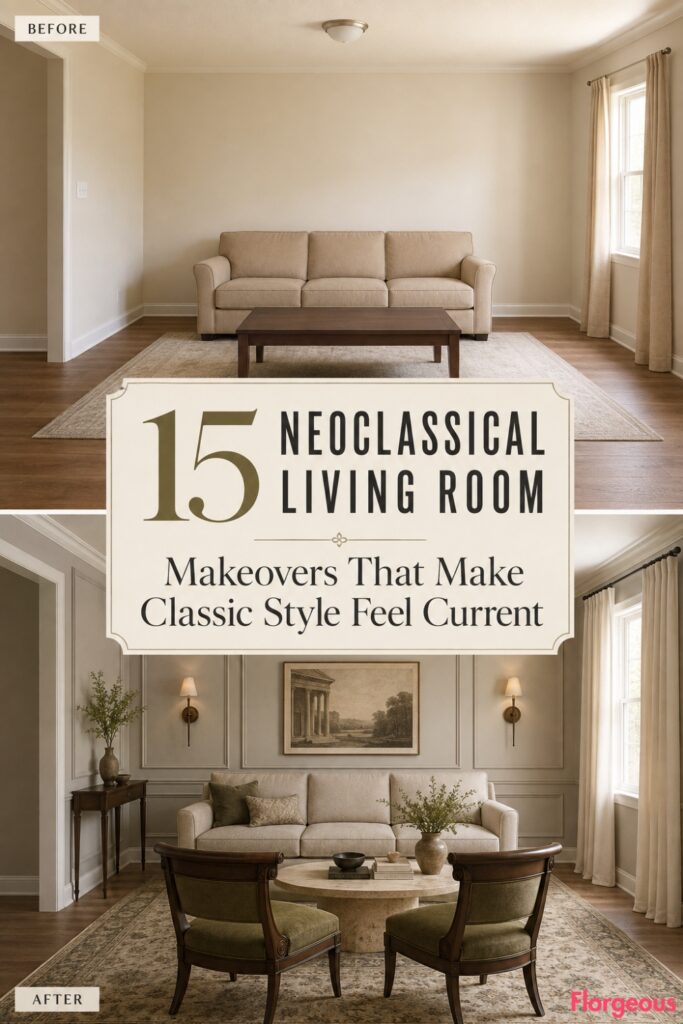
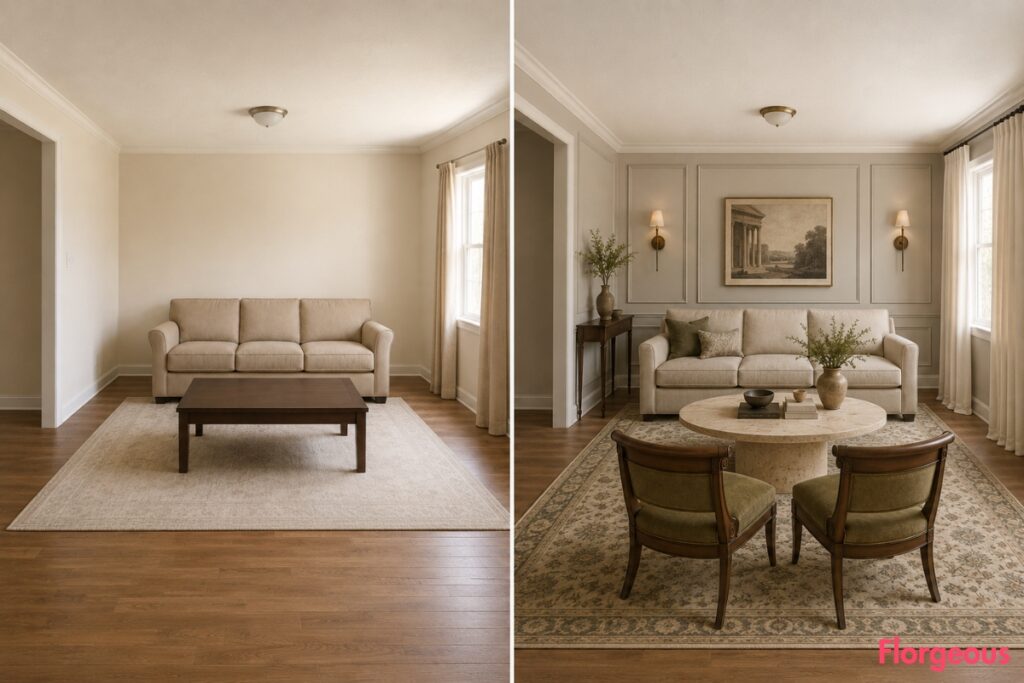
The starting room is deliberately ordinary: warm off-white walls, a straightforward beige sofa, a bare rectangular coffee table, a simple neutral rug, short curtains, a basic ceiling light, and almost nothing on the walls. It is clean and usable, but there is no architecture, focal point, or real sense of identity.
Now imagine that exact room photographed again and again from the same fixed camera position. The doorway stays put. The window stays put. The floor, ceiling height, wall proportions, and circulation route never change. Only the decorating does.
That is where a Neoclassical Living Room becomes interesting. The style can move from pale limestone calm to dark walnut richness, Mediterranean warmth, dusty blue refinement, sculptural minimalism, or dramatic burgundy without relying on palace-scale columns or excessive gold.
These 15 makeovers deliberately take different paths. Each uses classical proportion and visual order, but no two depend on the same palette, furniture formula, or architectural treatment.
1. Begin With Pale Limestone and Sculptural Walnut
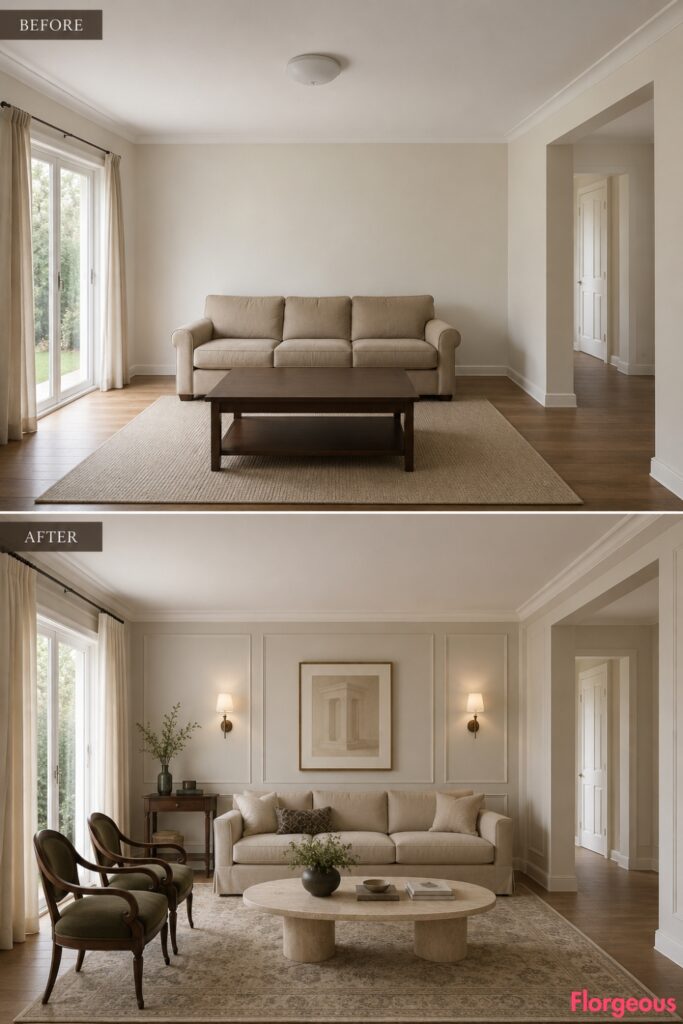
This is Neoclassical restraint at its most approachable.
Before: The original builder-grade room has warm off-white walls, beige seating, a plain rectangular coffee table, short curtains, and no architectural focal point.
After: Warm limestone-gray walls gain wide but shallow picture-frame molding. A flax linen sofa sits opposite two dark-walnut klismos-inspired chairs upholstered in muted olive wool. An oval travertine table keeps the center visually light, while parchment curtains and bronze shaded sconces soften the architecture.
The result feels ordered and classical, but nothing is overly decorative.
Designer Tip: Keep applied molding shallower than expected. Strong proportion usually communicates classical architecture better than ornate profiles.
2. Give the Same Room a Dusty Blue Parisian Rhythm
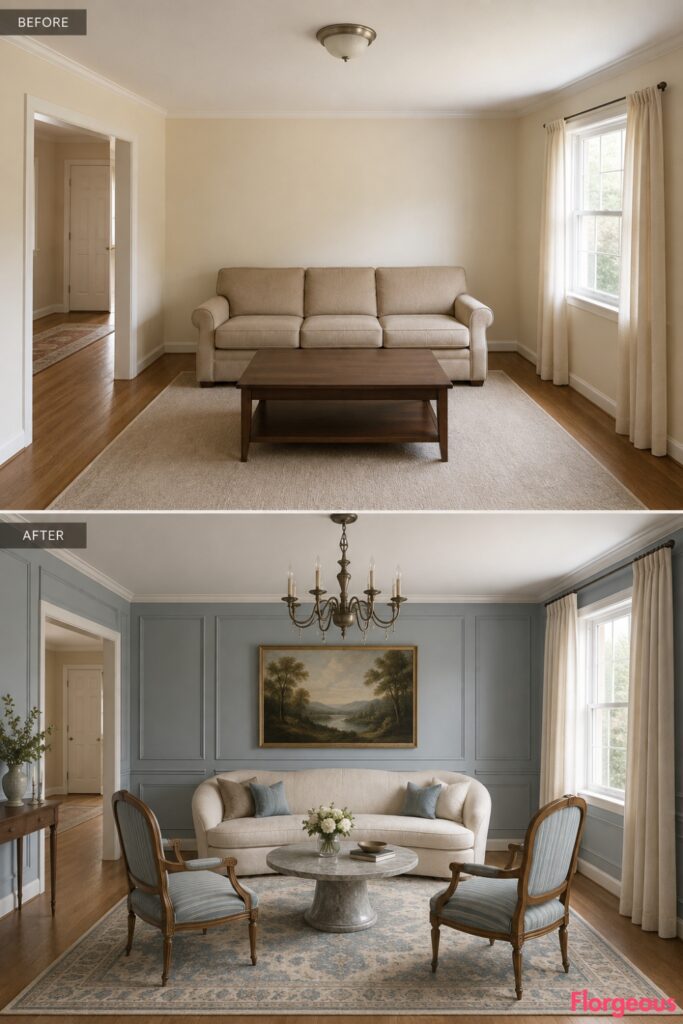
Instead of earthy neutrals, this version uses muted blue to make the architecture feel cooler and more refined.
Dusty blue-gray walls are divided with narrow symmetrical molding. A parchment curved sofa keeps the room light, while two medium-walnut fauteuil-inspired chairs in a fine blue stripe add pattern without fussiness.
A gray marble pedestal table, antique-nickel lighting, full cream curtains, and one oversized landscape complete the composition.
Unlike the first room, this one feels lighter, crisper, and more distinctly European.
3. Bring in Sun-Washed Terracotta and Travertine
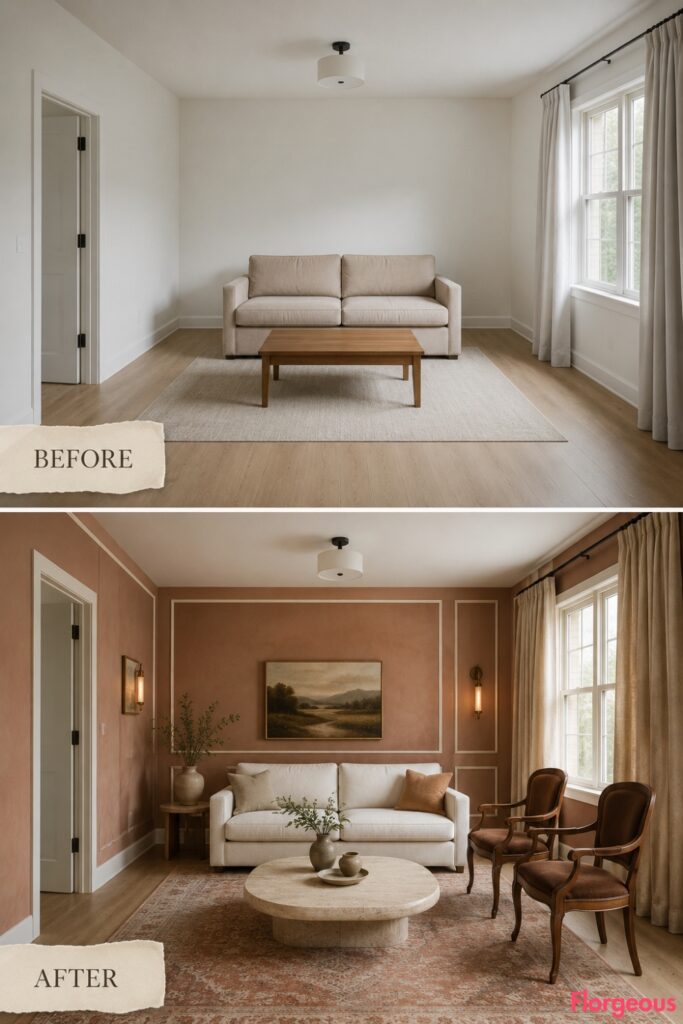
Neoclassical design can feel warm enough for a relaxed Mediterranean home.
Here, muted terracotta limewash replaces cool plaster tones. Fine cream molding gives the walls structure without competing with the color. The sofa becomes soft ivory linen, paired with walnut saber-leg chairs upholstered in tobacco fabric.
An irregular oval travertine table, faded rust-and-sand rug, bronze lighting, and full flax curtains complete the room.
Color Story: Terracotta, walnut, cream, and aged bronze make classical design feel sun-warmed rather than ceremonial.
4. Turn Forest Green Into a Quiet Classical Cocoon
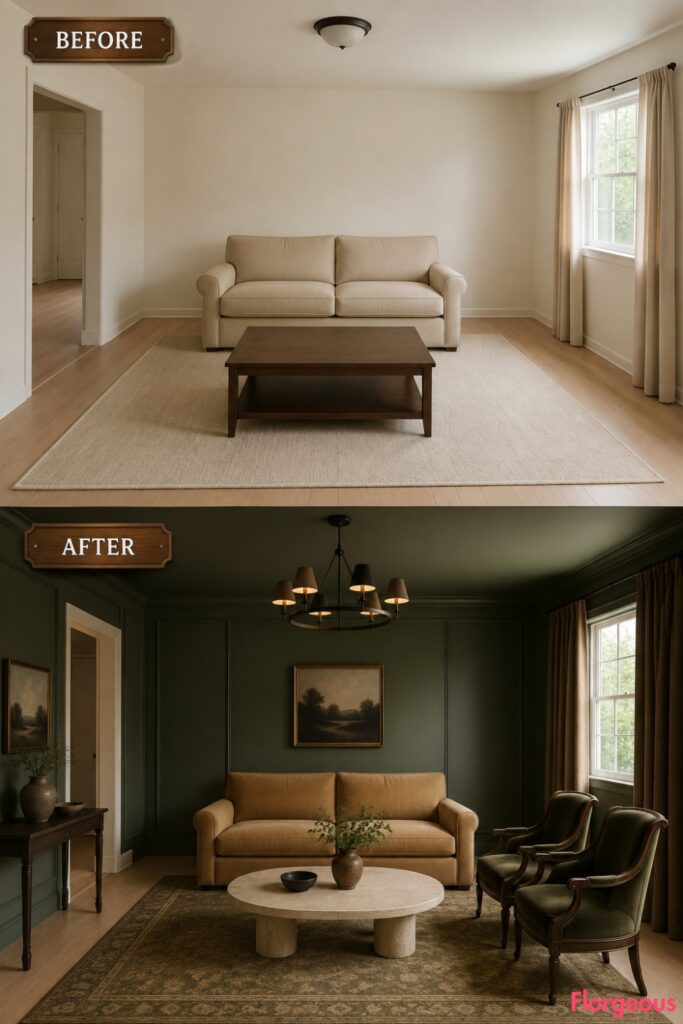
This makeover proves that dark color does not have to make Neoclassical design feel theatrical.
Deep forest-green walls and molding are painted the same color, creating a seamless architectural envelope. A camel wool sofa introduces warmth, while two blackened-walnut chairs in moss velvet bring depth without adding another strong hue.
A cream limestone coffee table keeps the center bright. Tobacco curtains and dark-bronze shaded lighting make the room especially inviting at night.
5. Sharpen the Architecture With Black and Ivory
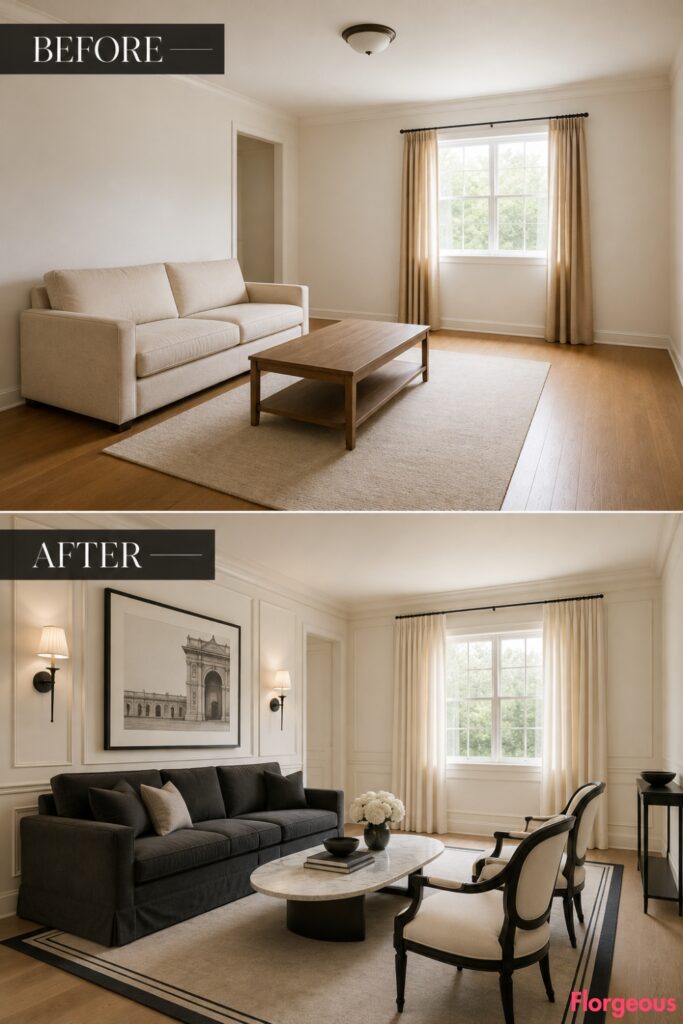
This version takes a graphic route instead of a soft traditional one.
Warm ivory walls get crisp geometric molding. Against them, a charcoal tailored sofa and two black-lacquer curved chairs with ivory upholstery form a strong but simple seating group.
The coffee table is pale gray marble with an uncomplicated oval shape. Full ivory curtains, blackened-metal sconces, and one large monochrome architectural artwork keep the room contemporary.
There is almost no decorative clutter, so proportion and contrast do the work.
6. Make a Small Apartment Feel Gustavian and Airy
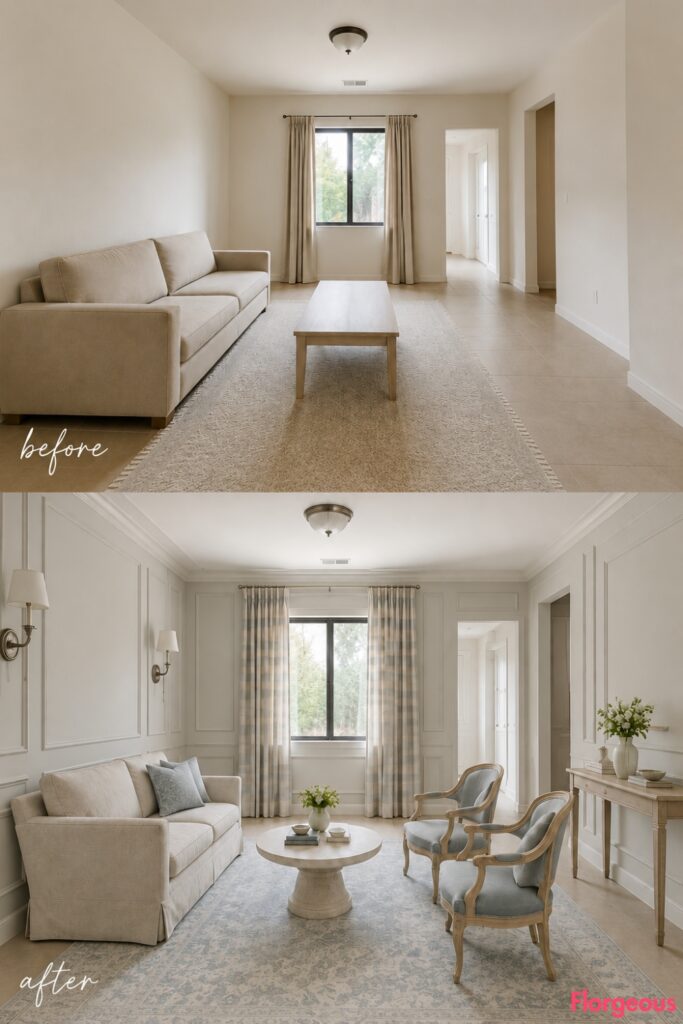
A compact room benefits from a lighter interpretation of classical design.
Paint the walls chalky pale gray and use delicate, widely spaced molding rather than deep architectural detailing. Swap the bulky sofa for a compact flax loveseat and choose two pale-oak chairs upholstered in washed blue-gray.
A small round limestone pedestal table leaves more usable floor area than a wide rectangular table.
Small Space Tip: Look for chairs with open legs and narrow arms. Classical silhouettes can still feel spacious when you can see more floor beneath them.
7. Build a Dark Walnut Library Without Making It Heavy
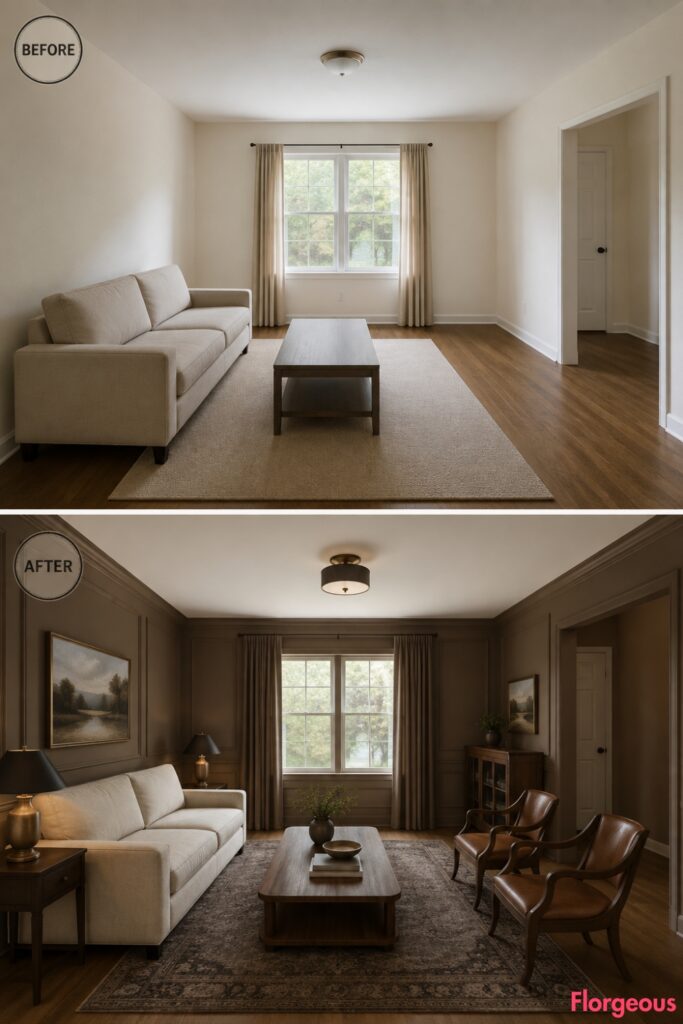
This room leans into polished wood, but it avoids the oversized furniture associated with old-fashioned libraries.
Tobacco-brown walls create a warm backdrop for a parchment sofa. Two slim dark-walnut gondola-style chairs in cognac leather face it across a softened rectangular walnut veneer table.
A shallow glass-front cabinet provides book storage without stealing the walkway. Bronze lamps and mushroom curtains keep the effect warm rather than gloomy.
This version is distinctly masculine, intimate, and furniture-led.
8. Use Dusty Rose for a Softer Classical Room
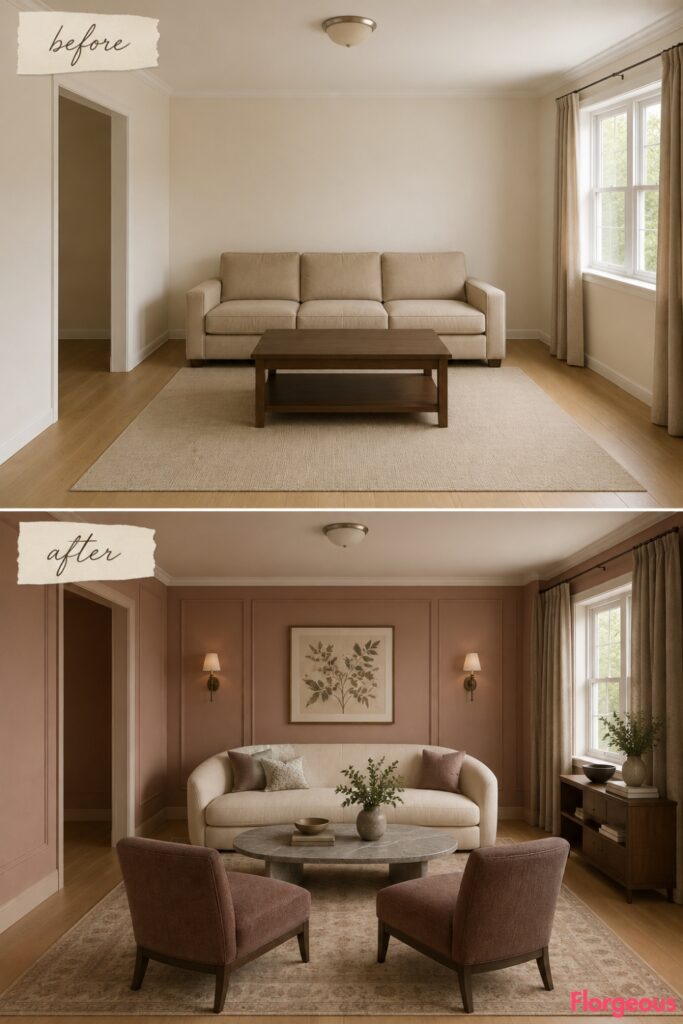
A feminine Neoclassical room does not need sugary pink, ornate carving, or floral overload.
Choose a muted rose-beige wall color and paint narrow molding in the same shade. Add a warm cream gently curved sofa and two dark walnut slipper chairs upholstered in smoky rose-brown wool.
A honed gray marble coffee table cools the palette. Mushroom curtains and antique-nickel lighting stop the room from becoming overly sweet.
9. Give a Rental Olive Architecture That Can Leave With You
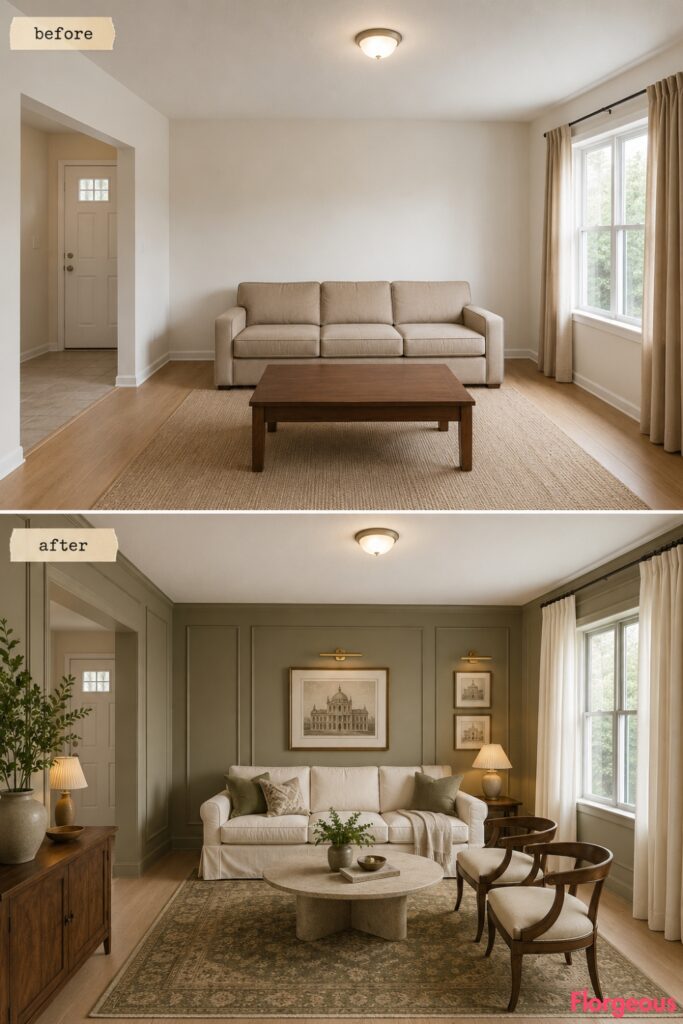
This makeover focuses on reversible decisions rather than permanent millwork.
Use removable lightweight molding on muted olive walls. Keep the existing floor untouched, then add an oatmeal slipcovered sofa, two walnut reproduction klismos chairs, and a stone-look coffee table rather than real marble.
Plug-in picture lights eliminate electrical work. Ready-made ivory curtains hung close to the ceiling improve the proportions immediately.
The room still reads as architectural even though almost every major addition can be removed later.
10. Make Blue-Gray Neoclassical Style Family-Friendly
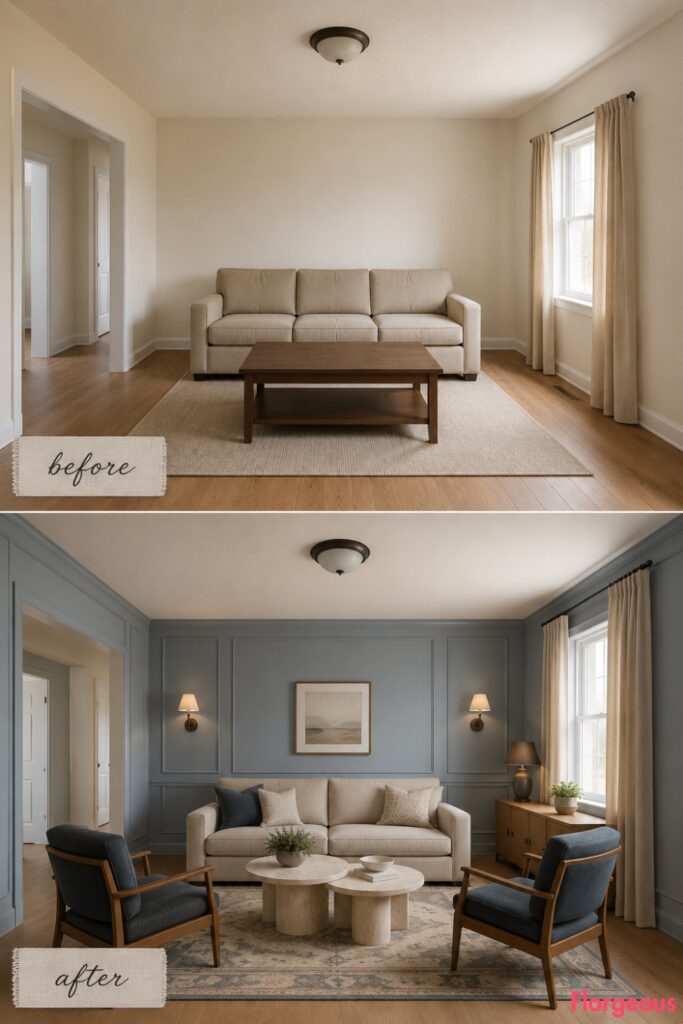
Formal-looking architecture and practical upholstery can live in the same room.
Mineral blue-gray walls get broad, simple molding. The main sofa uses oatmeal performance fabric, while two medium-oak chairs are upholstered in washable muted navy wool-look fabric.
Instead of a sharp marble table, use rounded travertine nesting tables. Closed oak storage replaces fragile open displays.
Common Mistake: Do not assume a family room needs to abandon classical proportions. Choose washable materials and rounded edges, then keep the architectural framework.
11. Let the Art Lead in a Pale Greige Gallery Room
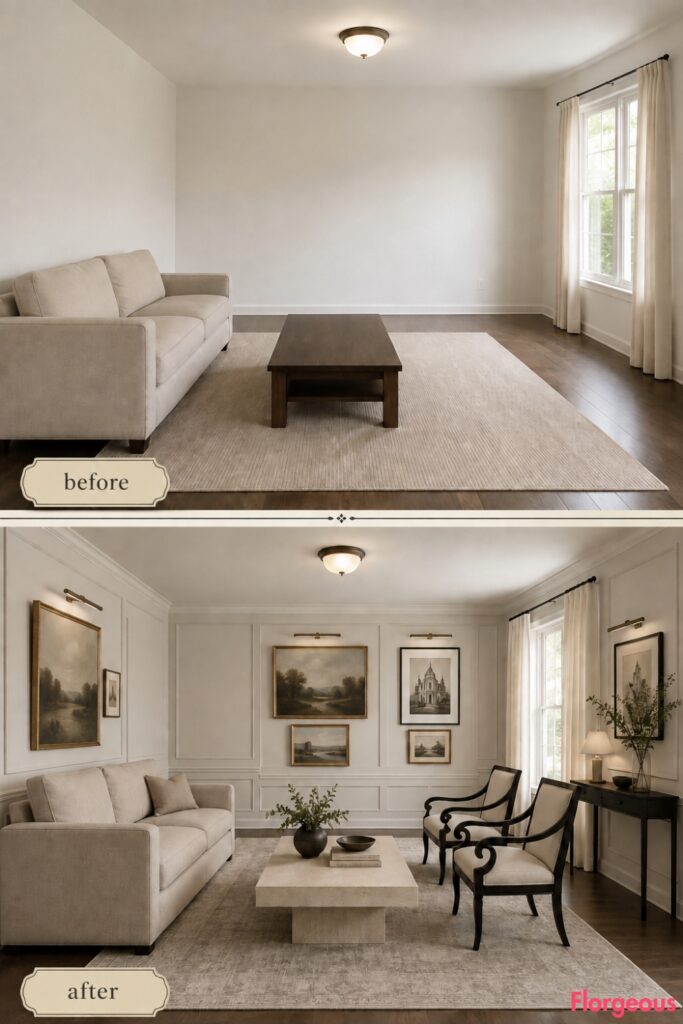
Instead of using color or furniture as the main statement, this makeover puts the walls and artwork first.
Pale greige walls receive simplified rectangular molding. A mushroom linen sofa and two ebonized chairs sit quietly beneath a carefully spaced group of large landscapes and architectural studies.
A low limestone plinth table and narrow picture lights reinforce the gallery feeling. Decorative objects are limited to a few ceramics and one sculptural bowl.
The room feels curated without resembling a museum.
12. Fake the Architecture With Paint and Cherrywood
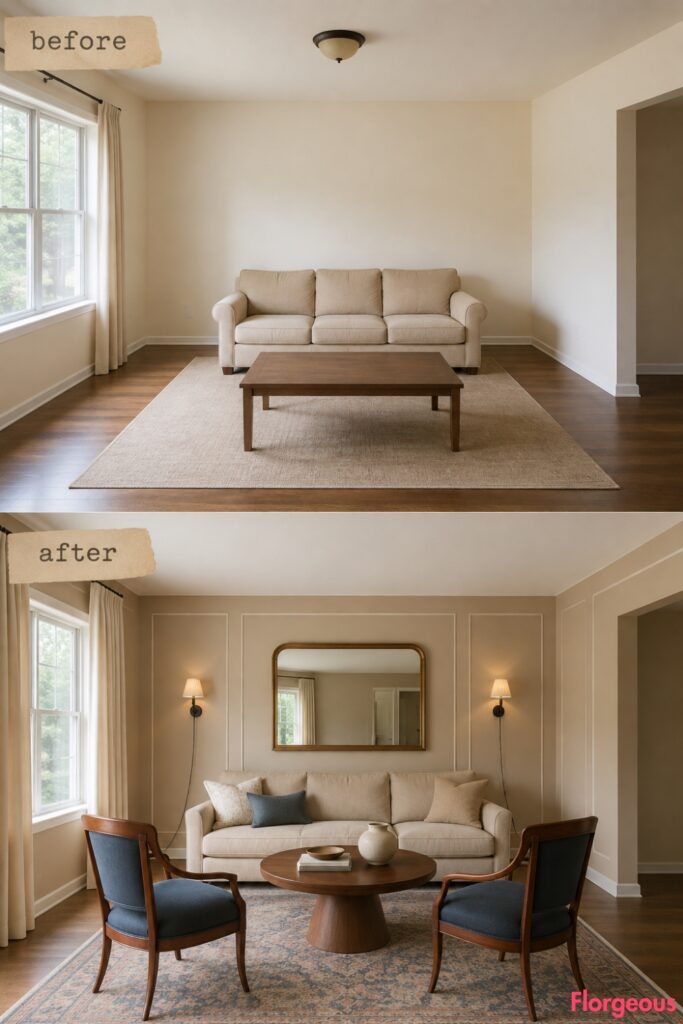
This is the most budget-conscious transformation in the collection.
Instead of installing molding, paint fine symmetrical rectangular borders onto warm sand walls using a slightly deeper tone. From a distance, the divisions create the same sense of order.
Pair the painted architecture with an oatmeal sofa, polished cherrywood chairs, a simple round wood pedestal table, and inexpensive plug-in shaded sconces.
Budget Version: Painter’s tape, two closely related wall colors, and careful measuring can create a surprisingly convincing panel effect for far less than custom trim.
13. Strip Everything Back to Monochromatic Mushroom Plaster
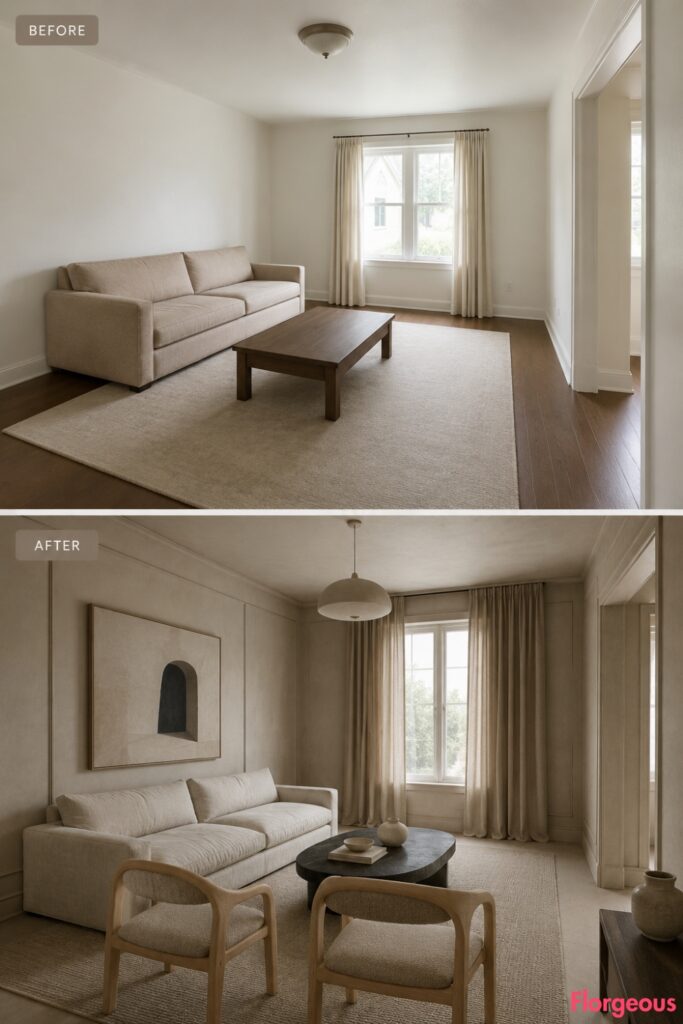
This interpretation is quieter than the black-and-ivory room because it relies on texture instead of contrast.
Walls and shallow panel divisions are finished in nearly identical mushroom mineral plaster. Add a low oatmeal sofa, sculptural pale-oak chairs with curved backs, and a soapstone coffee table.
A tonal wool rug, mushroom curtains, and a simple plaster ceiling pendant create a nearly monochromatic interior.
Style Note: A room can feel unmistakably classical through balance and furniture silhouette even when ornament and color contrast are minimal.
14. Use Burgundy and Pale Maple for a Jewel-Box Effect
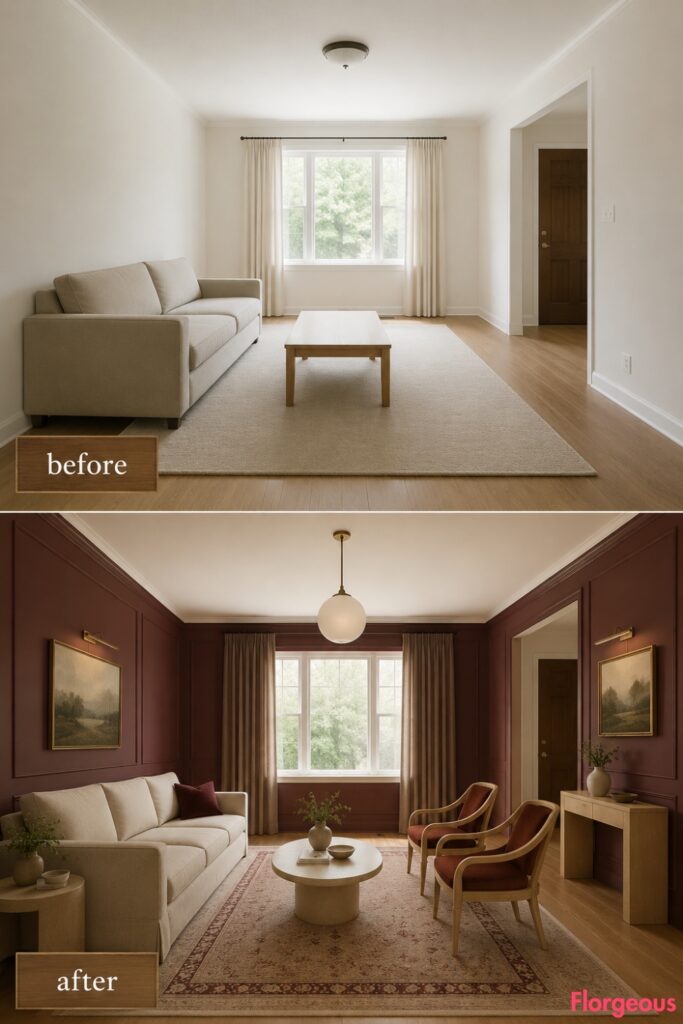
This is the boldest color story in the gallery, but the furniture keeps it controlled.
Muted burgundy walls are paired with pale maple rather than dark mahogany, immediately making the room feel less historical. A parchment tailored sofa sits across from two pale-maple gondola-inspired chairs covered in tobacco-red wool.
Add a cream limestone pedestal table, mushroom curtains, opaline globe lighting, and only two restrained landscapes.
The combination is rich, graphic, and surprisingly fresh.
15. Finish With Tobacco, Medium Oak, and Dark Bronze
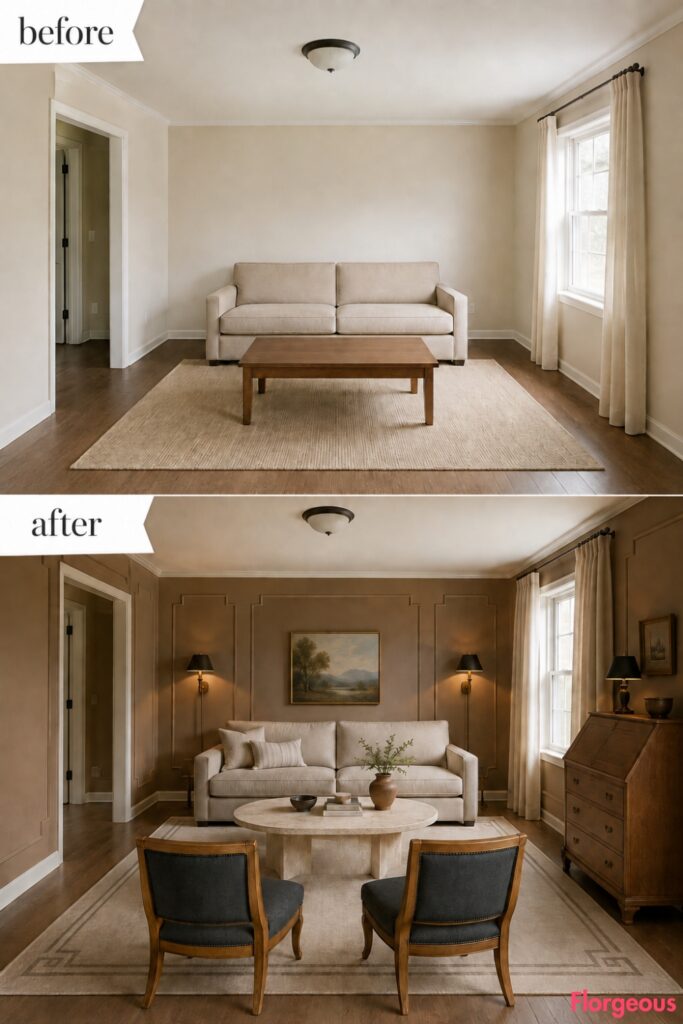
The final room is neither pale nor dramatically dark. Instead, it uses warm mid-tones to create a relaxed, collected interpretation.
Warm tobacco walls receive fine Directoire-inspired geometric borders rather than traditional rectangular panels. A mushroom linen sofa sits opposite two medium-oak saber-leg chairs upholstered in charcoal-blue wool.
The coffee table is honed cream limestone, the rug carries a subtle Greek-key-inspired border, and dark-bronze lamps provide contrast. Full parchment curtains soften the geometry.
This makeover feels mature and architectural while still looking like a home you could comfortably use every evening.
How to Choose the Right Classical Direction for Your Room
These rooms work because the classical references are edited rather than piled on. Each makeover chooses a different main idea, such as pale stone, dramatic wall color, polished wood, graphic contrast, artwork, reversible molding, or textural plaster, then lets the rest of the room support it.
For your own Neoclassical Living Room, start with the features you cannot easily change. Consider the flooring, natural light, room size, and existing openings before deciding whether the room wants pale limestone, deep green, terracotta, dusty blue, tobacco, or something softer.
Then choose four anchors before shopping: one architectural treatment, one dominant wood tone, one focal surface such as travertine or marble, and one restrained accent color. If those choices work together, you will need far fewer decorative objects to make the room feel finished.
For renters and tighter budgets, begin with curtains, painted symmetry, lighting, and one classical furniture silhouette. For family spaces, put durability first and let molding, proportion, and lighting carry the elegance.