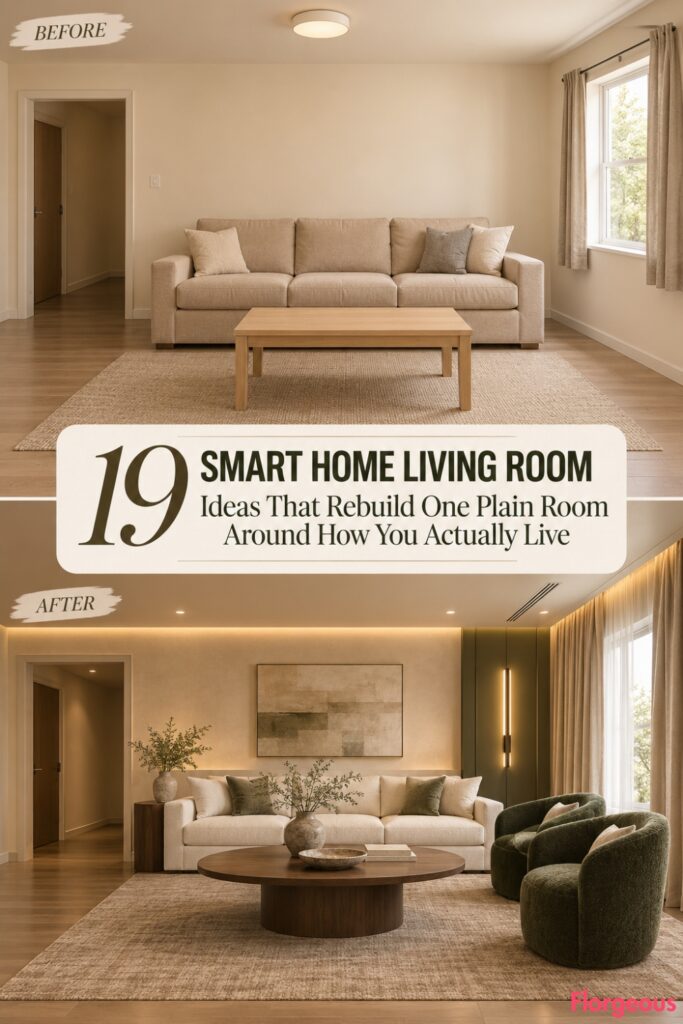
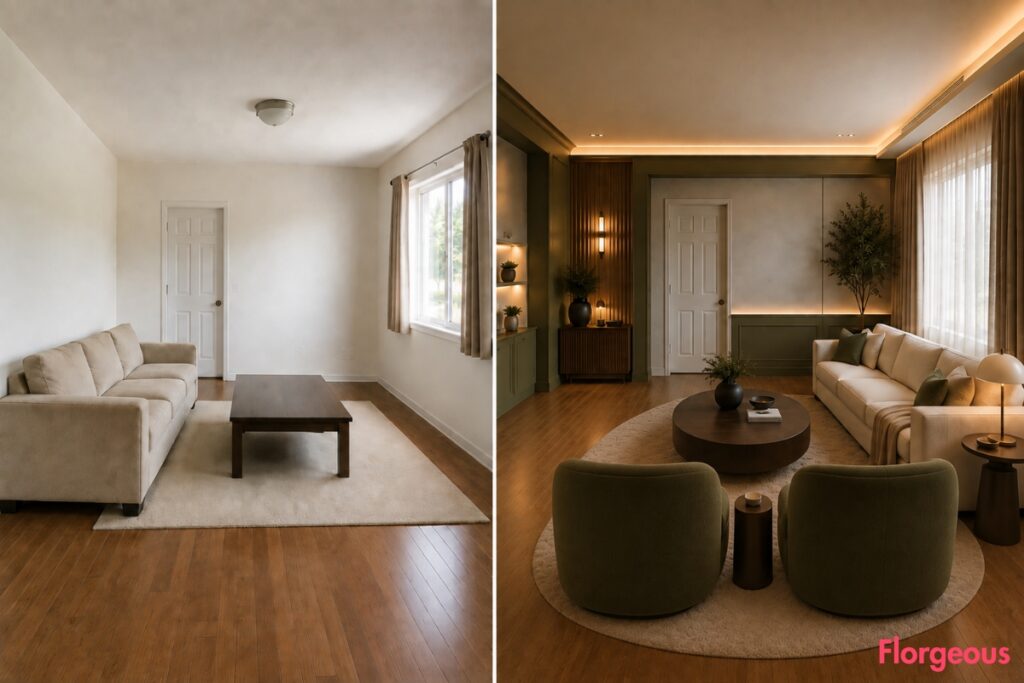
The starting point is intentionally ordinary: warm off-white walls, a straight beige sofa against the main wall, a bare rectangular coffee table, a simple neutral rug, short curtains, basic ceiling lighting, and almost no styling. It works, but it feels unfinished and technologically dated.
For these 19 makeovers, that room never changes structurally. The doorway, window, floor, ceiling height, wall proportions, camera position, lens, daylight direction, scale, and entrance route remain locked.
What changes is the purpose of the room. Instead of treating a Smart Home Living Room as a place to display gadgets, each version solves a different everyday need through furniture planning, materials, lighting, sound, storage, shading, or discreet automation.
The result is less about owning more technology and more about making the room work harder without looking busier.
1. Conceal the Entire Media Setup Behind Furniture-Grade Walnut
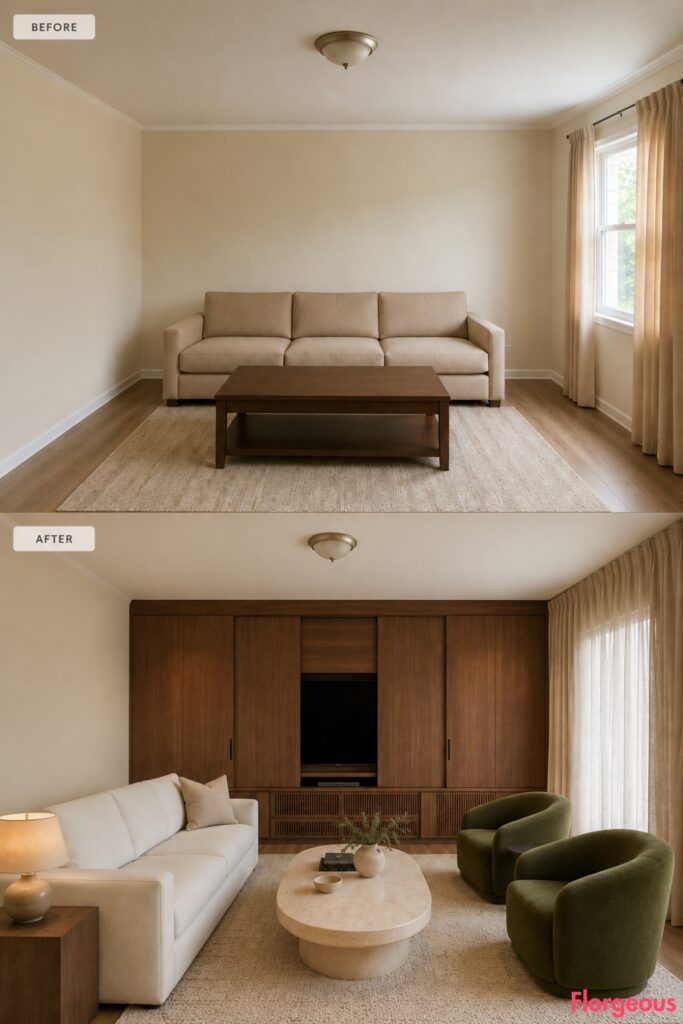
This version is for anyone who wants television at night without staring at a black screen all day.
Before: The canonical builder-grade room with warm off-white walls, straight beige sofa, bare rectangular table, neutral rug, short curtains, basic ceiling light, minimal styling, and soft daylight.
After: A tailored ivory sofa faces floor-to-ceiling walnut joinery. Sliding timber panels conceal the television, while ventilated lower cabinets contain media equipment and cables. Two compact moss mohair chairs sit together opposite the sofa with a deliberate gap, and a broad oval limestone table keeps the composition balanced.
Designer Tip: Keep the screen near seated eye level. Tall cabinetry does not mean the television should be mounted high.
2. Build a Cinema That Vanishes Into the Ceiling
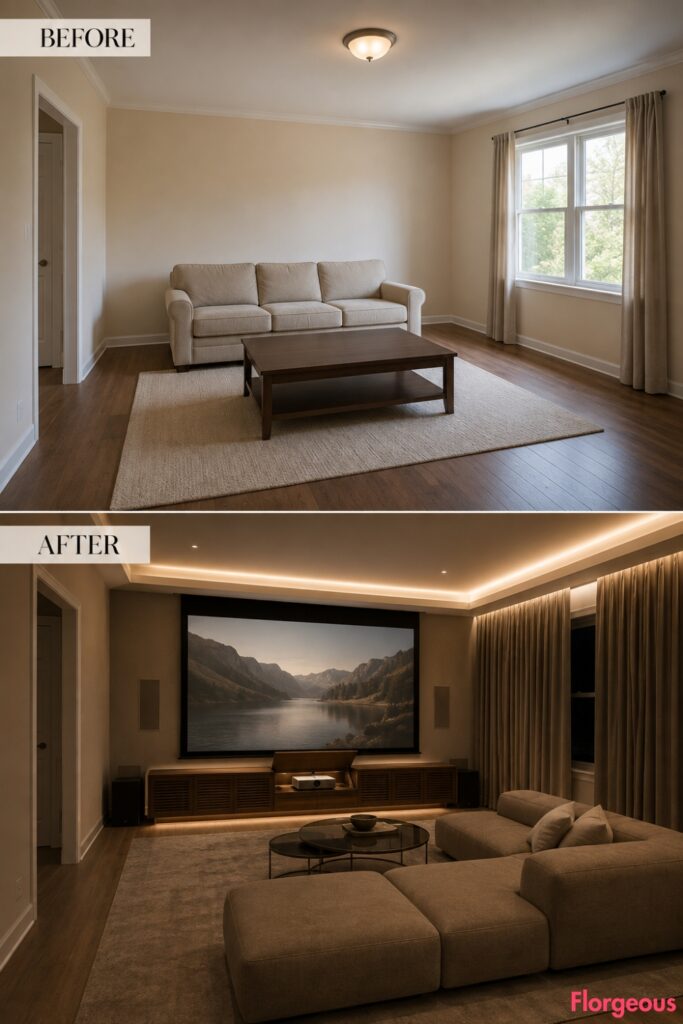
A projector creates a very different room because the wall can remain visually quiet when no one is watching.
Before: The exact same plain beige-sofa room with flat lighting and minimal decoration.
After: A deep mushroom modular sofa floats centrally on a broad wool rug. A motorized projection screen descends from a narrow ceiling recess, while the projector hides inside shallow cabinetry on the rear wall. Smoked-glass nesting tables leave the floor flexible, and blackout-lined curtains make movie scenes possible without permanently darkening the room.
Try this: Confirm projector throw distance before deciding where the sofa and cabinetry belong.
3. Let Circadian Lighting Become the Main Feature
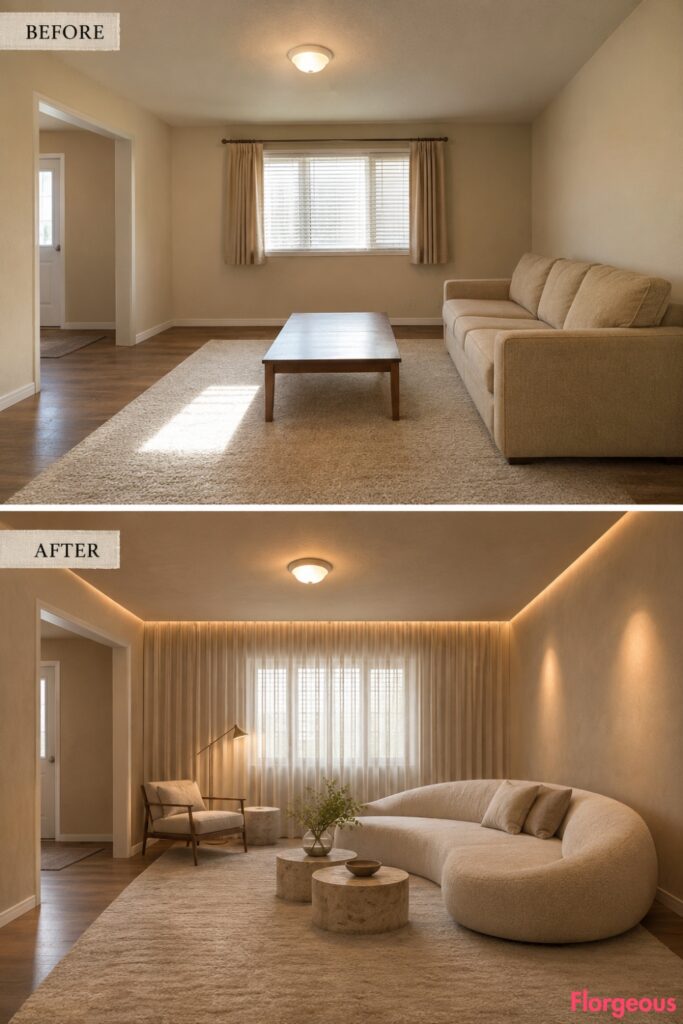
This makeover has no screen at all. The smart layer is almost entirely about how the room feels from morning to night.
Before: The unchanged builder-grade room with beige sofa and one basic ceiling fixture.
After: A softly curved oatmeal sofa floats on a pale mushroom rug, accompanied by one ash-framed reading chair and two small stone side tables. Concealed cove illumination, wall washing, task lighting, and motorized sheers gradually shift from brighter daytime light to warmer evening scenes.
Lighting Note: Circadian schemes look best when architectural and decorative lights change together instead of producing competing color temperatures.
4. Turn the Room Into a Serious Listening Lounge
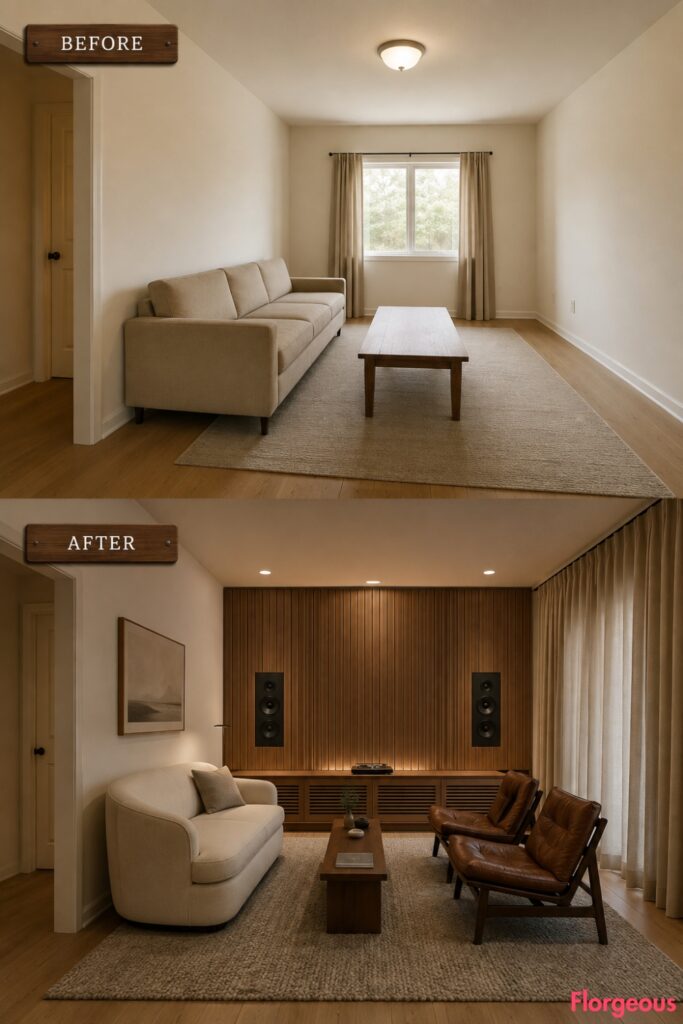
Here, sound rather than television determines the layout.
Before: The same neutral builder-grade living room with generic furniture and hard, untreated surfaces.
After: Two low tobacco leather chairs sit side by side facing a compact cream settee across a narrow walnut table. A partial wall of fluted oak acoustic treatment contains symmetrically positioned speakers, while full linen curtains and a dense wool rug reduce reflections naturally.
Nothing resembles a recording studio.
5. Make Acoustic Treatment Look Like Custom Architecture
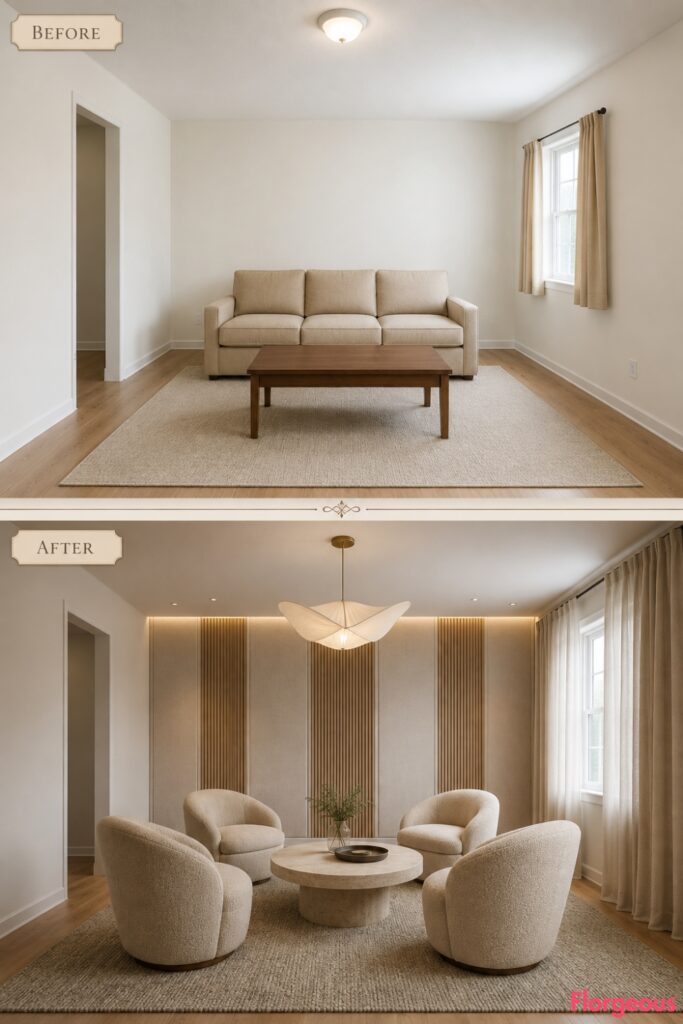
This room addresses noise differently from the listening lounge. It is designed for conversation, not hi-fi equipment.
Four rounded lounge chairs create a screen-free salon around a circular limestone table. Behind them, alternating upholstered panels and shallow timber ribs soften echo while creating a strong architectural rhythm.
Acoustic Tip: Rugs, curtains, upholstery, and wall treatment should share the workload. The room will feel softer without covering every wall in panels.
6. Create a Renter-Friendly Connected Room With Zero Construction
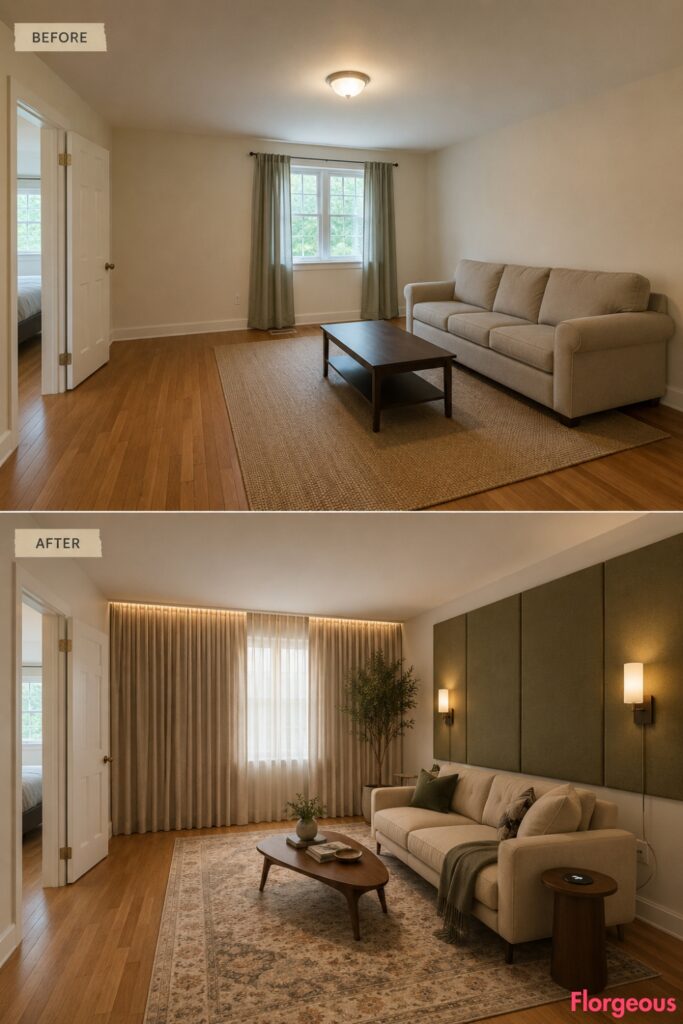
Smart upgrades do not have to begin with custom millwork.
Before: The original beige sofa and plain builder-grade shell remain untouched.
After: The beige sofa stays, but removable olive textile panels improve the wall, a vintage walnut coffee table replaces the basic one, and a much larger washable rug visually anchors the seating. Retrofit curtain motors, plug-in sconces, smart bulbs, removable cable raceways, and a wireless charging side table add useful automation without permanent work.
7. Give Family Clutter Somewhere to Disappear Automatically
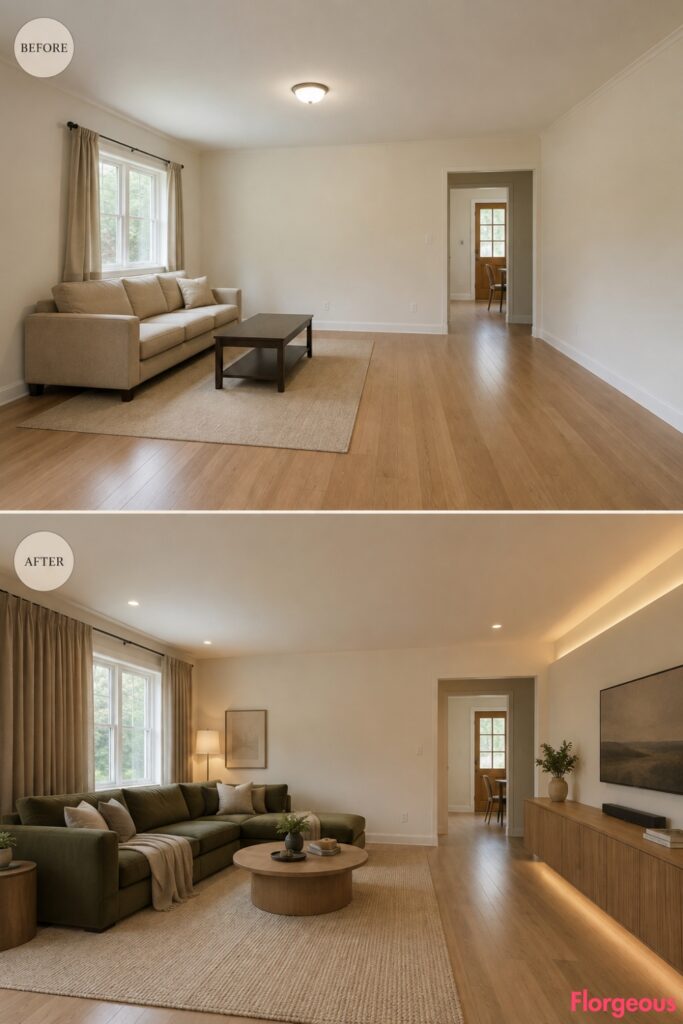
This design is organized around storage rather than entertainment.
A soft olive sectional follows one wall, leaving the room center open. A rounded oak table is safer around children, while a long low cabinet hides games, chargers, cables, speakers, and media accessories behind assisted doors.
Washable upholstery and preset evening lighting make the room easier to live with.
8. Make a Tiny Living Room Work Like a Larger One
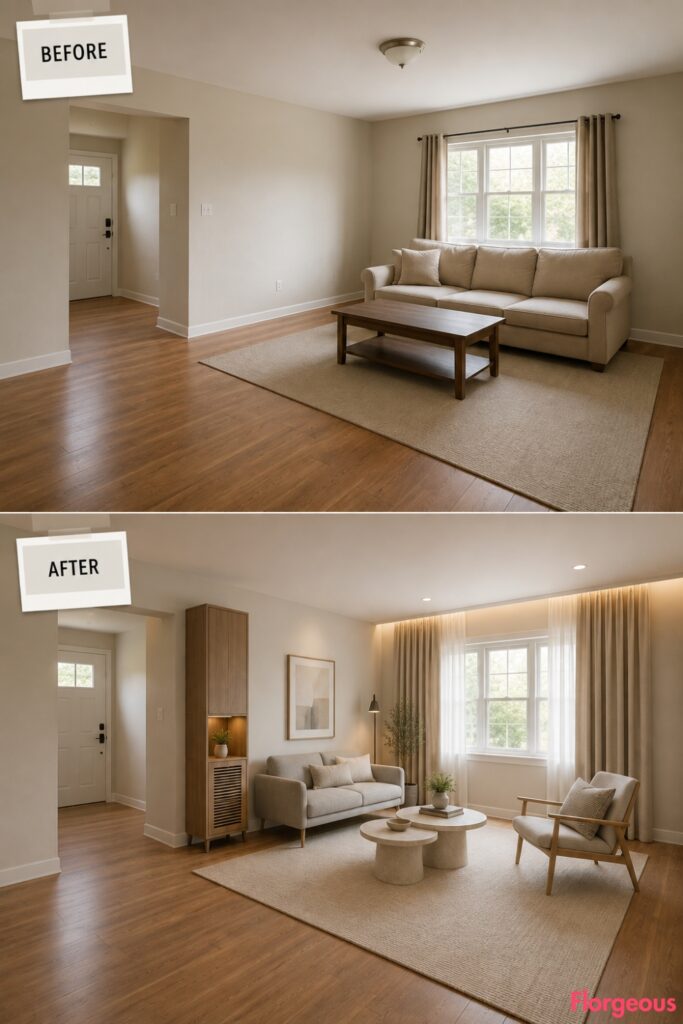
Instead of adding technology, this compact scheme uses it to reduce the number of objects needed.
Before: The same plain room with a full-size beige sofa and underused floor area.
After: A pale-gray settee replaces the bulky sofa, one lightweight ash lounge chair angles toward it, and two nesting stone tables separate only when needed. A slim vertical cabinet hides charging, a smart-home hub, power management, and small media accessories.
Small Space Tip: Prioritize technology that eliminates visible objects rather than technology that introduces another device.
9. Hide a Complete Home Office Behind Shallow Cabinetry
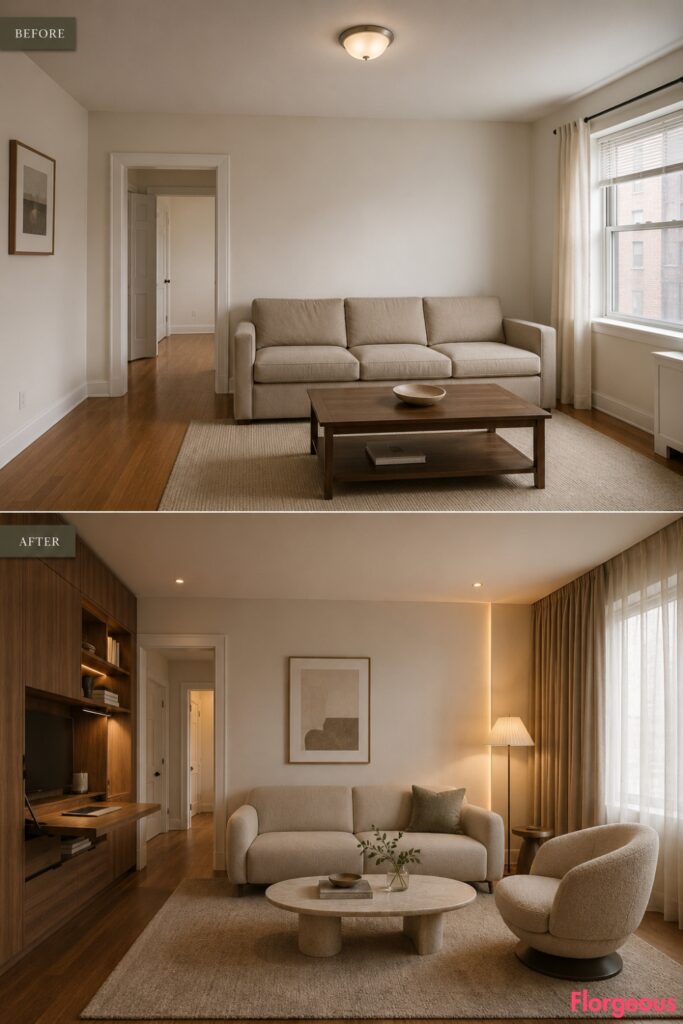
This is a working room during the day and a proper living room again at night.
Before: The unchanged beige-sofa room has nowhere practical to work.
After: A compact mushroom sofa sits against the main wall with one cream swivel chair and a slim oval stone table. Shallow walnut cabinetry contains a fold-down desk, charging, task light, monitor storage, and work supplies, then closes into a clean wall after hours.
10. Design the Room Around Entertaining, Not a Screen
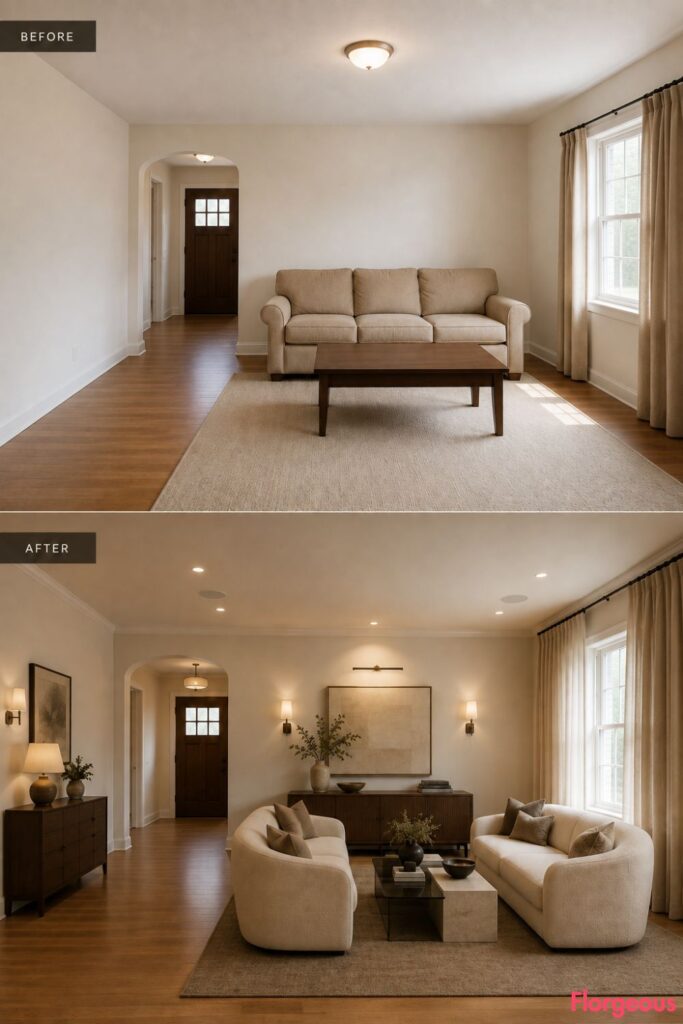
Two sofas facing each other completely change the social dynamic.
Before: The standard sofa points toward an empty wall without creating a real conversation zone.
After: Two compact parchment sofas face one another across offset smoked-glass and limestone nesting tables. Slim walnut side cabinets conceal charging drawers, while integrated ceiling audio distributes music evenly. Lighting scenes move from brighter gathering light to a soft late-evening setting.
11. Create a Gaming Room That Does Not Look Like an Arcade
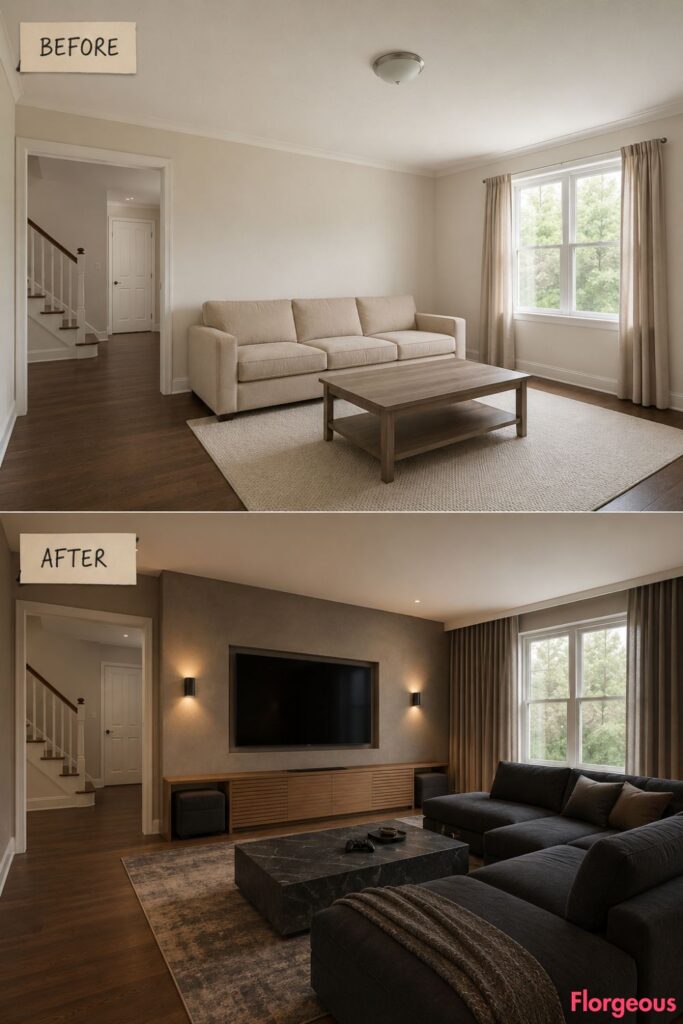
The goal here is flexibility. Gaming equipment exists only when it is being used.
A low charcoal sectional faces a flush display set into warm taupe plaster. Controllers and consoles disappear into ventilated oak drawers, while two movable upholstered cubes provide extra seating and tuck beneath a side console afterward.
There are no neon strips or exposed hardware.
12. Use Plants as the Visible Layer and Environmental Tech as the Invisible One
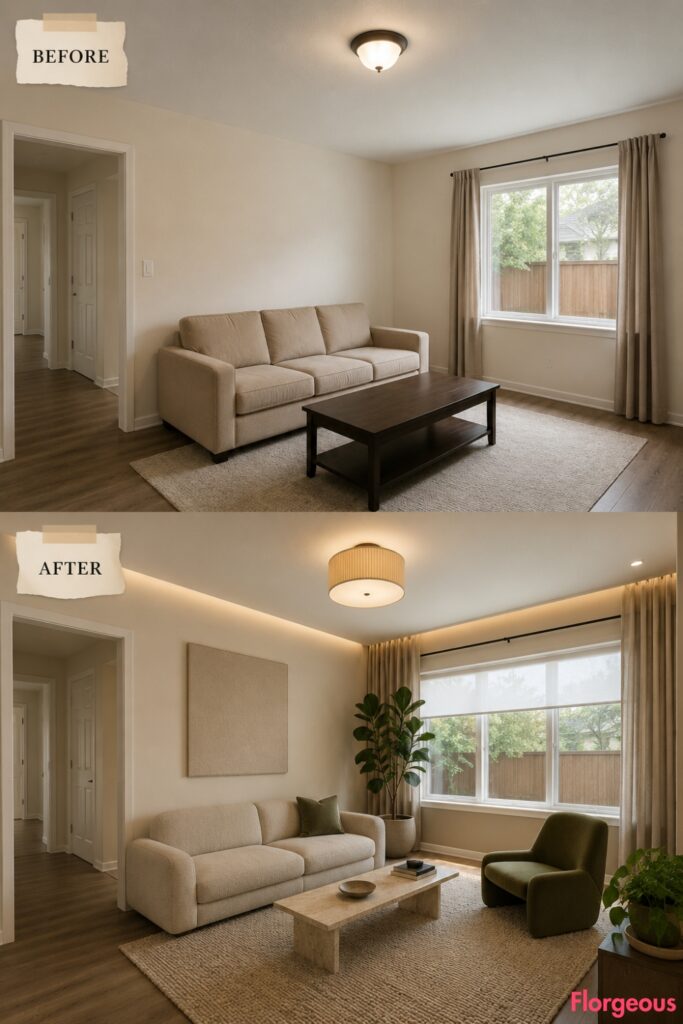
This is a biophilic room without rows of gadgets or pots.
Before: The identical plain room has little texture or connection to the window.
After: A low oatmeal sofa rests against the main wall with one moss lounge chair angled toward it. A single mature rubber tree sits beside the window, accompanied by a restrained low philodendron grouping. Automated shading, concealed plant-support lighting, air-quality monitoring, and quiet climate control operate almost invisibly.
13. Let Automated Shading Do the Heavy Lifting
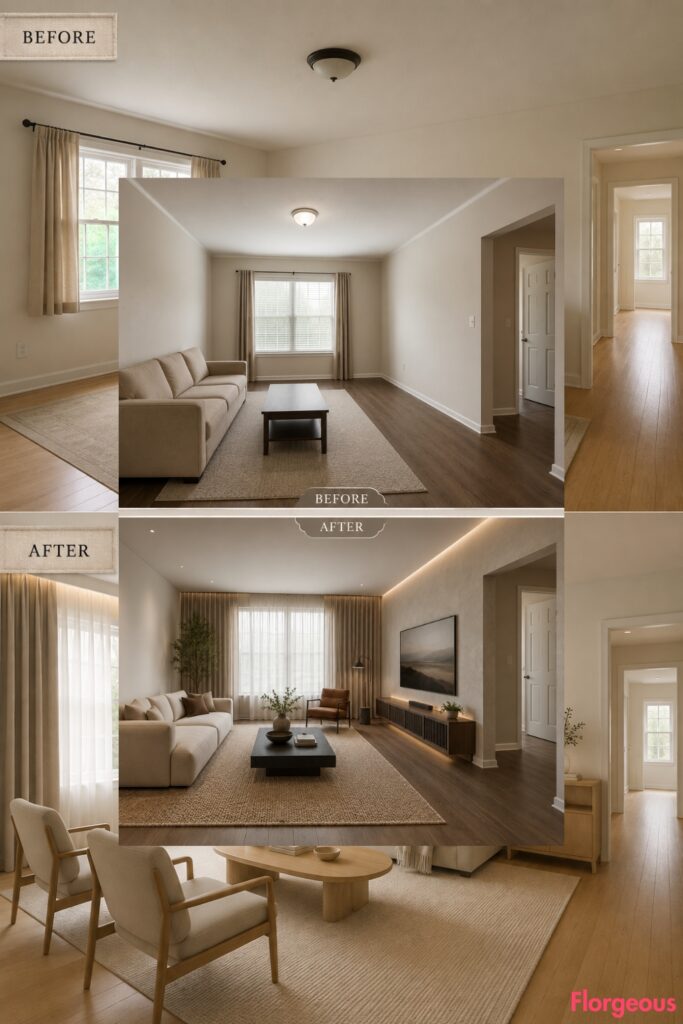
This version focuses on energy and daylight rather than entertainment.
A flax sofa and two slender ash chairs create a light, open composition around a pale oak table. Motorized sheers manage glare during the day, while secondary thermal curtains close when more insulation is useful. Daylight-responsive lighting dims automatically when natural light is sufficient.
The window itself remains completely unchanged.
14. Make Artwork the Focal Point and Let Media Hide Inside It
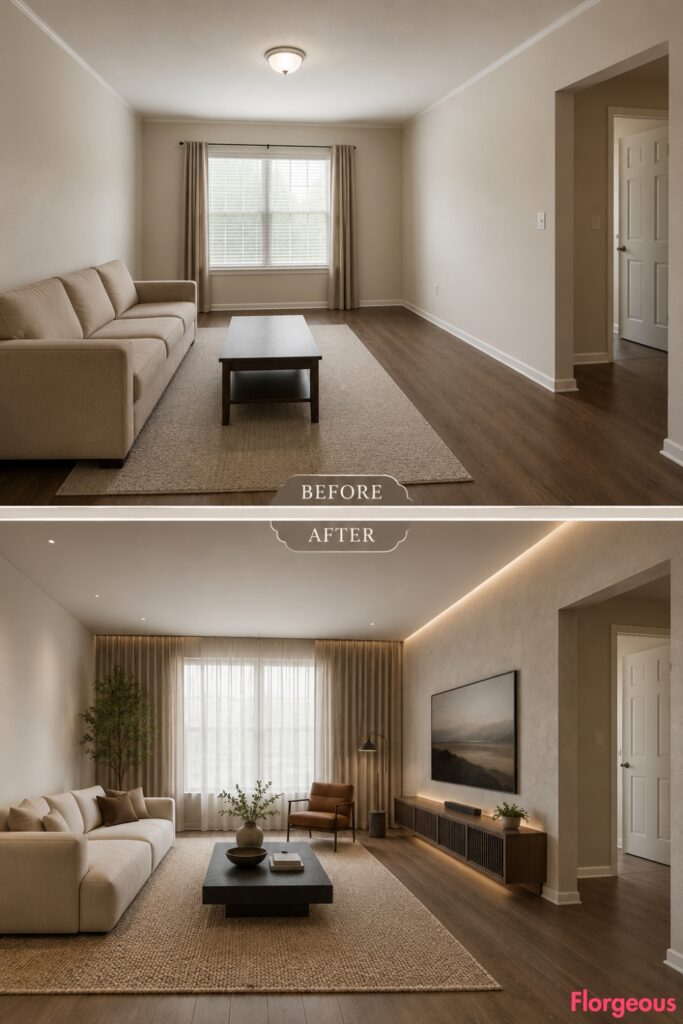
The room should read as a gallery before it reads as a media space.
Before: The same generic room has no focal point.
After: A low ivory sofa faces a flush art-mode display integrated into a broad textured-plaster composition. One tobacco leather lounge chair balances the room, while a blackened-oak table and oversized natural wool rug add weight.
Cables and equipment disappear into a ventilated low cabinet.
15. Make the Room a Screen-Free Smart Reading Retreat
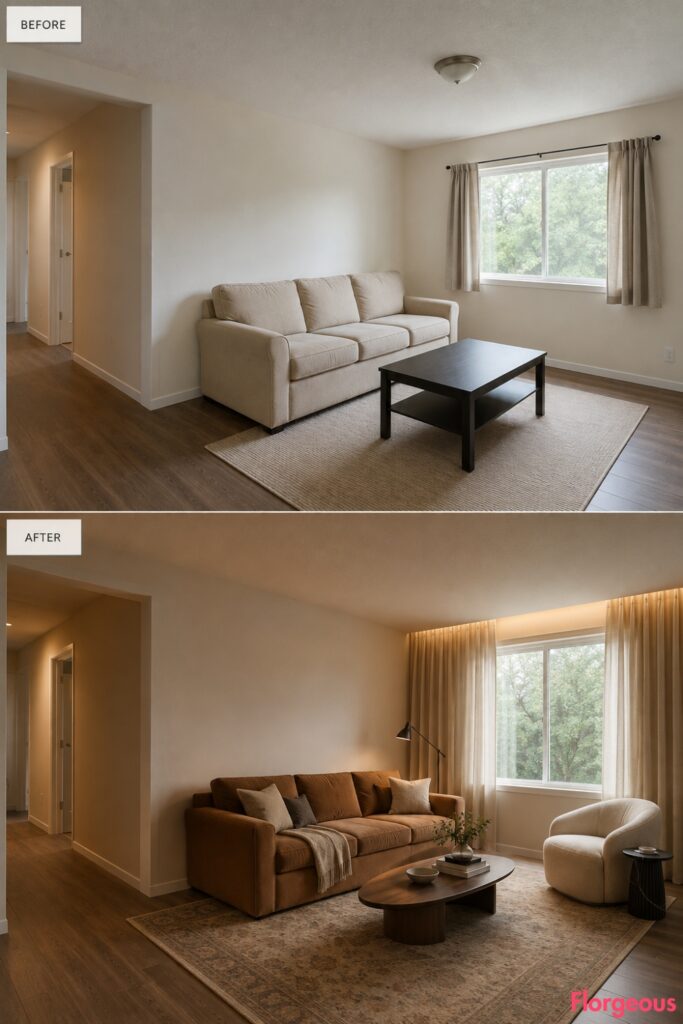
This makeover uses automation to support quiet rather than entertainment.
A tobacco linen sofa sits against the main wall. One sculptural cream reading chair occupies the brighter window side without obstructing it, and a narrow walnut oval table replaces the bulky rectangular coffee table.
Motorized curtains, hidden charging, a precise reading lamp, and a low evening scene are the only obvious smart functions.
16. Let Motorized Furniture Change the Room Instead of Adding More Furniture
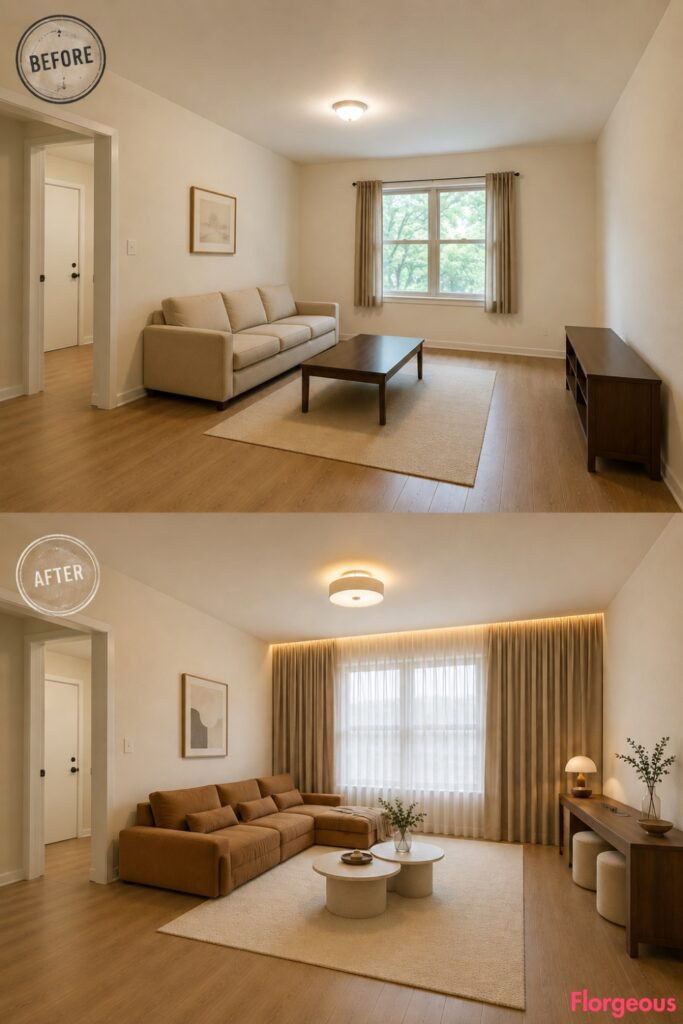
Rather than giving every activity a permanent zone, this version uses adaptable pieces.
Before: The original room has one static seating arrangement.
After: A low caramel modular sofa sits on a broad cream rug. A slim walnut console contains two upholstered stools that extend outward on concealed mechanisms when guests arrive, while a pair of lightweight round tables can separate for drinks or tuck together for everyday use.
Power and charging are integrated into the console rather than the seating area.
17. Create Quiet-Luxury Automation With No Visible Control Center
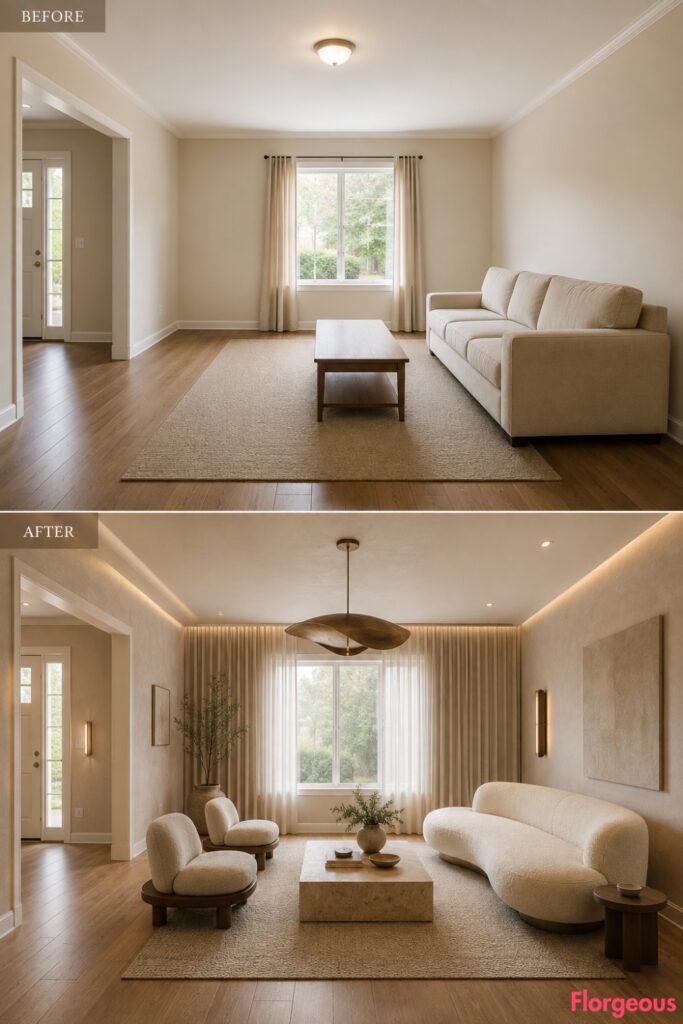
This is the most polished interpretation, but the room still feels residential.
A sculptural ivory sofa floats on a mushroom wool rug opposite two low walnut-framed mohair chairs. A broad travertine table anchors the center. Textured plaster, bronze lighting, integrated audio, climate control, motorized curtains, charging, and scene automation disappear into the architecture.
Technology Tip: Essential lighting and shading scenes should still have physical controls. A beautiful smart room should remain usable when a phone is nowhere nearby.
18. Keep the Beige Sofa and Spend the Budget Where It Shows
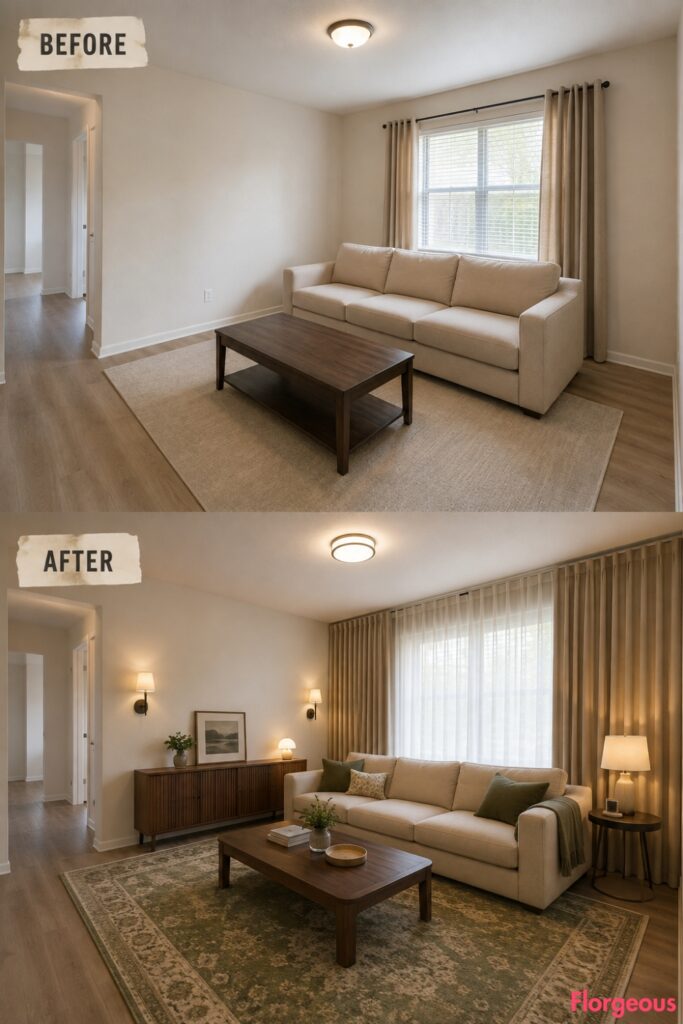
This is the most achievable transformation in the gallery.
The original sofa stays. A larger olive-and-cream rug, secondhand walnut table, ceiling-height ready-made curtains, retrofit curtain motor, smart dimmer plugs, plug-in sconces, and a slim cable-managed media console make the room look far more resolved.
Budget Version: Start with lighting, curtains, and cable control before replacing furniture. They change both the photographs and the daily experience of the room.
19. Make the Smartest Room the One Where You Can Barely See the Technology
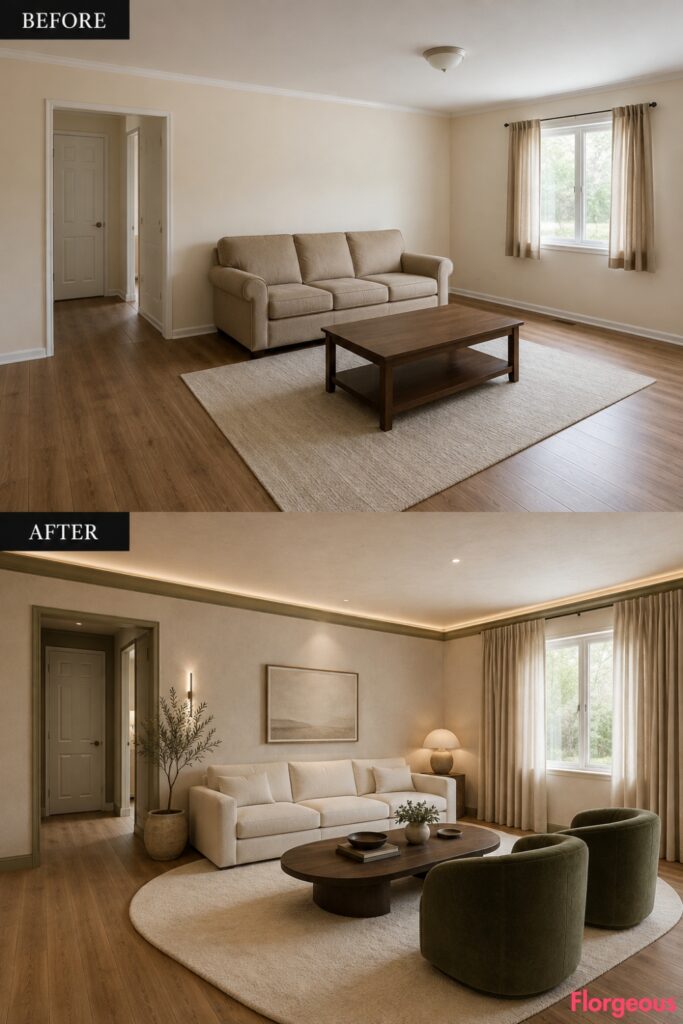
The last scheme removes the temptation to make any device the star.
Before: The familiar plain room remains exactly as it was at the start.
After: A tailored ivory sofa sits against the main wall. Two compact emerald-to-moss mohair chairs are arranged together opposite it with a deliberate gap, and a broad dark-walnut oval table sits between them. Restrained olive architectural detailing, acoustic plaster, mushroom wool, floor-to-ceiling flax curtains, invisible speakers, hidden charging, automated lighting, environmental sensing, and discreet climate control make the room work quietly in the background.
There is no visible television, touchscreen, hub, or pile of electronics.
Start With the Problem, Not the Gadget
The most convincing connected interiors rarely look particularly technological. They simply make ordinary things easier: controlling glare, charging a phone, finding comfortable light, hearing music clearly, hiding work, managing clutter, or watching a film without sacrificing the room the rest of the day.
If you are planning a Smart Home Living Room, decide what currently frustrates you before buying anything. A room with poor lighting may benefit more from dimmers and better fixtures than a new screen. A noisy room may need curtains and acoustic surfaces before upgraded speakers. A small room may improve most through hidden charging and flexible furniture.
Solve the first problem properly, then add technology only when it gives the room another useful ability. That approach produces an interior that feels current without becoming dated the moment the next gadget appears.