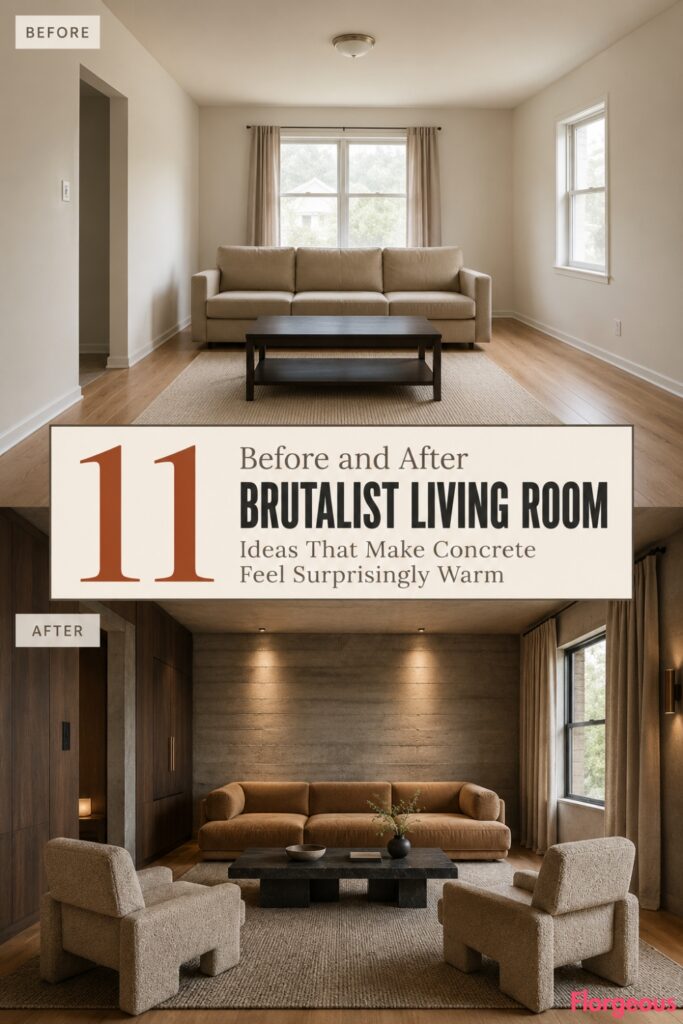
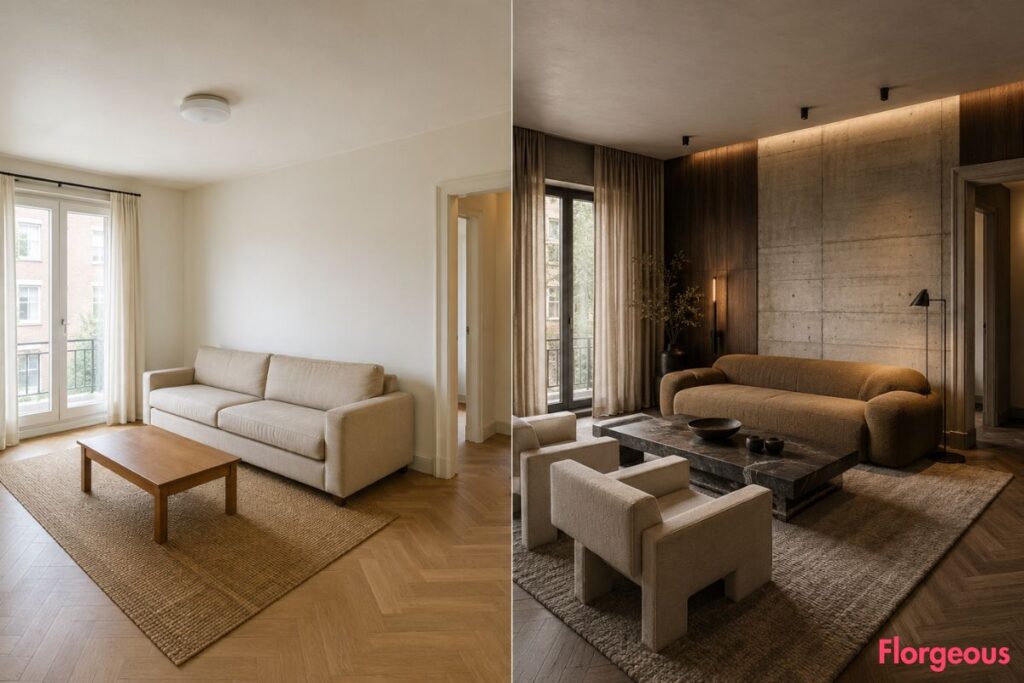
The plain builder-grade living room looked clean and usable, but it lacked personality. Warm off-white walls, a straight beige sofa, a bare coffee table, short curtains, and basic lighting gave the space no architectural focus.
For this makeover series, that exact room is redesigned 11 different ways. The camera position, doorway, windows, flooring, ceiling height, dimensions, and circulation stay unchanged in every version.
These Brutalist Living Room ideas show how honest materials and substantial forms can create comfortable, expressive interiors. The transformations move from classic concrete and warm timber to soft plaster, colored glass, biophilic forms, compact storage, reversible rental treatments, and polished stone-and-bronze luxury.
1. Turn the Plain Room Into a Classic Board-Formed Concrete Retreat
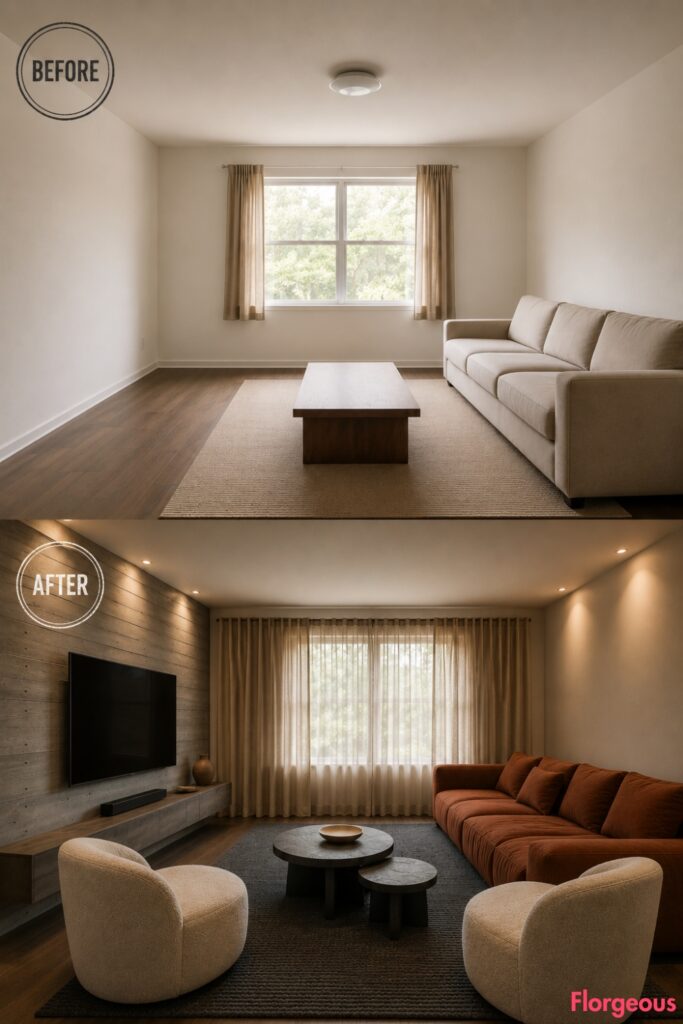
The first makeover captures architectural Brutalism in its clearest form. Instead of covering every surface with gray concrete, it concentrates the strongest texture on one carefully designed focal wall.
Before: The familiar builder-grade room has off-white walls, a beige sofa, a bare rectangular table, a simple rug, short curtains, and no clear focal point.
After: A board-formed concrete media wall anchors the room with visible timber-grain impressions. A low rust-colored sofa faces two oatmeal wool chairs, while slate nesting tables, a charcoal flatweave rug, full-length flax curtains, and recessed wall washers soften the hard surface.
The long, low composition makes the room feel wider and more architectural without changing its structure.
Designer Tip: Use concrete-effect wall panels or mineral plaster over a shallow media unit if poured concrete is impractical.
2. Warm Concrete With a Floor-to-Ceiling Walnut Storage Wall
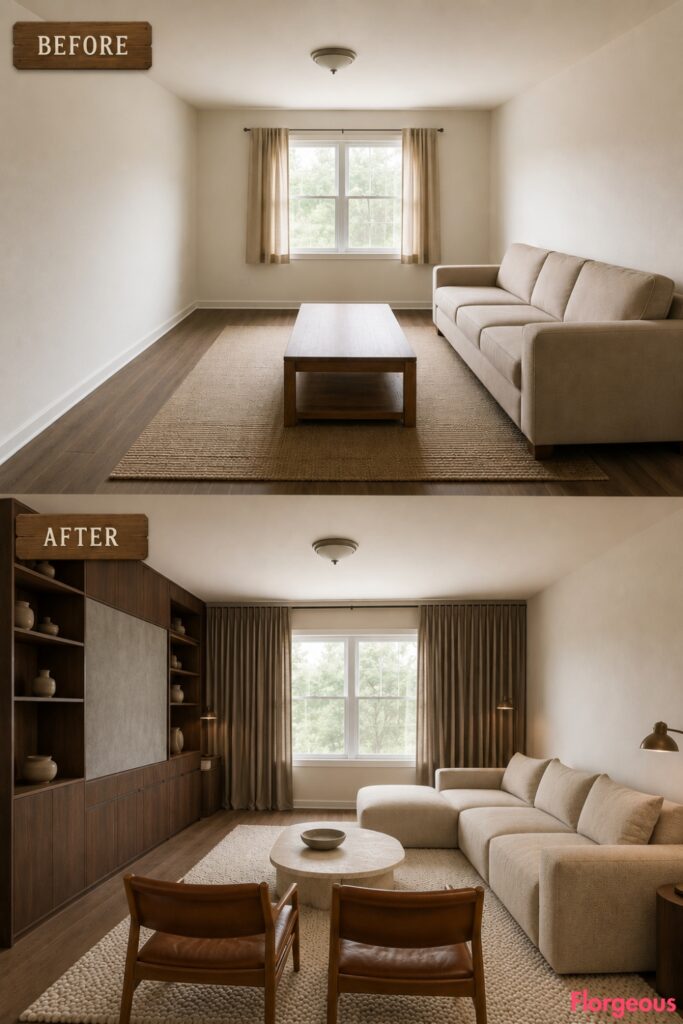
This version balances structural concrete with richly grained timber, creating a room that feels grounded rather than severe.
A smoked-walnut storage wall stretches from floor to ceiling, concealing media equipment, books, and everyday clutter. Opposite it, a smaller smooth-concrete panel creates a quiet counterpoint.
The seating arrangement centers on a sand-colored modular sofa and two saddle leather chairs positioned side by side facing it. An oval travertine table, thick cream rug, bronze reading lamps, and taupe curtains add softness without weakening the architectural character.
Walnut is especially effective because its reddish-brown undertones counteract the cool cast of concrete.
Why It Works: The cabinetry provides practical storage while introducing natural pattern, warmth, and visual depth.
3. Create Soft Brutalism With Mushroom Plaster and Deep Textiles
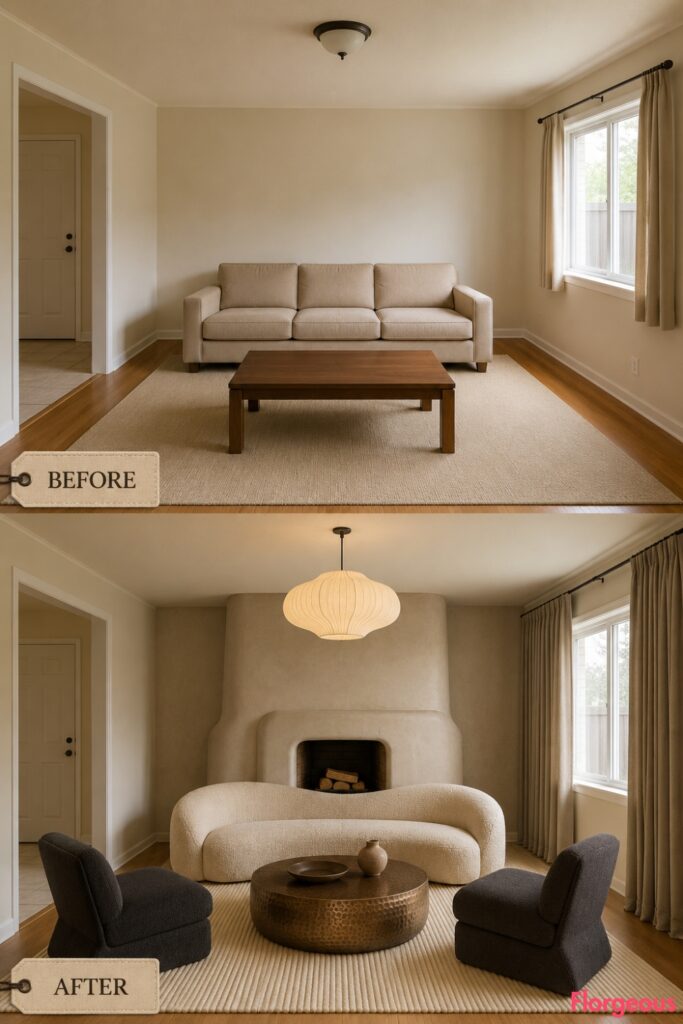
Brutalist design can rely on mass, texture, and shadow without using exposed concrete at all.
In this transformation, a broad mushroom-plaster chimney breast becomes the focal point. Its rounded edges and hand-finished surface create a sense of permanence while feeling softer than raw cement.
A curved oatmeal bouclé sofa sits opposite two charcoal wool lounge chairs. The seating is gathered around a hammered-bronze table, with a ribbed cream rug, heavy greige curtains, and a sculptural paper pendant completing the room.
The curtains and thick upholstery improve acoustics, which can be particularly helpful in rooms filled with plaster, stone, and other reflective surfaces.
Common Mistake: Avoid adding dozens of small cushions. A few deeply textured materials create a cleaner and more architectural result.
4. Make Pale Limestone Feel Monolithic but Light
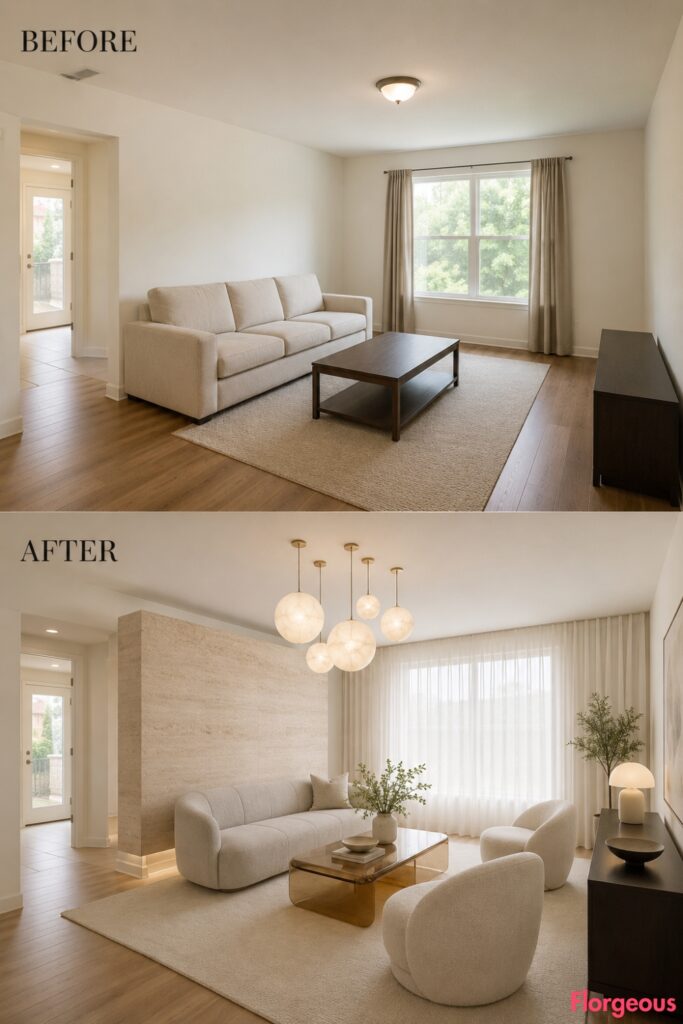
This interpretation uses pale stone to create visual weight without darkening the room.
A freestanding limestone screen becomes the main focal point, separating the seating zone from a narrow storage console while allowing space around both sides. Its honed finish and subtle fossil markings introduce quiet pattern.
A pearl-gray sofa is paired with two chalk-white molded chairs facing it. A translucent amber resin table prevents the composition from feeling too heavy, while a seamless ivory rug, sheer curtains, and clustered alabaster globes reflect daylight throughout the space.
Unlike the first concrete makeover, this room feels bright, polished, and almost weightless despite its substantial stone centerpiece.
Material Note: Select sealed limestone for easier cleaning, especially on tables or ledges used every day.
5. Introduce Industrial Brutalism With Steel and Colored Glass
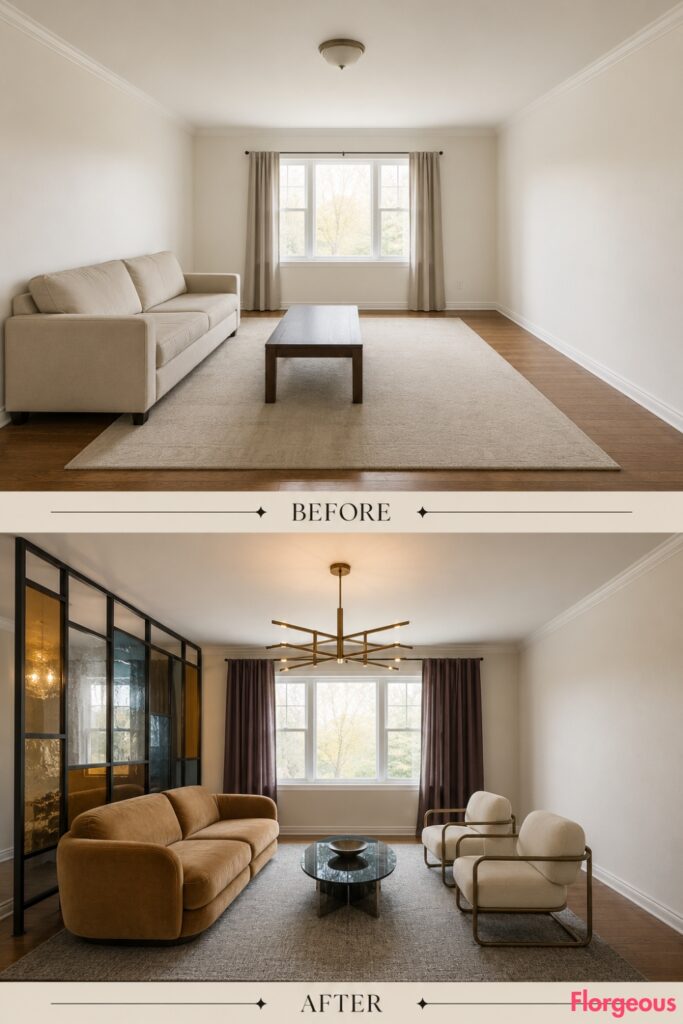
Blackened steel gives this room a precise industrial structure, while amber and smoked-blue glass prevent it from becoming visually flat.
A freestanding steel divider creates the primary focal point. Its geometric frame holds translucent colored-glass panels, allowing daylight to pass through while partially screening a compact media and work zone.
A camel mohair sofa faces two ivory tubular-frame chairs. An oval smoked-glass table, a silver-gray wool rug, aubergine curtains, and an angular bronze chandelier complete the composition.
This approach offers a stronger contrast than the timber-led room, yet the glass and mohair keep it suitable for comfortable everyday living.
Try This: A modular metal shelving system with acrylic panels can recreate the divider without permanent construction.
6. Turn the Living Room Into a Gallery for Collectible Brutalist Design
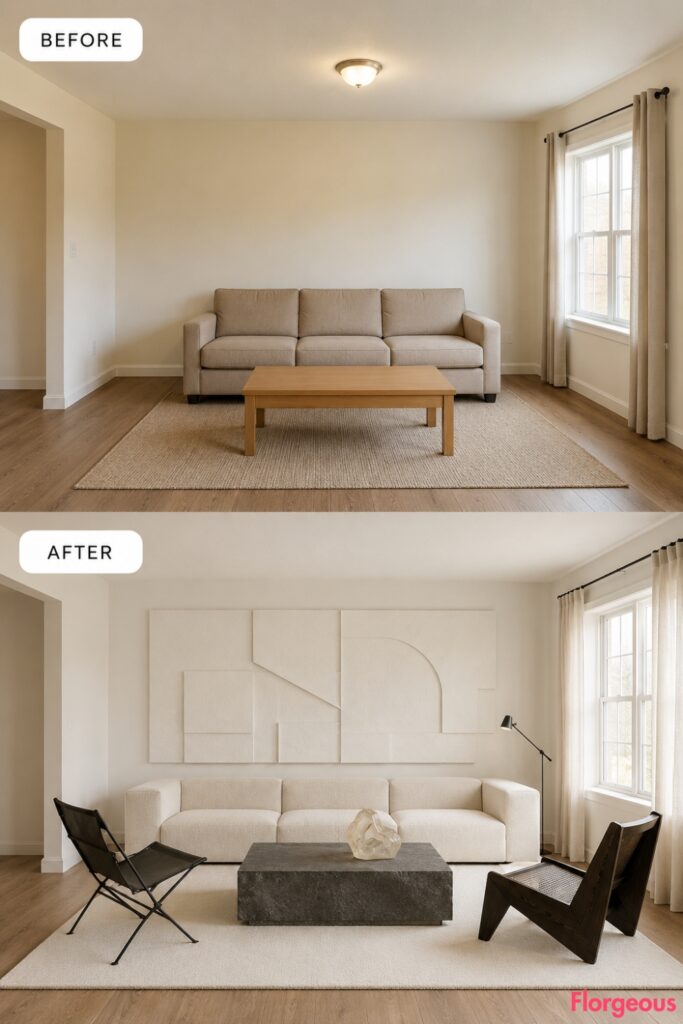
In this room, furniture and art provide the architecture.
Luminous mineral-white walls create a restrained backdrop for one oversized geometric plaster relief. The relief is the only large decorative feature, giving the space depth without introducing busy color or pattern.
A cream block sofa sits across from a folded black-metal chair and a sculptural dark-oak lounge chair. A monolithic soapstone table, pale floor covering, translucent resin sculpture, and adjustable reading lamp make the interior feel collected rather than conventionally decorated.
Each object has enough empty space around it to be appreciated from several angles.
Style Note: The furniture does not need to come from one collection. A mixture of vintage, contemporary, and handmade pieces often looks more authentic.
7. Build a Moody Charcoal Lounge Around Oxblood Leather
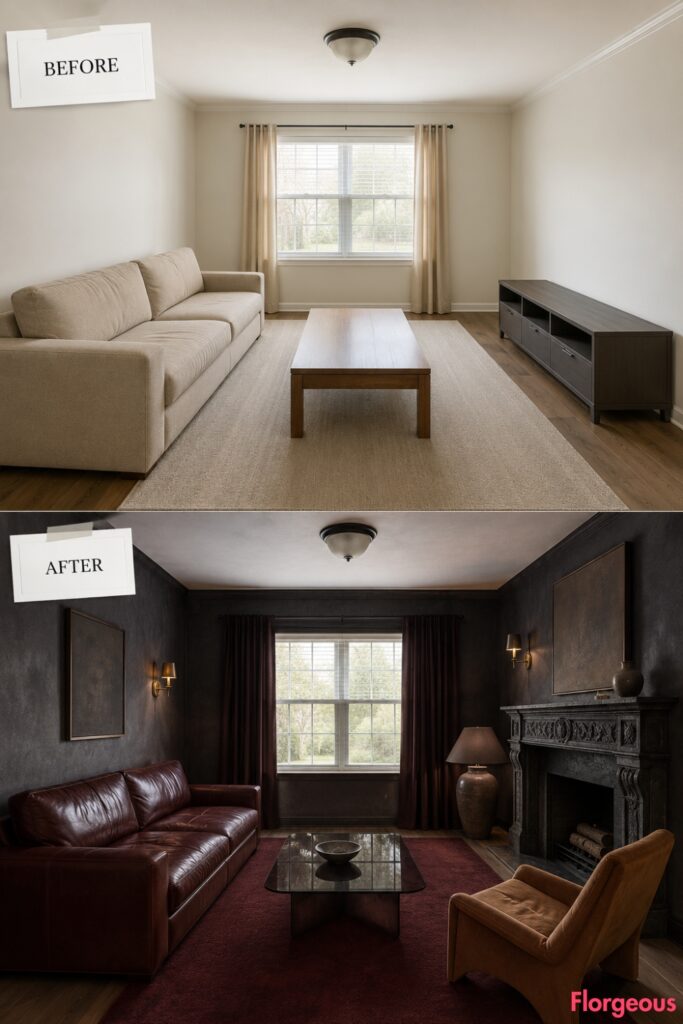
This is the darkest transformation in the collection, but layered color and lighting keep it intimate rather than bunker-like.
Charcoal limewash wraps the room in a softly mottled finish. A surface-applied carved dark-stone fireplace surround creates the focal point without changing the original opening or room architecture.
An oxblood leather sofa is paired with a camel suede lounge chair, smoked-glass table, burgundy wool rug, espresso curtains, brass sconces, and a large ceramic floor lamp.
The red, brown, and brass notes add warmth while preserving a restrained Brutalist palette.
Lighting Tip: Use several warm 2700K sources at different heights. Dark textured walls need side lighting to reveal their depth after sunset.
8. Combine Concrete, Cork, and Greenery for Biophilic Brutalism
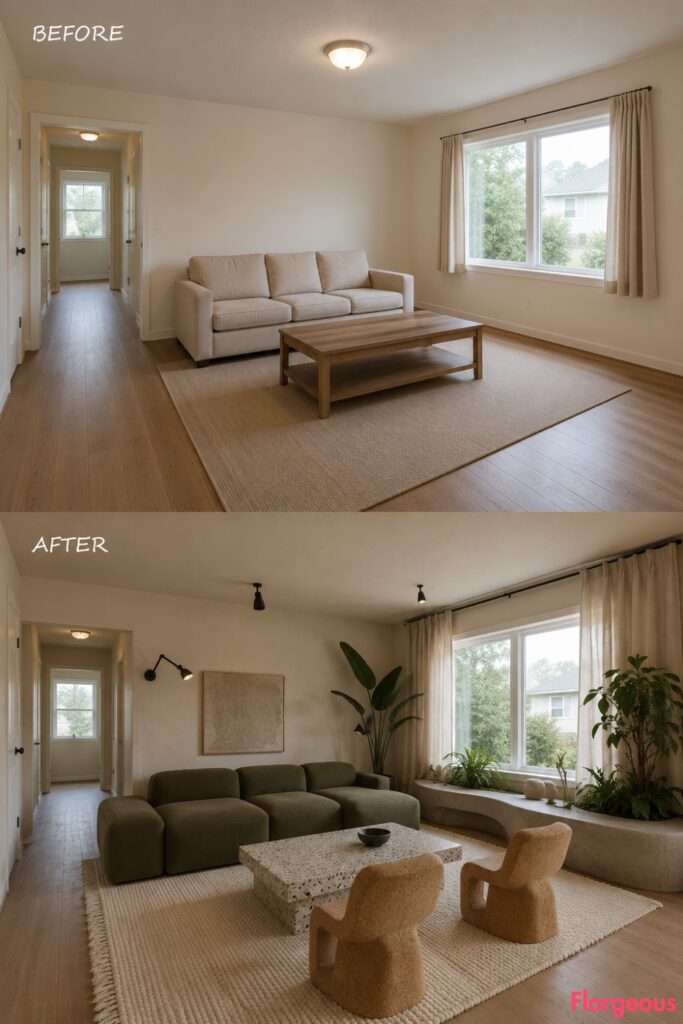
This room contrasts structural geometry with living, irregular forms.
A biomorphic concrete planter bench curves beneath the window while leaving the glass and circulation unobstructed. It accommodates several large sculptural plants and includes a dry ledge for books or a lamp.
An olive modular sofa faces two molded cork chairs across a recycled-terrazzo table. An undyed wool rug, flax curtains, and adjustable black lighting complete the natural material palette.
The concrete bench gives the room architectural weight, while cork, wool, plants, and muted green upholstery prevent it from feeling sterile.
Choose a few large plants rather than many small pots. Strong leaf silhouettes work better with substantial furniture.
9. Revisit 1970s Brutalism With Burnt Orange and Smoked Acrylic
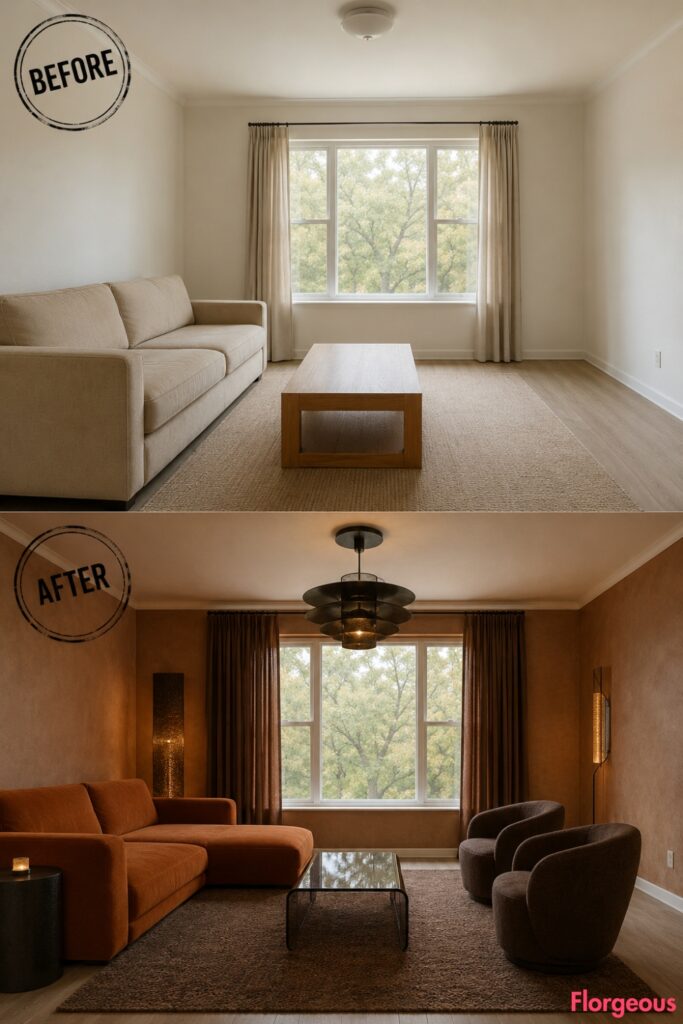
This retro makeover introduces rounded furniture and earthy color without becoming a generic mid-century room.
A large layered dark-metal ceiling light acts as the primary sculptural element. Beneath it, a burnt-orange modular sofa faces two chocolate swivel chairs, creating the feeling of a sunken conversation lounge without altering the floor level.
A smoked-acrylic table, muted brown rug, tobacco curtains, and warm clay walls complete the palette. The reflective table keeps the seating arrangement from feeling too visually dense.
Keep the colors concentrated in broad, confident areas. Scattering small orange and brown accessories around the room would make the look feel themed rather than architectural.
10. Give a Compact Room Architectural Storage and Flexible Seating
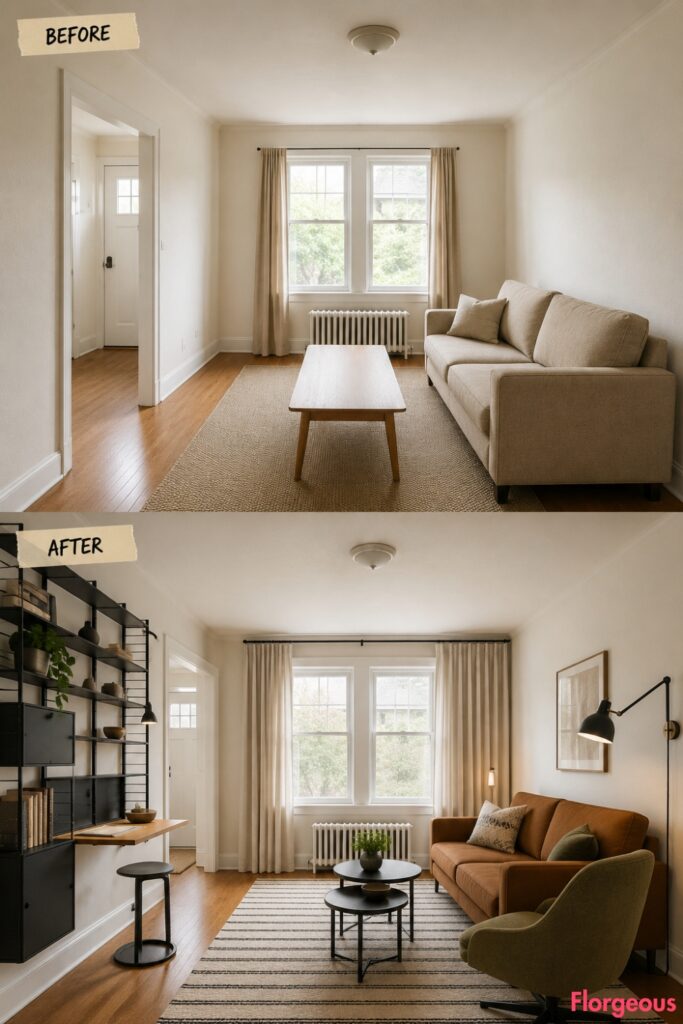
A small living room does not need oversized stone furniture to feel Brutalist. Strong lines, functional construction, and clearly defined mass can create the same character.
A narrow wall-mounted grid system becomes the room’s focal point. It combines closed storage, open display sections, and a concealed fold-down desk, all without extending into the doorway.
A compact camel loveseat, olive swivel chair, lightweight black nesting tables, striped runner, ceiling-track curtains, and swing-arm wall lights keep the center of the room open.
The furniture has substantial shapes, but each piece can move easily when the desk is used.
Small Space Tip: Keep the tallest and deepest elements against one wall, then protect a direct walkway from the entrance to the window.
11. Create a Reversible Luxury Look With Bronze, Color, and Stone
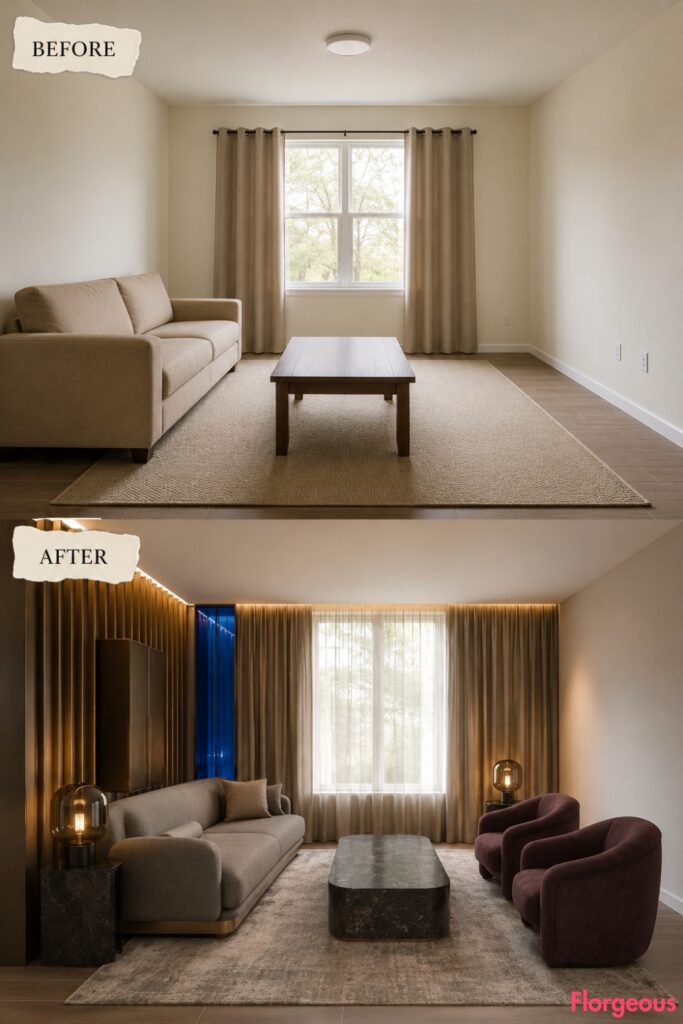
The final transformation combines rental-friendly installation methods with the polished materials associated with contemporary luxury Brutalism.
Removable vertical bronze-finish fins create the main focal point and conceal a slim freestanding storage unit. Between the fins, one translucent cobalt glass panel introduces color without relying on painted feature walls.
A streamlined greige sofa faces two plum mohair chairs across a dark recycled-stone table. A silver-beige rug, full-height flax curtains, smoked-glass lamps, and warm indirect lighting produce a layered, high-end atmosphere.
Every major feature can be removed or relocated. The fins attach to a freestanding frame, the glass panel is decorative rather than structural, and the stone table can be replaced with a lighter composite version.
Budget Version: Use bronze-effect timber battens, colored acrylic, and a stone-look laminate table to recreate the composition at a lower cost.
How to Choose the Right Brutalist Direction for Your Living Room
A successful Brutalist room does not require concrete on every surface. Begin with one dominant architectural idea, such as a textured wall, timber storage system, steel divider, plaster relief, stone screen, or sculptural lighting installation.
Then balance its visual weight with comfortable upholstery, warm light, tactile curtains, and a clear furniture plan. Pale stone and mushroom plaster suit rooms with limited daylight, while charcoal, blackened steel, oxblood leather, and dark timber work best where several warm light sources can be layered.
Renters and small-space dwellers can use removable panels, freestanding frames, mineral-effect paint, modular storage, and movable furniture to capture the character without permanent construction.
Before starting a full Brutalist Living Room makeover, test concrete, plaster, stone, timber, metal, and fabric samples in the room. View them in morning daylight, afternoon shadow, and warm evening light, since their color and texture can change noticeably throughout the day.