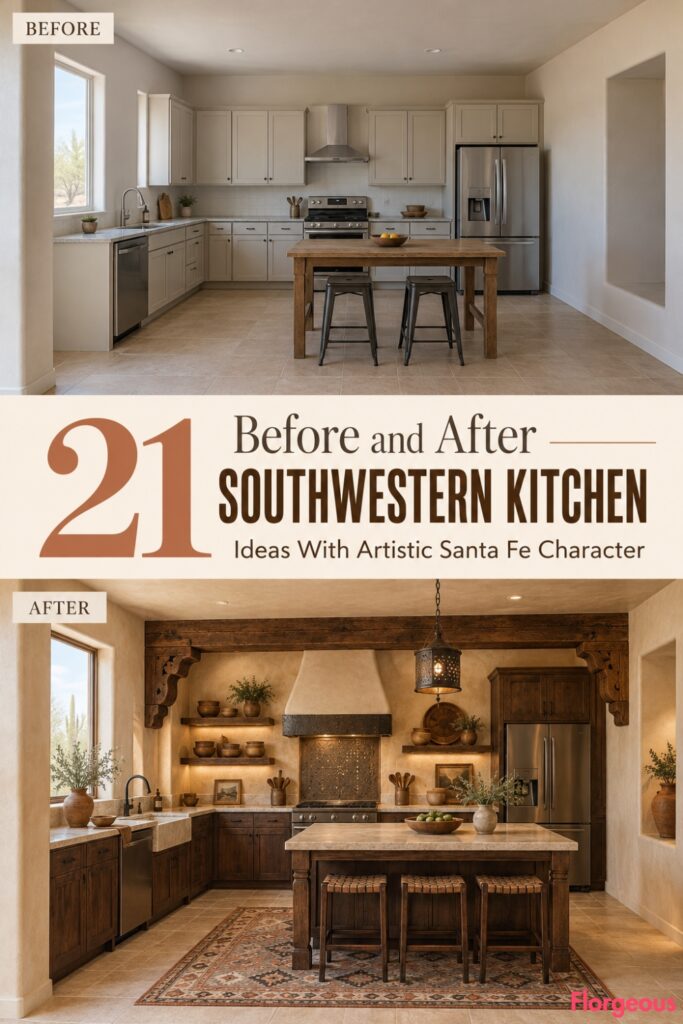
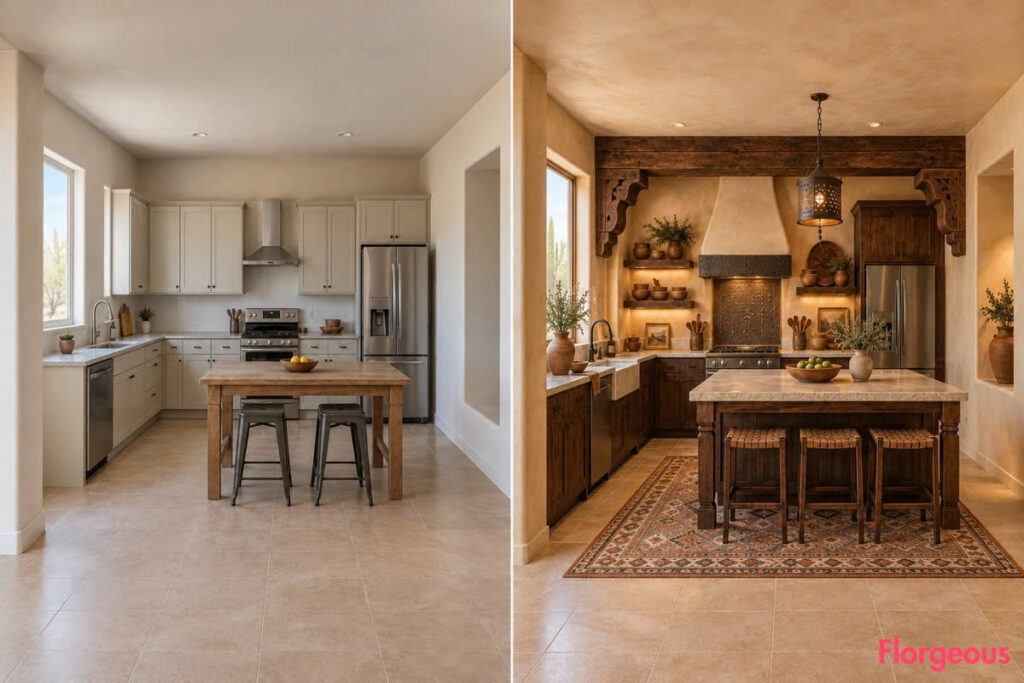
A plain builder-grade kitchen can have everything it technically needs and still feel completely forgettable. Pale cabinetry, ordinary counters, standard appliances, flat lighting, and a simple utility table offer function, but very little atmosphere.
A memorable Southwestern Kitchen should feel rooted in place. Santa Fe plaster, carved New Mexican woodwork, Spanish Colonial metalwork, Pueblo-inspired massing, regional textiles, hand-worked clay, dark iron, copper, and desert colors give the style a visual language that is far richer than simply painting cabinets terracotta.
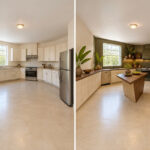
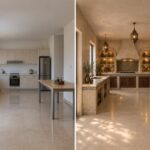
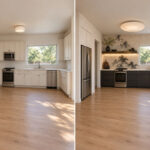
For all 21 transformations, begin with the same wide rectangular builder-grade kitchen: a wide open entry at the front-left, one tall narrow window toward the rear of the left wall, a shallow off-center rectangular recess on the rear-right wall, flat white ceiling, warm beige porcelain flooring, one pale cabinet run across the rear wall, fixed sink at rear-left, range at rear-center, refrigerator at rear-right, standard appliances, and a cheap rectangular utility table near center-right.
The shell, openings, ceiling, floor footprint, window, fixed plumbing, cooking service, refrigerator location, and room proportions never change. Camera positions vary between sections, but each BEFORE and AFTER pair must use the exact same camera, lens, framing, perspective, and daylight direction.
1. Create a Sculptural Santa Fe Adobe Screen
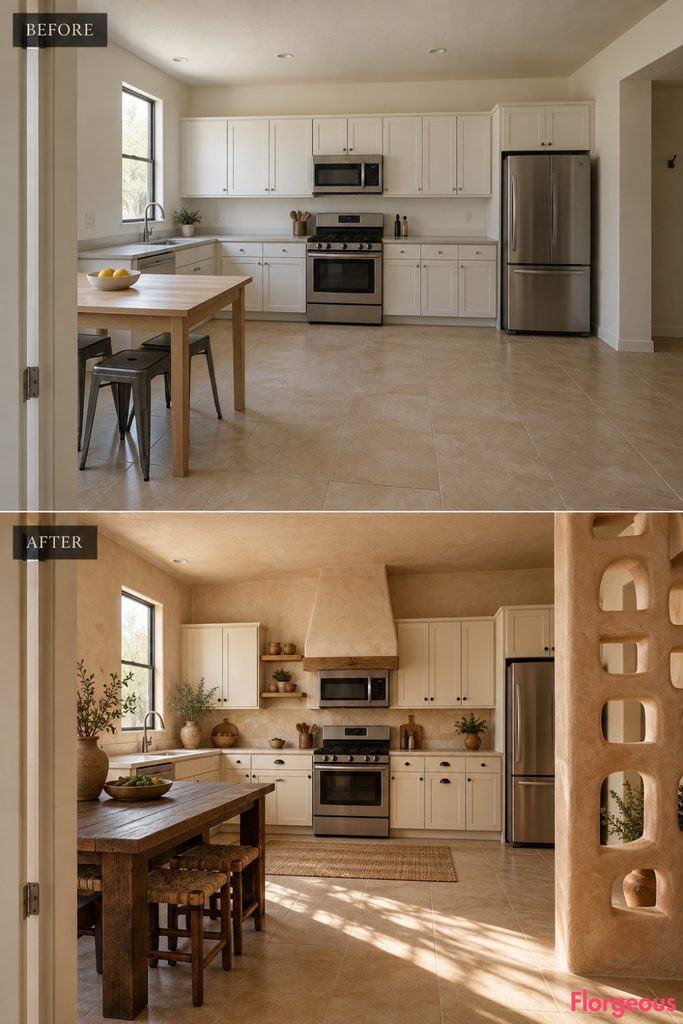
Turn the plain center of the kitchen into a striking Southwestern architectural moment.
Before: The basic utility table leaves the kitchen feeling flat and undefined.
After: Replace it with a dark mesquite prep table beside a freestanding perforated adobe-clay screen. Large geometric openings cast dramatic shadows across warm lime plaster, pale stone, and quiet cream cabinetry.
Why it works: The screen adds authentic Southwestern material, strong geometry, and artistic depth without blocking circulation.
Try this: Keep the clay pattern bold and simple so it feels architectural rather than decorative.
2. Build the Room Around a Spanish Colonial Copper Bell Hood
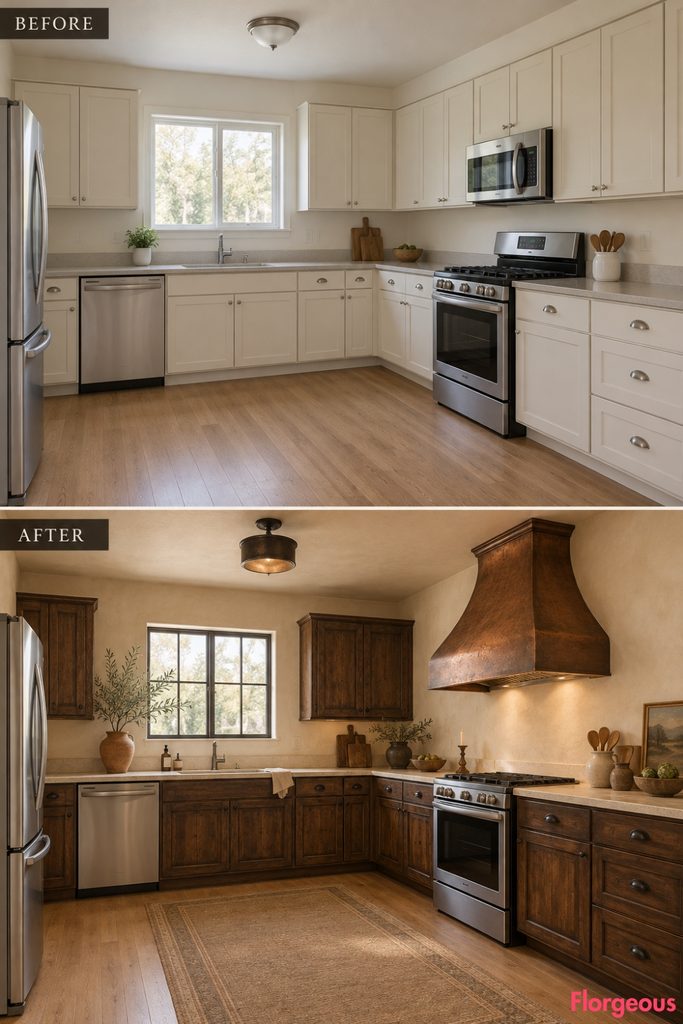
Here, a single handcrafted metal form becomes the visual anchor.
Before: The range sits anonymously within the cabinet run.
After: A broad bell-shaped hammered copper hood rises above the fixed range, with an irregular hand-worked surface and subtly darkened edges. Creamy mineral plaster and dark carved pine cabinetry create a quieter frame around it.
The copper should look aged and substantial, not glossy or decorative.
Designer Tip: Let the hood dominate. Avoid competing patterned tile behind it.
3. Make Punched Tin Cabinetry Feel Like Jewelry
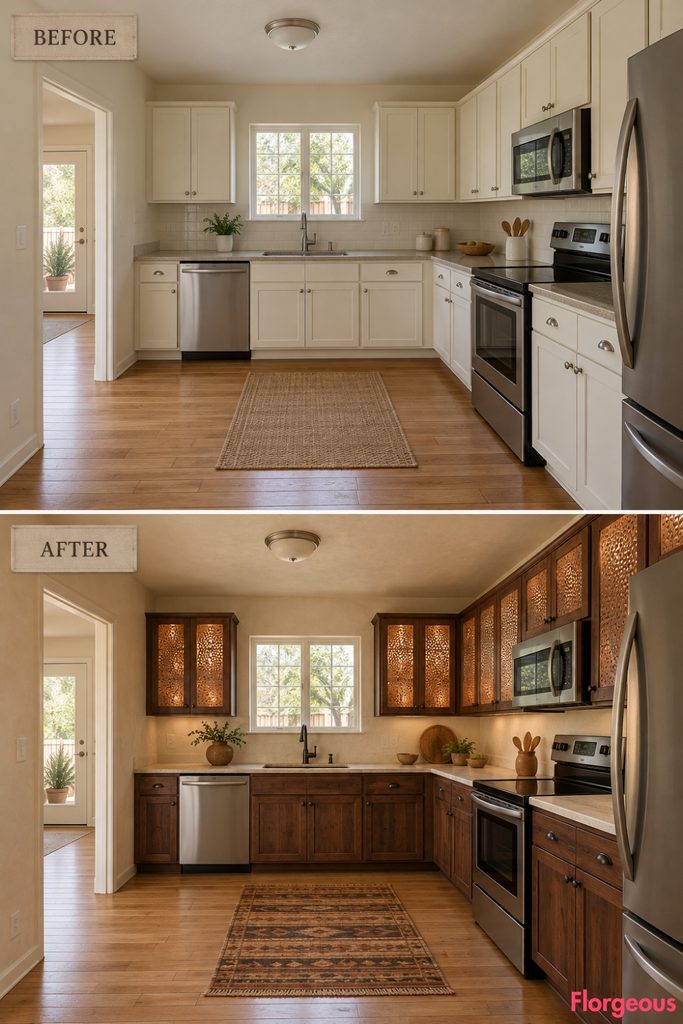
Traditional Southwestern tinwork becomes the centerpiece instead of a small accessory.
Before: Plain upper cabinets make the rear wall visually heavy.
After: Replace selected upper fronts with intricate hand-punched tin panels mounted inside dark wood frames. Use abstract geometric perforations rather than readable symbols or imagery.
Soft light inside the cabinets creates tiny points of shadow and depth across the metal.
Why it works: The kitchen keeps a strong regional craft identity while feeling detailed and almost jewel-like.
4. Create a Taos Blue Carved-Pine Composition
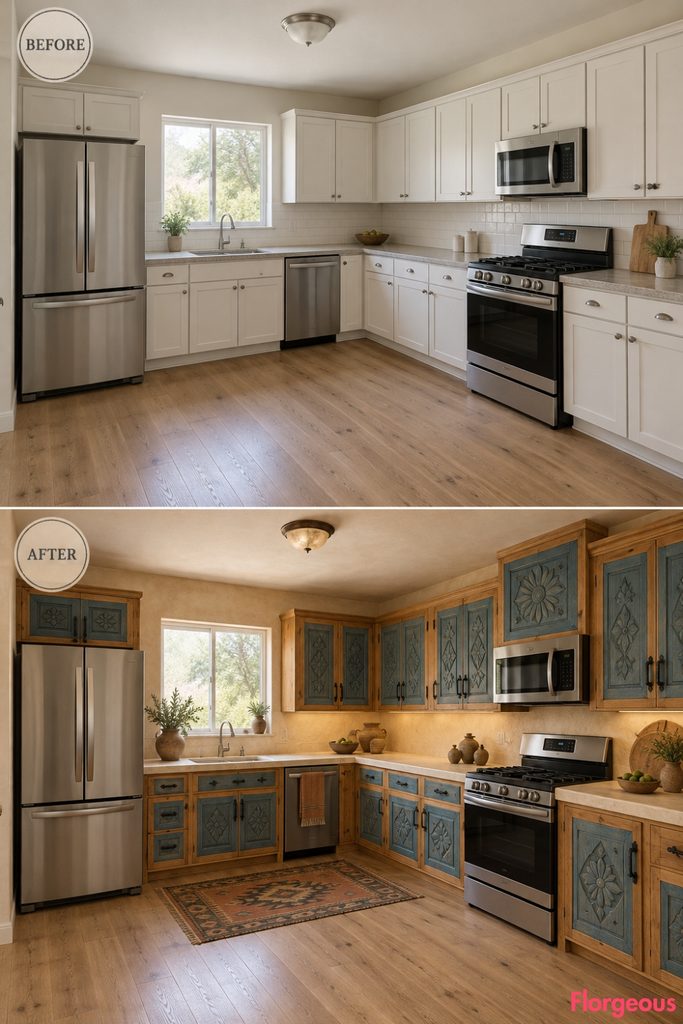
Taos blue becomes more sophisticated when combined with craftsmanship rather than simply covering every cabinet door.
Before: The cabinetry forms one bland continuous strip.
After: Use deep muted blue only on several large carved cabinet panels, each framed in natural pine with shallow hand-cut geometric detailing. Surround them with warm chalk plaster and honey-toned wood.
The result feels collected and regional rather than coastal.
Color Story: Keep the blue dusty and mineral, never bright turquoise.
5. Wrap One Central Piece in Chimayo-Inspired Woven Geometry
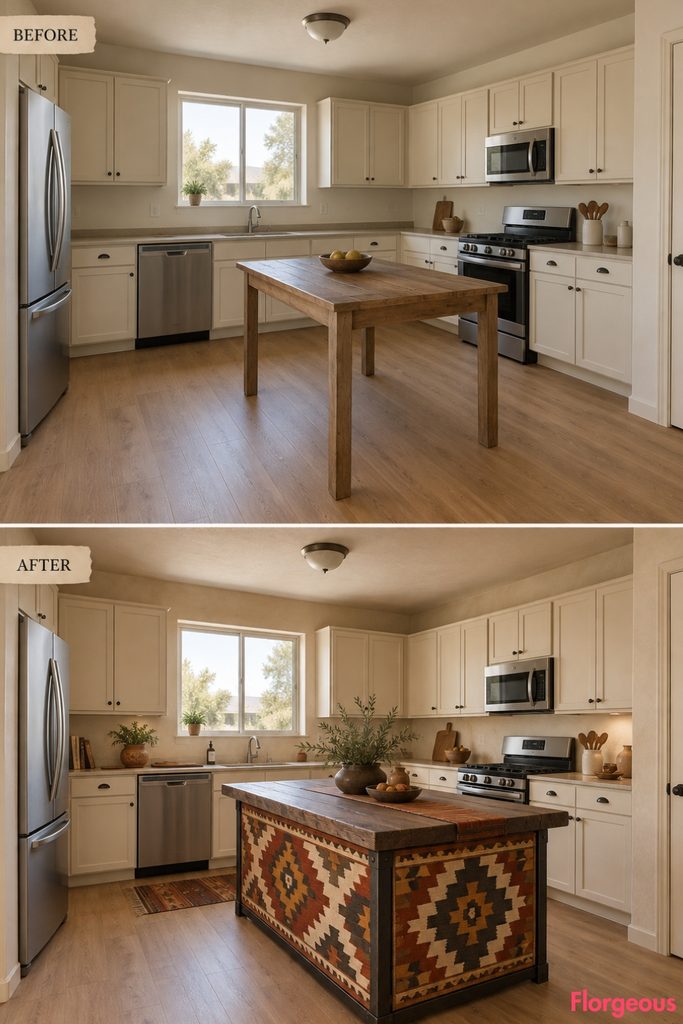
This idea uses textile craft at architectural scale.
Before: The cheap utility table adds no visual value.
After: Replace it with a compact rectangular preparation island whose outer face is wrapped in protected handwoven wool panels using muted brick, cream, tobacco, ochre, and charcoal stripes inspired by regional Southwestern weaving traditions.
A thick dark mesquite worktop adds enough visual weight to balance the textile.
Why it works: The centerpiece reads like functional textile art rather than a standard cabinet island.
6. Introduce Reclaimed Cactus-Rib Cabinet Doors
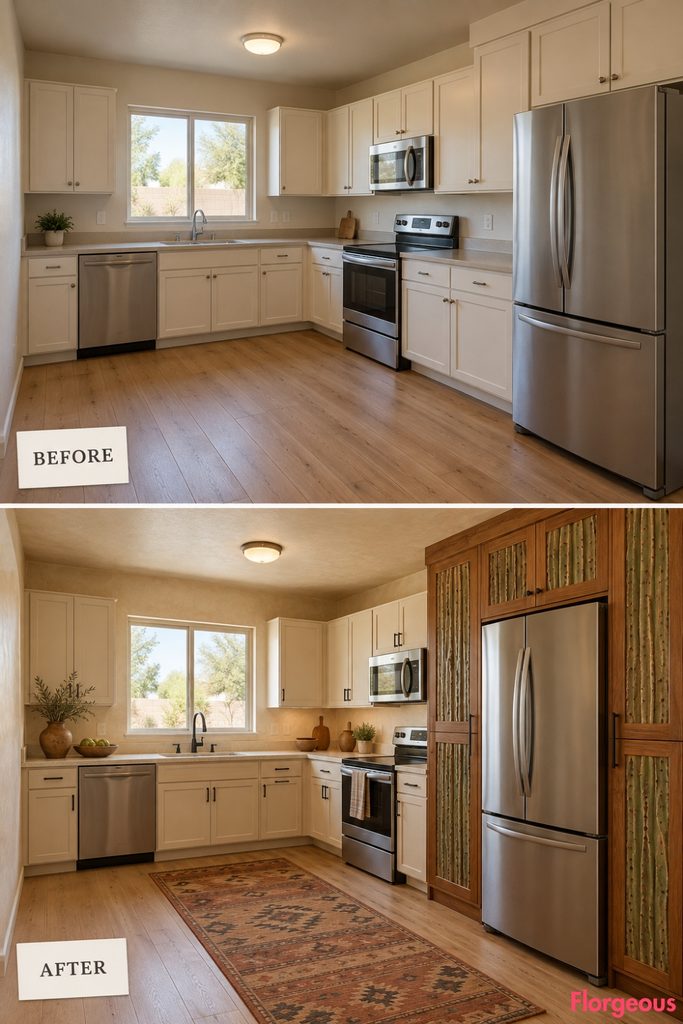
The Sonoran desert influence appears through material rather than decorative motifs.
Before: The tall storage around the refrigerator feels ordinary.
After: Selected tall cabinet doors use reclaimed cactus-rib inserts held inside simple warm wood frames. Their natural vertical texture creates a delicate contrast against thick smooth plaster.
Keep the material concentrated around the refrigerator zone so it feels special.
7. Shape the Cooking Hood Like Sedona Rock Layers
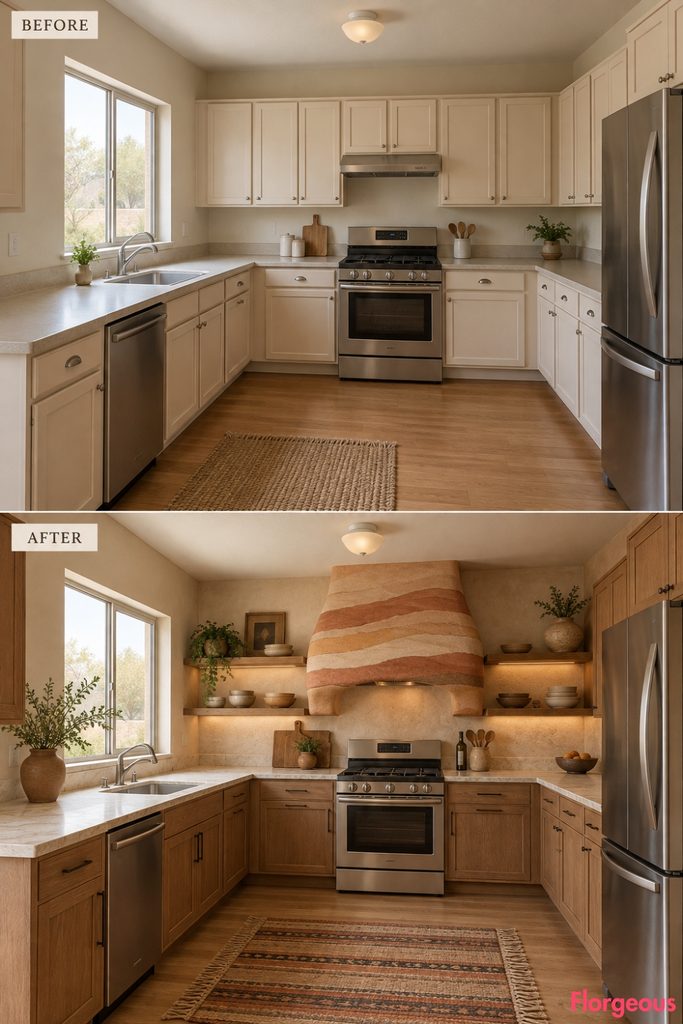
This transformation turns plaster into sculpture.
Before: The cooking wall is flat and predictable.
After: Above the fixed range, several broad horizontal plaster layers project at slightly different depths, creating an abstract hood form inspired by stratified red-rock cliffs.
Muted sienna, dusty clay, and chalk mineral tones emphasize the horizontal layering without becoming a literal landscape.
Why it works: It feels unmistakably desert-inspired while remaining a functional architectural element.
8. Paint a New Mexican Folk-Art Cabinet Frieze
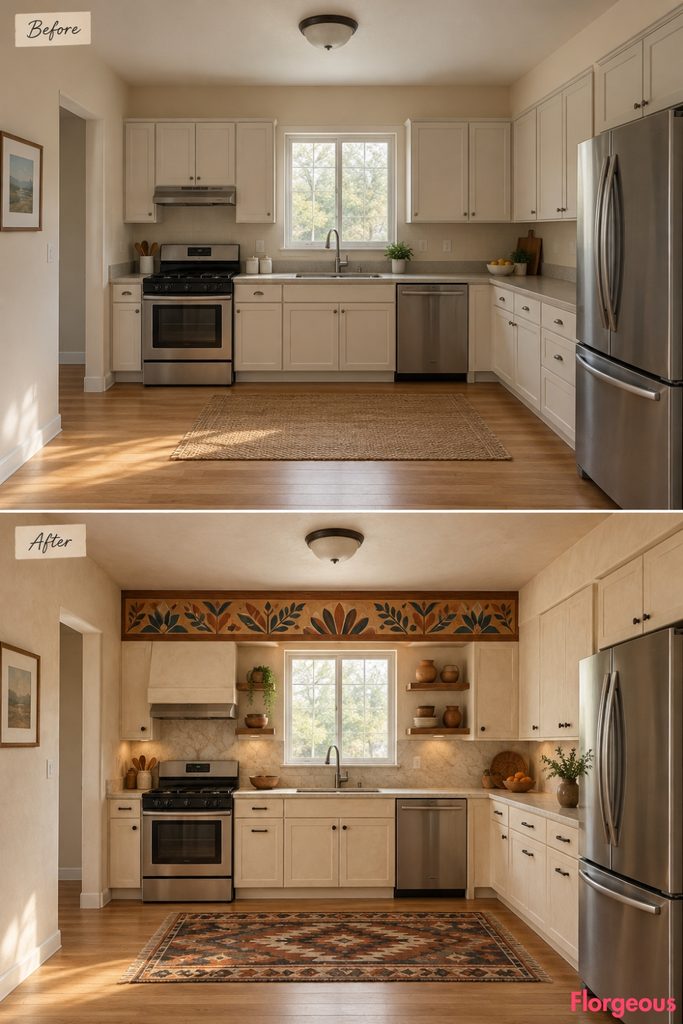
Instead of covering a wall with art, integrate artwork directly into the millwork.
Before: A blank strip above the lower cabinetry contributes nothing to the room.
After: Introduce a continuous hand-painted wooden frieze across the rear cabinetry using abstract desert flowers, leaves, birds, and geometric linework in faded ochre, rust, blue-green, black, and cream.
The rest of the kitchen stays calm and mineral.
Style Note: The artwork should feel handmade and imperfect, never digitally printed.
9. Create a Pueblo Blackware Kitchen
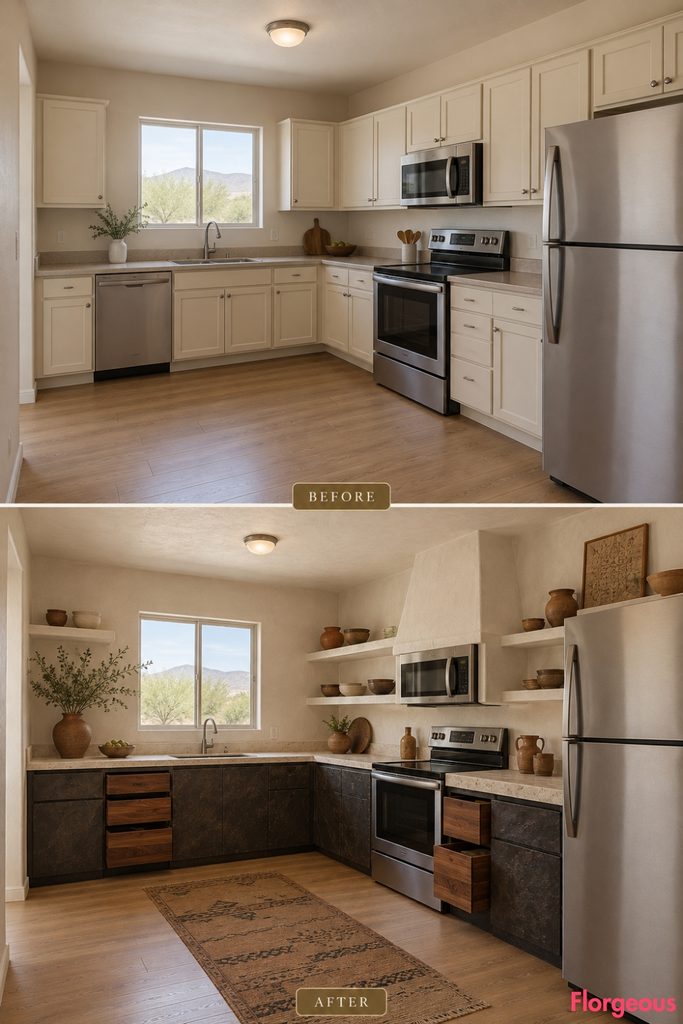
This concept uses fired clay in a darker and more sculptural way.
Before: Pale factory cabinetry makes every surface look lightweight.
After: Large matte-black fired-clay panels face the lower cabinetry, each with subtly irregular hand-burnished surfaces. Chalk-white plaster above creates a dramatic contrast.
Warm pecan interiors appear only when drawers and doors open.
Why it works: The black clay gives the kitchen weight and craft while keeping the palette unmistakably Southwestern.
10. Reinterpret Territorial Style With Milled Wood Frames
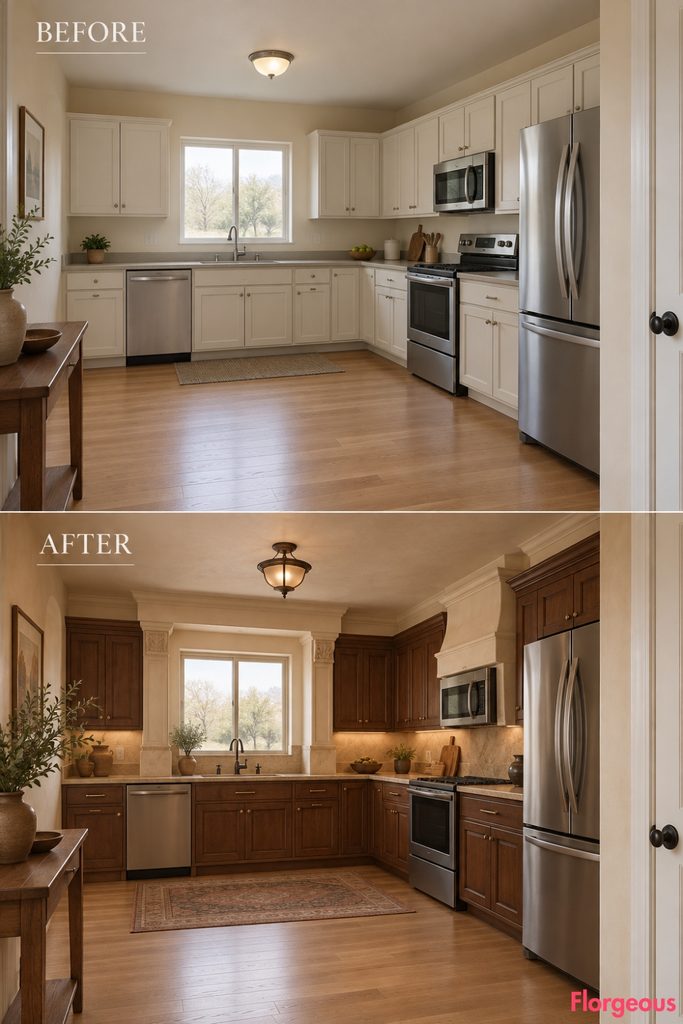
Territorial interiors bring a slightly more formal edge to Southwestern architecture.
Before: The cabinetry feels mass-produced and visually loose.
After: Cream-painted milled wood frames organize the sink, range, and refrigerator zones into a disciplined composition. Deep walnut cabinet doors sit inside the pale framework, while small carved corner blocks add subtle historic character.
Why it works: The room feels Southwestern without relying on rustic roughness.
11. Use Spanish Colonial Ironwork as Cabinet Architecture
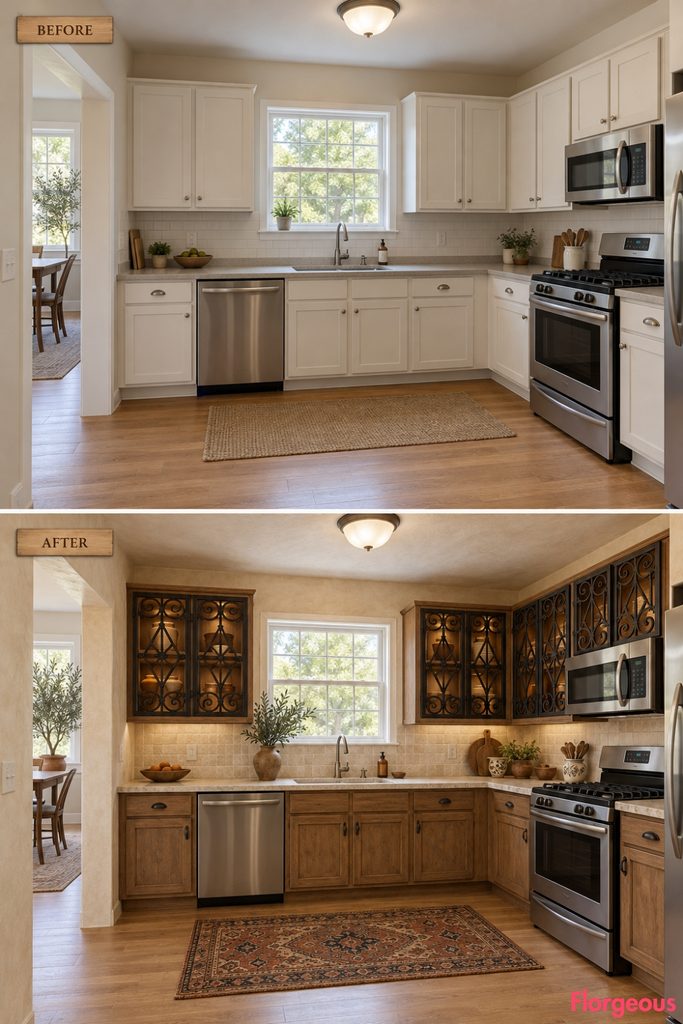
Instead of placing ironwork only in lighting, make it part of the cabinetry itself.
Before: Upper storage consists of ordinary solid doors.
After: Selected cabinets become deep dark niches fronted with beautifully forged black iron grilles using loose scroll and diamond geometry. Timber backs and warm ceramics show through the metal.
No glass is needed.
Why it works: The iron introduces shadow, transparency, and craftsmanship without repeating glass-front cabinetry.
12. Suspend Colcha-Inspired Textile Panels Overhead
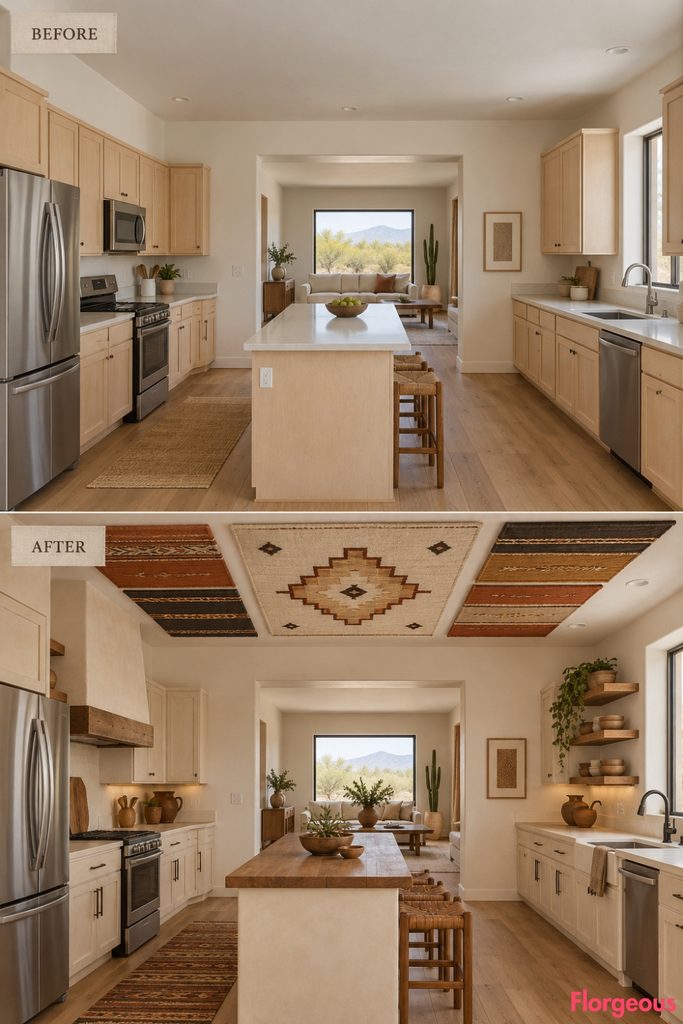
This makeover makes the ceiling artistic without using beams or slats.
Before: The flat white ceiling does nothing for the room.
After: Several broad, shallow textile panels mount directly against the ceiling plane, upholstered in muted hand-embroidered wool with simplified geometric and botanical stitching inspired by regional New Mexican textile craft.
The ceiling height remains unchanged.
Why it works: Texture and craft move overhead without becoming a conventional beam treatment.
13. Give an Arizona Ranch Kitchen Tailored Leather Millwork
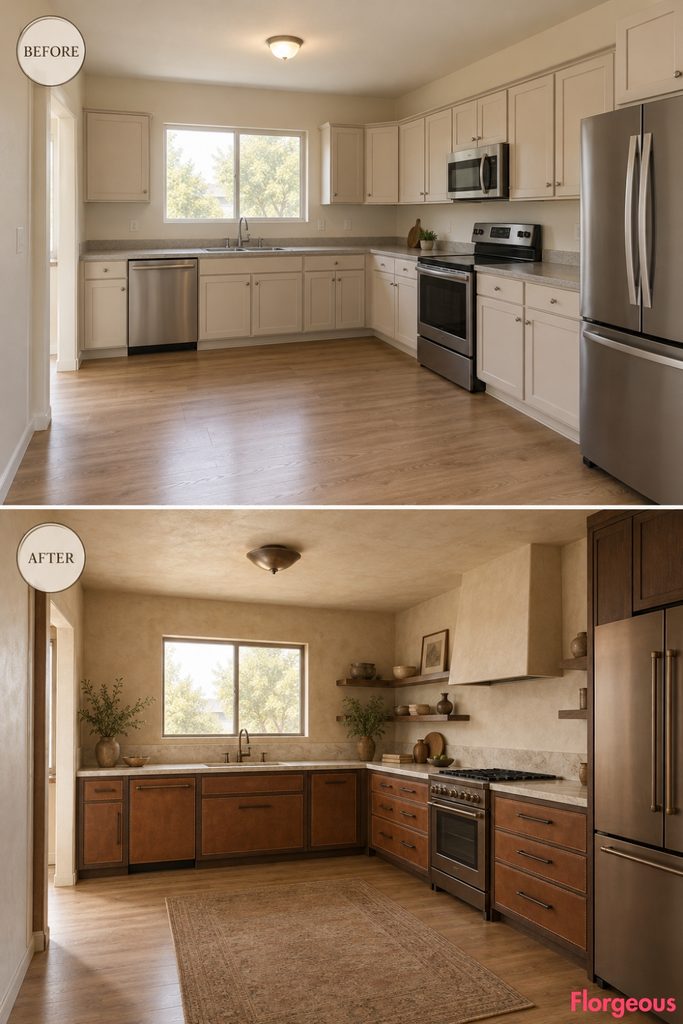
Ranch references can look refined rather than themed.
Before: The drawers and lower cabinets are visually flat.
After: Selected wide drawer fronts are wrapped in saddle-brown leather with precise contrast stitching and dark mesquite perimeter frames. Cream plaster and pale stone prevent the leather from making the room too dark.
Large sculptural iron pulls finish the composition.
14. Create a Mesilla Dry-Garden Edge
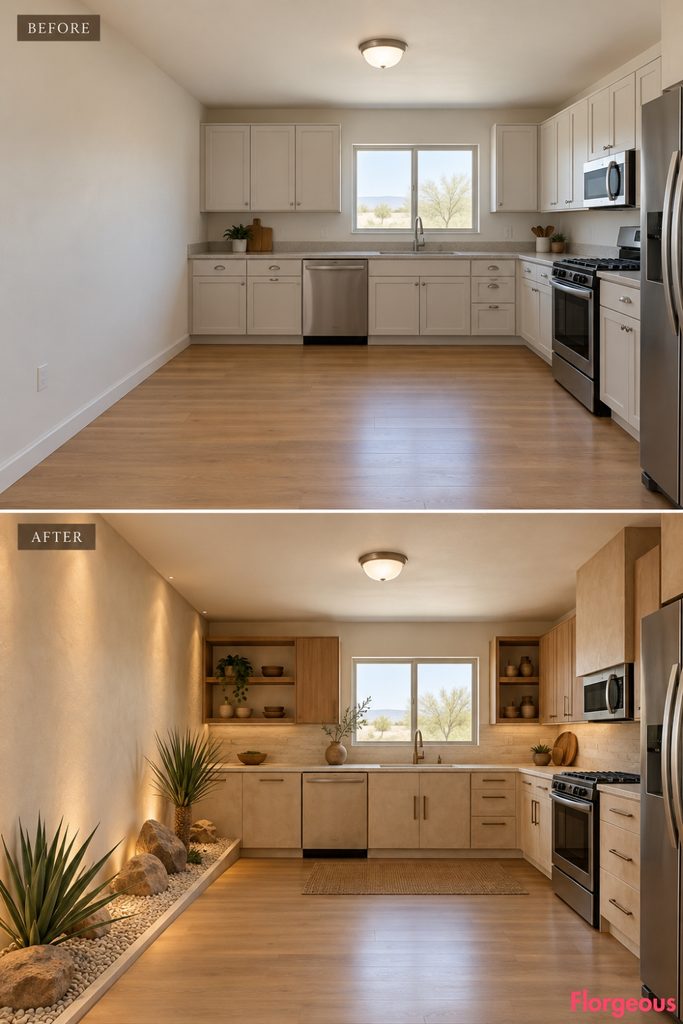
Bring the desert landscape inside without filling the kitchen with houseplants.
Before: The long solid side wall feels unused.
After: Install a very shallow raised mineral trough along part of the solid wall, filled with pale gravel, sculptural stones, and only two or three carefully spaced desert plants such as agave or yucca.
A narrow wall wash makes their silhouettes part of the composition after dark.
Why it works: It introduces the desert itself as visual material while leaving the kitchen center completely open.
15. Turn the Sink Into a Hand-Painted Ceramic Composition
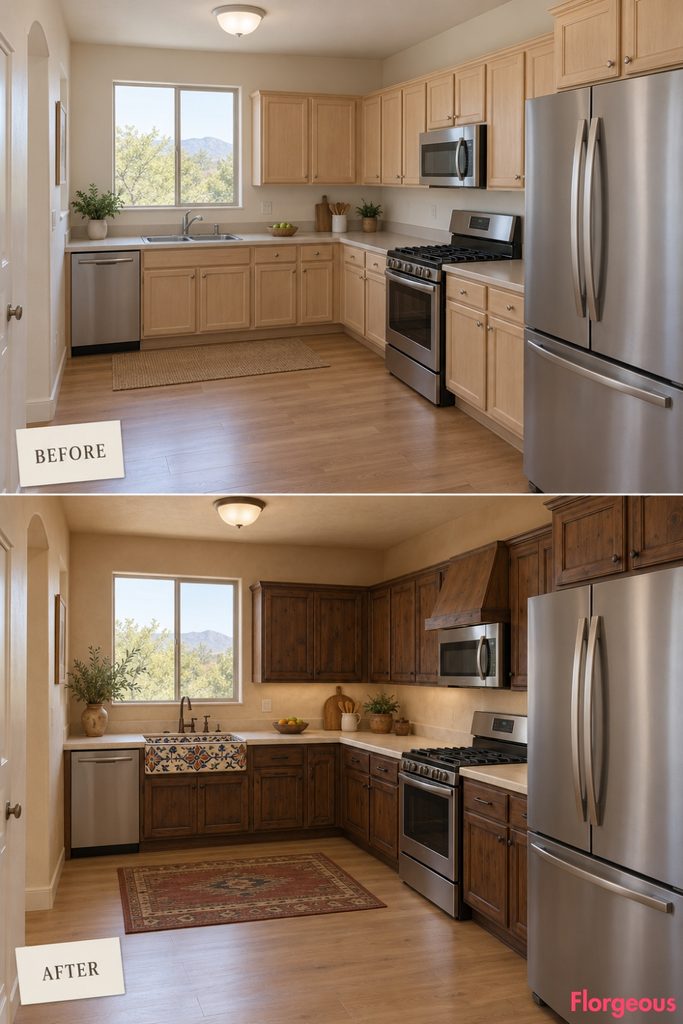
This is the most colorful traditional direction in the set, but the color remains tightly controlled.
Before: The fixed sink is visually anonymous.
After: Introduce one large handmade ceramic apron sink with a painterly cobalt, rust, cream, and muted green pattern. Surround it with dark carved wood cabinetry and a simple pale stone counter so the sink reads like functional artwork.
Avoid repeating the ceramic pattern anywhere else.
16. Push Southwestern Style Toward Arizona Desert Modern
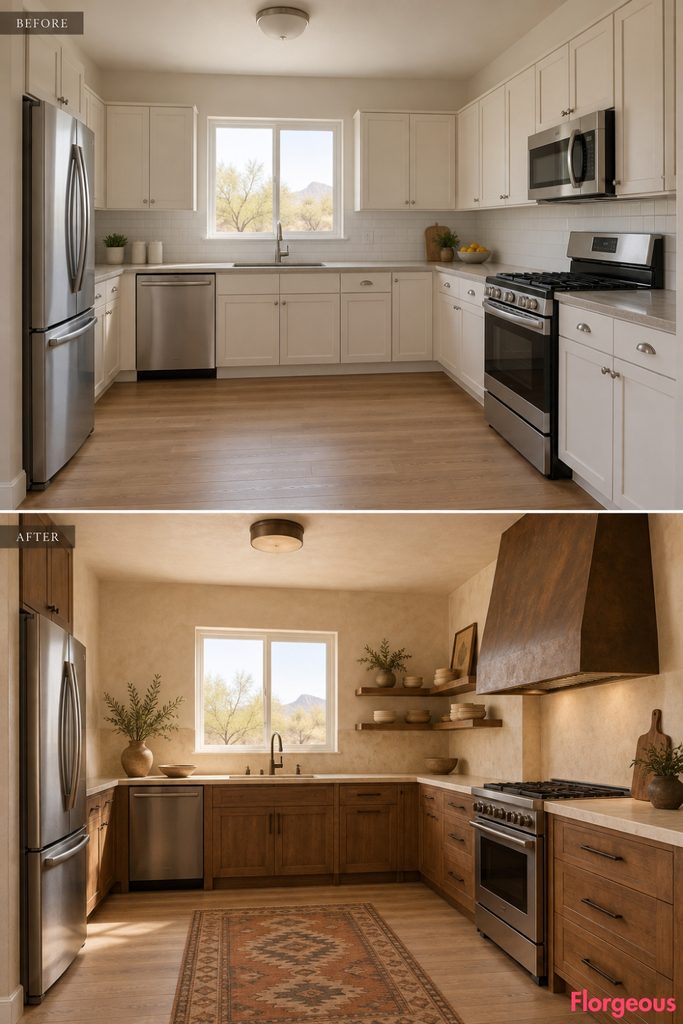
This section keeps the regional palette but sharpens the architecture.
Before: The kitchen has no visual tension.
After: A broad oxidized-steel range shield rises behind the fixed cooking zone, framed by bone-colored plaster and warm mesquite cabinetry. Its naturally rusted surface brings the red-brown desert palette into a much cleaner contemporary composition.
Why it works: The room remains unmistakably Southwestern through color and material, but the expression becomes modern and gallery-like.
17. Turn Blackware Pottery Into a Sculptural Lighting Language
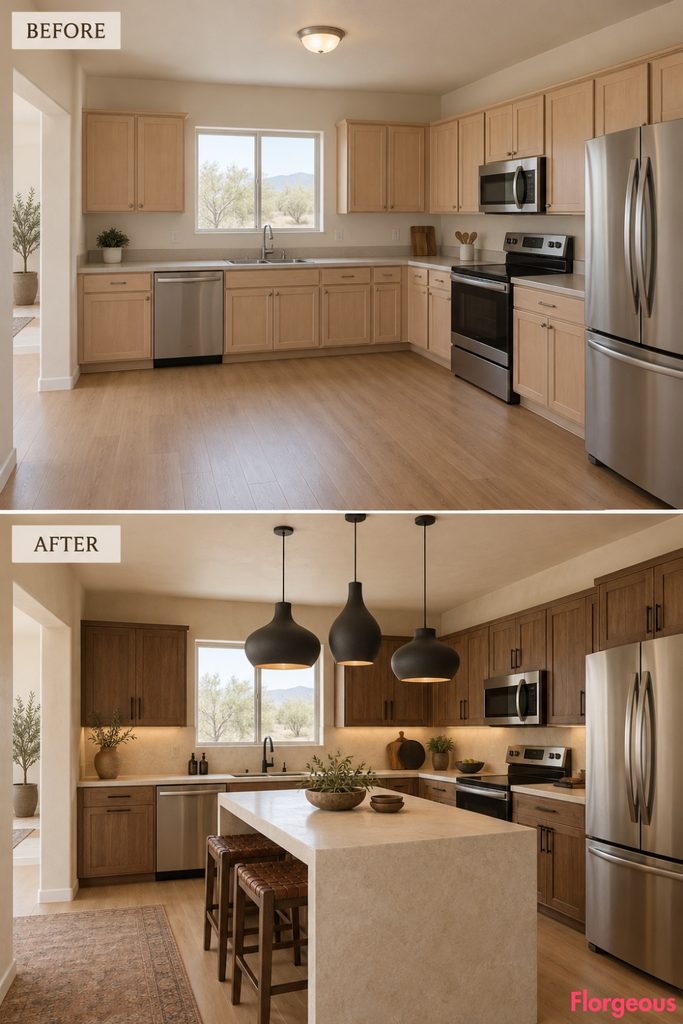
Instead of standard pendants, reinterpret Southwestern pottery as light sculpture.
Before: One basic ceiling fixture leaves the room visually flat.
After: Use three oversized matte-black ceramic shades shaped like abstract hand-thrown vessels, each different in silhouette but related in finish. They hang at carefully controlled heights over the preparation zone.
The cabinetry stays pale enough for the dark forms to read clearly.
18. Cover the Ceiling With Painted Santa Fe Panels
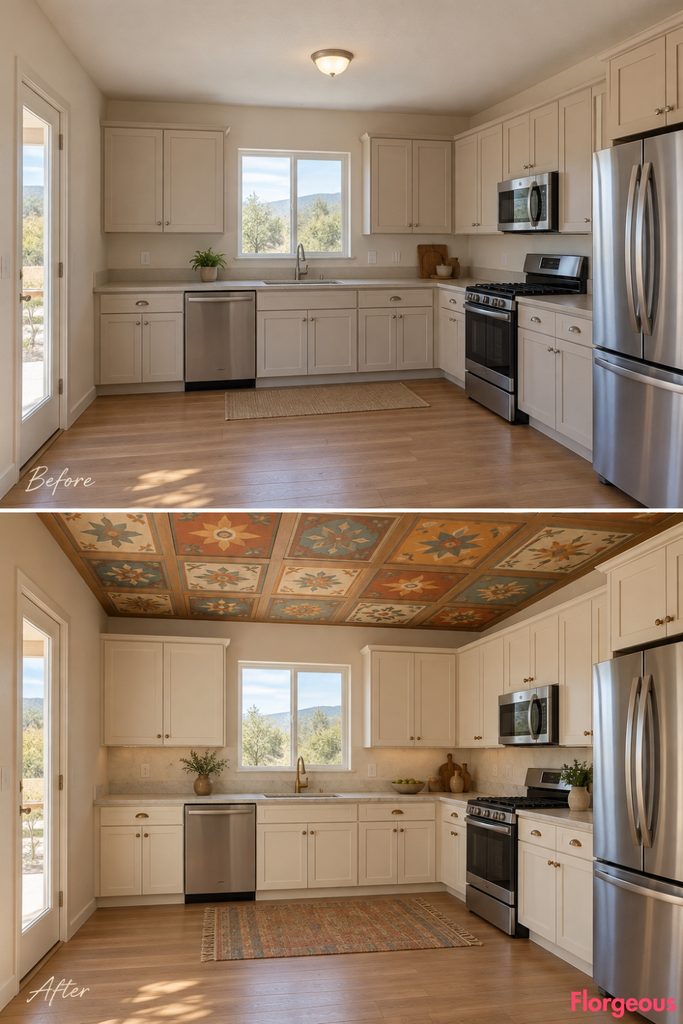
This ceiling treatment relies on color and folk craft rather than timber beams.
Before: Flat white ceiling, one generic light.
After: Apply a grid of shallow painted wood panels directly to the existing ceiling surface. Each panel uses a different muted desert field such as clay, ochre, faded turquoise, cream, and tobacco, with subtle hand-brushed border work.
The cabinetry below becomes restrained and nearly monochrome.
Why it works: Looking upward becomes part of the experience of the room.
19. Create a Rio Grande Textile Cabinet Band
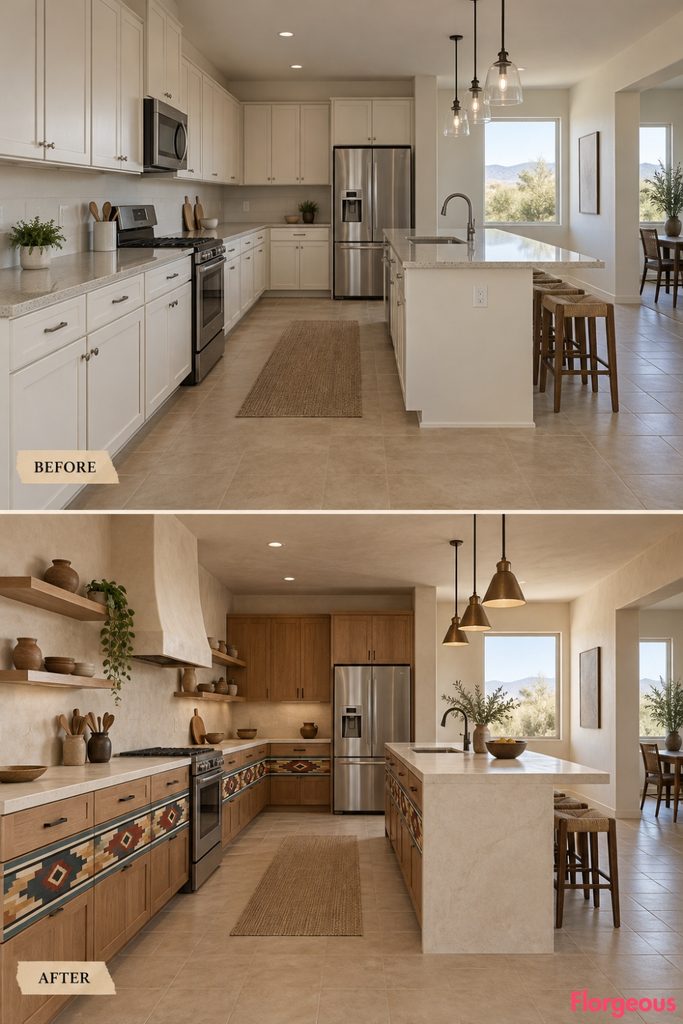
Here, the regional textile becomes a continuous horizontal artwork.
Before: Lower cabinetry reads as a repetitive line of plain doors.
After: A narrow band of protected woven textile runs across selected cabinet fronts at hand height, using alternating cream, black, brick, ochre, and muted blue stripes. The remainder of each door stays warm timber.
The stripe behaves almost like an architectural datum around the room.
20. Carve a Spanish Colonial Stone Apron Across the Prep Zone
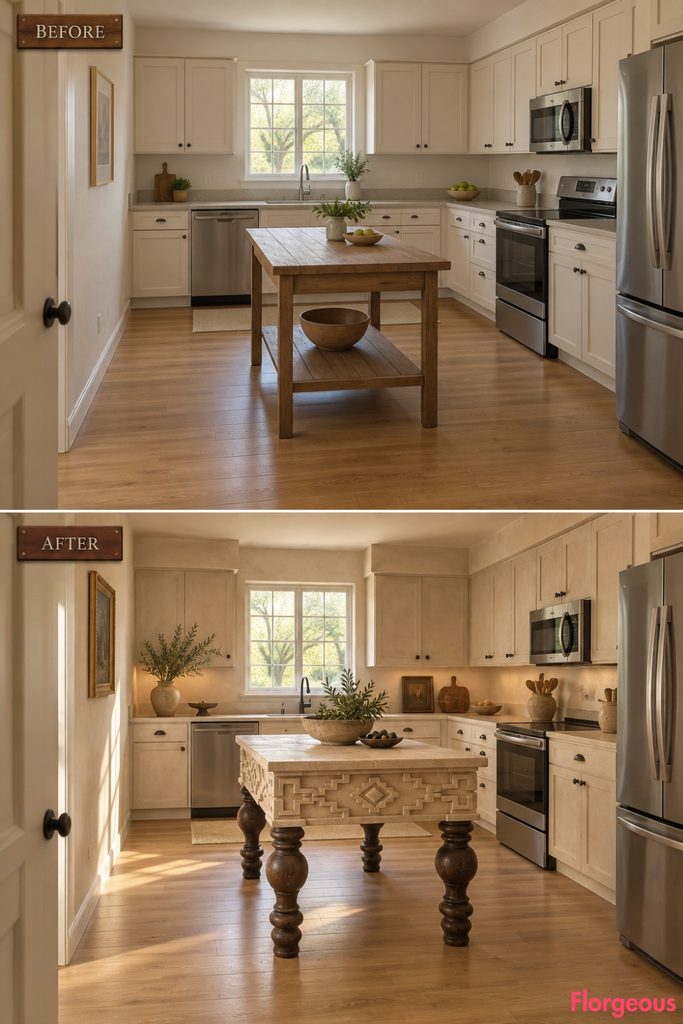
Instead of a conventional island base, treat the central preparation surface almost like carved furniture.
Before: The center contains a lightweight rectangular utility table.
After: Replace it with a broad preparation table whose pale carved-stone apron features deep but restrained geometric relief, supported by four dark turned-wood legs. A simple slab top keeps it functional.
The carving is abstract and non-symbolic.
Why it works: It feels handcrafted, substantial, and related to Spanish Colonial Southwestern interiors without copying ordinary stone islands.
21. Finish With a Monumental Santa Fe Desert Fresco
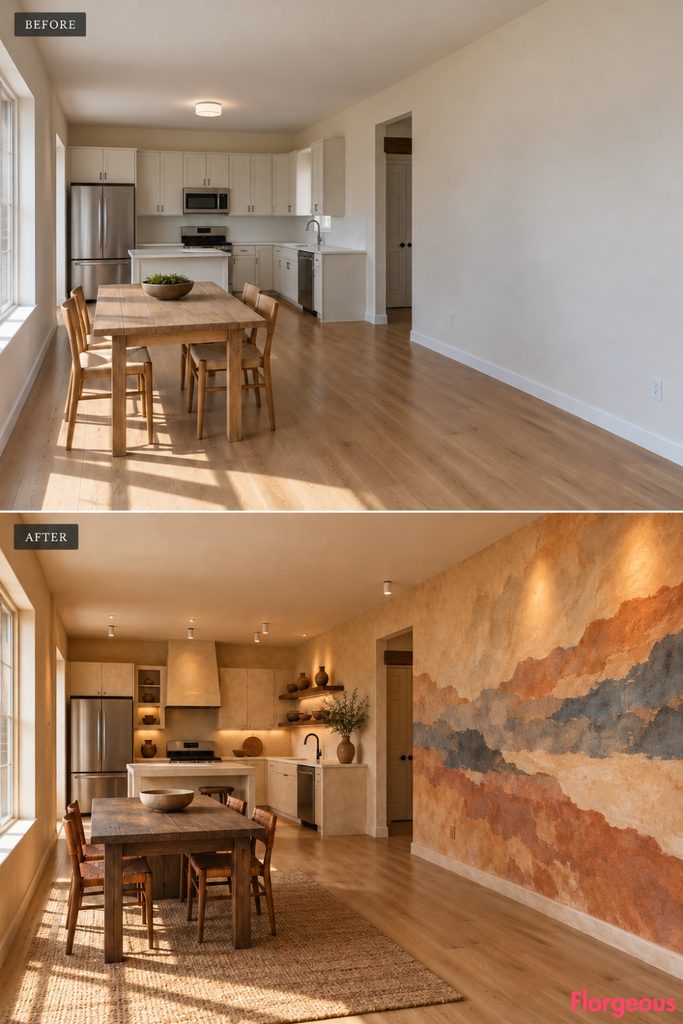
The final transformation treats the kitchen like an artist’s interior rather than simply a styled room.
Before: The long solid side wall is blank and disconnected from the kitchen.
After: Cover that wall in a hand-troweled mineral fresco composed of large abstract fields of sun-baked clay, faded ochre, chalk, charcoal, dusty blue, and sand. The forms suggest mesas, sky, and desert light without depicting a literal landscape.
Keep the actual cabinetry quiet in warm plaster and dark wood so the wall becomes the single visual event.
Choosing a Southwestern Kitchen Direction That Feels Authentic
A strong Southwestern kitchen should be recognizable through more than terracotta paint and rustic furniture. Architecture, craftsmanship, material weight, handmade surfaces, and regional artistic traditions are what give the style its identity.
Start by choosing one hero element. A carved-corbel wall, copper hood, punched-tin cabinetry, hand-painted folk frieze, woven textile island, blackware surfaces, sculptural ceramic lighting, or mineral fresco can carry the room on its own.
Then let everything else become quieter. The most visually successful Southwestern rooms rarely ask every surface to compete for attention.
Also consider the character of your home. Santa Fe plaster and carved pine feel warm and architectural. Spanish Colonial metalwork creates stronger drama. Pueblo-inspired clay feels earthy and substantial. Arizona desert modern works well when you want the same regional warmth with cleaner lines.
The best Southwestern Kitchen is not the one with the most Southwestern objects. It is the one where the architecture, material story, craft, and focal point feel intentional from the first glance.